Showing posts with label Trailers. Show all posts

Sunday, 28 April 2013

'Iron Man 3', 'Oblivion', 'The Look of Love' and 'Mud': review round-up and 'Thor: The Dark World' trailer


Here's a trailer for this November's terribly exciting looking 'Thor: The Dark World', just because. Now on to the business of reviews:


'Iron Man 3' - Dir. Shane Black (12A)

As much as I love 'The Avengers' and am (as evidenced above) obsessed with the entire Marvel Cinematic Universe, 'Iron Man 3' was not a film I rushed into with much expectation or the excitement I already feel for the upcoming Thor and Captain America sequels. Whilst Robert Downey Jnr's Tony Stark has been the most profitable one of the bunch so far for Marvel, with the patchy 'Iron Man 2' the most successful pre-Avengers "Phase One" movie, Iron Man has always left me cold. I've enjoyed the films enough, but I never loved them like I love the others. Perhaps because Iron Man seems to love himself enough for the both of us. That all changed, however, with Shane Black's new sequel to the series, which basically just turns the franchise into an awesome 90s buddy comedy, combining jaw-dropping action sequences - and some of the biggest and most imaginatively conceived superhero set-pieces yet seen - with dozens of genuinely funny and quotable lines. It's exciting, clever, superbly acted (Ben Kingsley's performance, in particular), and as close as you can come to a guaranteed good time at the pictures.

The script somehow blends all the best elements of a buddy cop movie (notably in Downey Jnr and Don Cheadle's team-up), a sort of Capra-esque Christmas movie (it'll sound shit on paper, but Iron Man's pairing with a smalltown kid is entirely winsome), an espionage thriller, a deft political satire (maybe overselling that a touch, but what the film does with Kingsley's villain is inspired) and a classic modern superhero movie. It's a 'Kiss Kiss Bang Bang' style deconstruction of action movie tropes and a faithful sequel to both 'Iron Man 2' and 'The Avengers' - which it references whilst also managing to be its own thing completely. It bravely takes Tony Stark out of the suit for most of the movie - putting him in more peril than ever before, and allowing him to be more genuinely heroic - whilst also still recognisably being a Marvel comics adaptation. It does a lot of things and it does most of them excellently. And it's probably the only superhero movie to have a satisfying "end boss" fight to boot.

I can't express enough how smart and purely fun Shane Black's movie is: unsentimental and yet full of unabashed heart, in a way that finally made me love this character. His screenplay - co-written with Drew Pearce - is fantastic, not only in its dialogue and character choices (Gwyneth Paltrow is refreshingly allowed to be much more than a damsel in distress), but in the way he contrives such wonderful and unexpected action sequences. Such as when Tony is forced to improvise new weapons after losing his suit and so nips into a hardware store, or when he successfully retrieves part of his suit and has to make do with what boils down to a glove and a boot. Here, for the first time in one of these movies, filmmakers have crafted antagonists who can actually pose a threat, allowing Tony to reasonably deploy his extensive arsenal in its entirety, hopping between suits in a sequence that's fast-paced and unlike anything else in the series to date. Don Cheadle gets more punch-the-air-awesome moments than I thought possible for an actor who was the British one in 'Ocean's Eleven' and Guy Pearce makes a sensational villain. It's just fantastic summer fun.


'Oblivion' - Dir. Joseph Kosinski (12A)

Say what you will about Hollywood "product" being derivative and low on original ideas, but surely nothing - no sequel or spin-off or re-make - is as cynical and brazenly plagaristic as the Tom Cruise sci-fi vehicle 'Oblivion', directed by Joseph Kosinski of 'Tron: Legacy' fame. You'd struggle to name a sci-fi movie or video game made in the last two decades that this one doesn't pillage for intellectual property, stealing wholesale plot elements, concepts and designs from the likes of the low budget cult hit 'Moon' all the way up to blockbusters like 'Independence Day'. There's weapon and costume designs lifted from the game series Mass Effect, whilst many will be quick to spot the embarrassingly blatant similarities between Melissa Leo's character - an untrustworthy, disembodied computer-treated voice - and the game Portal. And that's not even mentioning how much it rips off the filmography of its star, as we watch his continued slow fade from relevance.

It's a film that allows Tom Cruise - in the increasingly desperate "I'm not too old, honest, look what I can do!" phase of his career - to run really fast across sand, to ride motorcycles wearing sunglasses and to play an ace-pilot-and-ace-marksman-who-is-the-best-at-everything-he-does-and-a-scientist-and-the-saviour-of-mankind-who-is-irresistible-to-all-womenTM. Within the first twenty minutes he's taken two showers and gone for a dip in a swimming pool, and whilst the man is in unquestionably good condition for a fifty year old (much better shape than I've ever been in, for the record), his ab-flexing determination to prove how he still "has it" really isn't at all appealing.

The film itself is at its most tolerable when it epitomises the world of Tom Cruise cliche rather than when it's raiding every modern sci-fi classic for ideas - but mostly it's a bland, flavourless waste of two hours. Sometimes it's at least a slick and reasonably pretty diversion, with Kosinski's bright white Apple-influenced brand of future chic carrying over from the similarly attractive-yet-hollow world of his last film. Yet more often the whole thing is a display of baffling incompetence on nearly every level, with a central premise that doesn't stand up to any scrutiny, clunky exposition monologues repeated in their entirety more than once and twists you see coming a mile away (at least one of which is on the damn poster). The drone robots are fairly cool - with their use in war raising the film's only potentially interesting moral question - and the 'Top Gun' style flying sequences have their moments, but this is definitely one to avoid and, I would predict, one destined to be quickly forgotten.


'The Look of Love' - Dir. Michael Winterbottom (18)

The Steve Coogan/Michael Winterbottom partnership, which has served both so well over the years with the likes of 'A Cock and Bull Story' and '24 Hour Party People', continues with 'The Look of Love': an unfocused and shallow biopic about Paul Raymond - the infamous millionaire who was once Britain's wealthiest man. The film chronicles Raymond's career from - as the film would have it - a glorified circus ringmaster in the 1950s to an ageing property magnate and soft-core pornographer in the 90s, via his 60s/70s heyday as the proprietor of Soho's most sophisticated and talked about gentleman's clubs and publisher of a controversial, and widely read, men's magazine. The main problem with the film, aside from its strange refusal to engage with any social/political issues beyond glib one-liners, is that Coogan - a versatile performer - plays Raymond as indistinct from TV creation Alan Partridge.

Now, I bow to no man in my love of Alan Partridge as a comedy creation, but I'm guessing Paul Raymond was not so similar to Norwich's favourite son and Coogan's decision to play him this way is baffling. Every comic aside, awkward pause and geekish piece of trivia is pure Partridge, albeit a wealthy and successful one. It's a fact that cheapens the movie and renders its few attempts at real drama insincere. This is a pity as the film becomes more and more about the apparently complex relationship between Raymond and his daughter, as played by emerging star Imogen Poots - who steals the film out from underneath its star with a multi-faceted showing that ranges from vulnerable and troubled, to self-assured and downright cocky. The fact that the tragedy of Poots' character takes centre stage - being part of the film's framing device and used as a the catalyst for present-day introspection for Raymond - makes it even more of a pity that Coogan's central performance seems so disingenuous.

If the purpose of a biopic is to reveal something about its subject, to leave you feeling you know more about a person on the way out than you did on the way in, then 'The Look of Love' has well and truly failed. I leave the film none the wiser about what Paul Raymond was like as a man, with film engaging with this real historical figure the same way it engages with the "swinging sixties": presenting both with crude, cartoonish caricature and seemingly without affection. It certainly doesn't earn its mawkish and manipulative ending.


'Mud' - Dir. Jeff Nichols (12A)

In the very best of ways, 'Mud' - Jeff Nichols' follow-up to the impressive 'Take Shelter' - is a kids film. Not merely because its protagonist, Ellis (Tye Sheridan), is a 15 year-old boy, but because of the way the tale is framed: not simply as a coming of age story, but as a classic boys adventure in the mold of Mark Twain or vintage Spielberg of the 1980s. Or, better yet, 'Stand By Me'. The sort of film that looks children in the eye and treats a young audience with respect, refusing to sand away the rough edges yet not completely forsaking wonder. I have no idea whether Nichols ever envisaged the film as one for all ages - and it certainly isn't being sold that way and may not end up reaching that audience - but 'Mud' is a pretty perfect children's film, featuring a young hero in Ellis young boys can certainly empathise with. It certainly nails a certain time in a boy's life and this is easily as complete and challenging a role as a young actor is ever given, with Sheridan a real talent.

At its simplest, 'Mud' is the story about aimless, working class kids from broken (or breaking) homes who spend their days doing what boys do at that age: they go places they aren't supposed to, stay out later than they are meant to and make grand plans in secrecy. These boys, living on a river, take to playing around on a deserted and snake-infested island, climbing trees and playing with sticks, until one day they find an abandoned boat in a tree and decide to make it their own. The only trouble is a wanted man named Mud (Matthew McConaughey) has made the boat is home and makes them a deal: they can have the boat with his blessing, if they bring him some food and run some simple errands. Increasingly dangerous little adventures follow, which bring the kids deeper into Mud's difficulties than might be sensible, but - in the great kids film tradition - the kids go through hell to protect their new, social outcast friend from the threat posed by the local grown-ups: the police, the parents and the rest. In Mud McConaughey has a role every bit as memorable and intense as 'Killer Joe'.

'Mud' is a beautiful and moving piece of work. Sincere and populated by warm, genuinely loving characters right through the cast. It goes unexpected places and sidesteps every cliche you think you can see coming along the way. Overwhelmingly it's a film about love - in all its forms - in all its fragility and with all its pitfalls, but which ultimately manages to be warm and optimistic without compromising the gritty stuff. Love is hard and sometimes impermanent, it says. You might throw everything into it and get your heart ripped out, or even find yourself publicly humiliated as a result of unrequited affection. Yet it's worth it: it's the best thing we have and the only thing in this world worth having. That is basically the lesson learnt by the young hero through his trials and tribulations, but all without seeming twee or saccharine in the slightest. Quite an achievement - and a noble one at that.

Tuesday, 16 April 2013

'A Late Quartet' review:


The fact that I forgot I'd seen 'A Late Quartet' - and thus forgot to include it in my last round-up - actually speaks volumes for how I felt about it. There's really nothing bad about it. It's solid existential New Yorker angst stuff, with a great ensemble cast featuring the always brilliant Philip Seymour Hoffman, Christopher Walken and Catherine Keener, and Yaron Zilberman's drama (co-written with Seth Grossman) is smart enough and rarely boring. Yet it's hard to get excited about, being a sort of middle-brow and evidently quite forgettable American version of this year's earlier 'Quartet' - and boasting the same "legendary musical troupe re-group for one final concert" plot-line. The main difference here is that more emphasis is placed on music, and playing instruments with a group, as a metaphor for life and relationships.

I don't really want to spend any more time on this, so here's a trailer for a film I'm really excited about. Noah Baumbach's 'Francis Ha', co-written with (and starring) Greta Gerwig. 'A Late Quartet' could have used some humour, not to mention a bit of Greta.

Tuesday, 5 March 2013

New Trailer: 'Iron Man 3'

Got a movie quiz to write for this Thursday, and lots of other work on at the moment, so I'll have to wait before reviewing the awesome 'Stoker', the boring 'Lore' and the fascinating 'No'. In the meantime, feed off my undying Marvel comics obsession and love of all things Avengers by watching the latest trailer for Shane Black's 'Iron Man 3'. On the strength of the trailers alone I'm already confident it's better than the second one.

This one went up today:

Tuesday, 27 November 2012

'The Master' review:


Aside from general tardiness, the reason I have taken so long to review 'The Master' - in spite of the fact I made sure I saw it first thing on the day of release - is because I haven't been entirely sure what to make of it. I make no secret of the fact that director Paul Thomas Anderson's 'Punch-Drunk Love' is my favourite film, which means watching the filmmaker's first feature since the almost equally brilliant 'There Will Be Blood' comes with a certain weight of expectation and a desire on my part to avoid a reactionary response which I might regret later! Mostly because I suspected (and continue to suspect) that his latest is a film which will gain a lot from repeated viewings.

'The Master' is not, at least to my mind, an immediately gratifying film. There are immediately gratifying elements, to be sure - the cinematography and Anderson's use of camera is one of the most obvious, as are the two central performances - but this story-light script is much more of a character study and exploration of various themes (such as religion as institutionalism and whether it is truly possible to be your own master). There's nothing wrong with that at all, and in fact the most interesting films are usually about characters rather than a narrative sequence of events, but 'The Master' takes this to an extreme, with very little happening outside of its broader exploration of themes.


The story boils down to: a mentally troubled man (the chameleon-like Jaoquin Phoenix) leaves the Navy after WWII and finds it difficult to maintain a job or relationship upon his return home. Circumstances lead to a chance encounter with a charismatic cult leader (Philip Seymour Hoffman), whose sheer force of personality and assumed place of authority subdue Phoenix and make him feel as though he belongs, becoming the cult's least questioning acolyte, intolerant of the slightest criticism of Hoffman and given to violence against perceived enemies of The Cause (a clear analogue of Scientology). Things happen, of course, but they aren't presented as a series of cause and effect events. Rather, various encounters between Phoenix and Hoffman, and all the incidents in between, serve as vehicles to explore the film's themes. Making it a difficult but potentially rewarding watch.

Hoffman's every mannerism and intonation is inspired, with the master already one of his best characters, whilst his customary ability to switch from gentility to rage is exploited here to its very best, and it's his scenes opposite the quiet, unhinged menace of Phoenix that are the film's clear highlight. In fact an interrogation scene between the two and their final scene together at the end - in which Hoffman delivers a truly brilliant monologue - are among the best individual scenes Anderson has ever filmed. Meanwhile Jonny Greenwood again provides the score, which whilst not as visceral and consistently unsettling as his work on 'There Will Be Blood' (or Jon Brion's mesmeric score for 'Punch-Drunk Love') is still one of the year's best.

I'll return to this film in the near future and will probably come back to talk about it some more when it's clearer in my own mind. In the meantime, it goes without saying that it's worth seeing and a masterpiece in so many ways, even if I'm not yet certain how great it is overall.

'The Master' is rated '15' by the BBFC and is on general release now in the UK.

Tuesday, 23 October 2012

'Iron Man 3' trailer hits!


Couldn't not post this: the first trailer for next year's 'Iron Man 3' - the first post-Avengers Marvel movie. With Shane Black now taking over as director from Jon Favreau, it seems the third entry has a very different tone to the first two. Darker and more brooding in keeping with the idea that this is the character's darkest hour. Interesting (to me at least) is Tony Stark (Robert Downey Jr's) monologue here, which references how the events of 'The Avengers' are haunting him and preventing him from sleeping. I like that they seem to be including that movie as part of the character's arc, whilst (at least from this first look) not going overboard.

We also see Ben Kingsley as Iron Man's arch nemesis Mandarin, and somebody sporting a Star-Spangled Iron Man suit which, in the comics, belonged to Spider-Man foe Norman Osborn (AKA the Green Goblin) as he called himself the Iron Patriot. Of course, with Sony holding the movie rights to that character, it is curious which villain is behind the armour this time.

'Iron Man 3' is set to come out in April as the first part of "Phase Two" - the next set of movies that will lead to the next big Avengers adventure. Following hot on its tail will be 'Thor: The Dark World' next summer, then 'Guardians of the Galaxy' and 'Captain America: The Winter Soldier' in 2014. 2015 will bring us that Avengers sequel and Edgar Wright's 'Ant-Man'. I couldn't be more of a fanboy at this point. You don't even want to know how much money I've blown on comic books since 'The Avengers' came out...

Tuesday, 18 September 2012

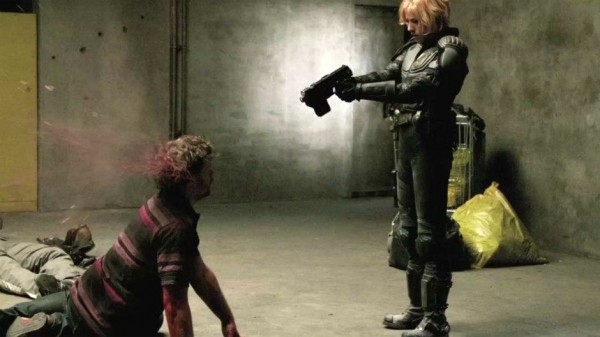
'Dredd' review:


Last year, I interviewed filmmaker José Padilha, who had at that point only recently been announced as director of next year's new 'RoboCop' movie. Naturally, in this age of vapid re-boots, I was concerned that the humour and political commentary of Paul Verhoeven's 1987 classic might be lost, with the film re-tooled as a straight action movie. A fear he swiftly countered, saying:
“The satire element of RoboCop is, I think, needed today... That kind of social, aggressive satire I haven’t seen done well in movies lately. And it’s almost like the politics and violence in the world is asking for this: 'Someone please make some satire now!' So we’re going to keep that edge.”
He is entirely right: the world - with its financial meltdown, government austerity measures, resurgence of right-wing politics and rapidly advancing technology - is practically begging for something like a vintage Verhoeven movie. We sorely needed a 'RoboCop' or 'Starship Troopers' to come along and savagely poke fun of things, whilst also shamelessly indulging in ultra-violence and gore for our entertainment. An old-school 18-rated science fiction movie, the like of which we haven't really seen since the '12A' certificate was ushered in by comic book movies a decade ago.


Yet, ironically, a comic book adaptation has beaten Padilha to the punch. With the Brazilian's film still nearly a year from release, British television director Pete Travis has swooped in from left-field to deliver all of the above with 'Dredd' - based on 2000AD's Judge Dredd series. Here Karl Urban dons the helmet of the titular fascistic "street judge" in a dystopian future, in a film which is deliciously satirical, whilst also being horrifically and uncompromisingly violent. Like a Verhoeven movie of old, the high-minded political business is indistinguishable from the exploitative, sickeningly fun action stuff. It's funny and sleazy and rarely subtle, with well choreographed action and a tight, disciplined structure. Yet Alex Garland's screenplay is also pretty smart once you get past some (perhaps intentionally) cringe-inducing one-liners.

Dredd himself - a cop, judge, jury and executioner (for those unfamiliar with the character) - is an uncompromising individual, obsessed with enforcing the law to the letter and without question or a shred of compassion. He is a walking Daily Mail column with fire-power, free to threaten the most vulnerable in society from an assumed position of moral authority: he harasses the homeless and sees every law-breaker as nothing more than a scumbag beneath contempt and, often, in need of a good state-sponsored murdering. Yet Garland and Travis tip us off to the fact that we shouldn't necessarily be uncomplicatedly on-side with the protagonist in a number of ways.


The most obvious is the fact that they give us a rather more relatable and warm character in the form of rookie Judge Anderson (Olivia Thirlby), who goes through the movie questioning and undermining her superior's harsh methods and views on society - even going against the rules to spare a criminal's life. Being from the slums herself, and from a marginalised community of psychic mutants, Anderson is less quick to (literally) judge those who transgress the law. Perhaps her psychic abilities give her more empathy than her sociopathic colleagues? What's more, in stark contrast to the unflappable Dredd, she feels remorse at having to kill. As well as Anderson, we're are also given plenty of other reasons to be suspicious of this world's justice system.

For instance, it's clear that giving police the power to murder criminals on sight has not acted as a deterrent against violent crime. In fact, we see that the Judges of Mega-City One are only able to respond to a small percentage of the crimes occurring at any given time. We also see how those fleeing from the cops of this world have little choice but to resort to all out warfare with the authorities. With no chance of reprieve, or anything like a considered trial, the drug dealers and pimps of this reality take to unloading their sub-machine guns and mowing down pedestrians as soon as they see Dredd in their rear-view mirror. If this wasn't a clear enough critique of right-wing ideology, then the scene in which Dredd and Anderson go to arrest a man for being homeless - only to barely react as he's pulverised by a huge mechanical door - is a pretty clear indication of how skewed the "good guys" of this movie are, from a moral standpoint.


Then there's the fact that Lena Headey's crime boss, Ma-Ma, is pretty clearly a victim of repeated sexual abuse and a drug addict. She's pretty cruel, guilty of lots of bloody crimes and seems to take sadistic pleasure in skinning her victims alive, but she's not uncomplicatedly "evil". She's undoubtedly messed up, yet she arguably needs sectioning rather than murdering. And her major vice is arguably less socially harmful than the law's reaction to it: her gang is responsible for putting a new drug called Slo-Mo on the streets - a chemical which causes the user to experience this grey, concrete world in glittery, multi-coloured slow-motion. It actually seems pretty appealing in context.

Where the movie really shines is that this high-minded and timely political commentary is ever-present without being heavy-handed or suffocating how much sheer fun the movie is. The action is brutal and bloody in a way you really don't see any more - even in stuff like 'The Expendables', which exists solely as a throwback to that 1980s action era. It's handled imaginatively, never gets repetitive and there are plenty of clever twists along the way. It's also fantastic that the premise of this movie is so small-scale: basically, our "heroes" get trapped in a gang-controlled skyscraper and have to fight there way to the boss at the penthouse - much like you might in a 90s SEGA arcade brawler. In many ways it's like a feature adaptation of 'Streets of Rage 2', in a very good way.

This is, in effect, the movie Padilha seemed to promise last year, when talking up his handling of 'RoboCop'. That film, however good it may turn out to be, is no longer being released in a vacuum.  Arguably, 'Dredd' is the strongest mainstream action-satire film since 'Starship Troopers' in 1997 and one of the year's biggest surprises.

'Dredd' is out in UK cinemas now, rated '18' by the BBFC.

Tuesday, 28 August 2012

'Take This Waltz': review


Rarely does a film slip so frequently, or so drastically, between infuriating and sublime as Sarah Polley's 'Take This Waltz'. It's typified as much by tortured metaphors and on-the-nose production design as it is by moments of heartbreaking honesty and dazzling vision. Several isolated scenes are perfectly judged, by the the cast and by Polley behind the camera, though just as many demand derision - notably an early exchange in which Michelle Williams foreshadows her fear of the uncertainty wrought by ending her marriage by describing her unease of being "in between things" during airport connections. The metaphor itself isn't miserable, but no room is left for interpretation or reflection and it gets worse when the same metaphor is picked up - and again discussed in detail - later on.

Though there are just as many great moments, the best involving Seth Rogen, as Williams' husband, and his myriad of emotional responses to the inevitable end of his marriage, including a tear-jerking reveal concerning a "long-term joke". Comic Sarah Silverman also turns in a credible dramatic performance as Rogen's alcoholic sister, though Williams' handsome extra-marital love interest is certainly the film's weak link, as played by Luke Kirby. But this is, for the most part, a showcase for Williams' significant acting talents and it is she who carries the film for the most part, with the other three principal cast members operating in her orbit.


Perhaps best of all is the judgement free way Polley, who also wrote the screenplay, depicts the end of a marriage where neither party has done anything particularly wrong. It's suggested that Rogen's guileless husband has neglected his wife sexually and that there relationship has became comfortable at the expense of excitement, yet overall the end of his marriage is tragic because it comes without much obvious cause. It's also complicated by the idea that, perhaps, Williams will live to regret her decision at some point in the future. Williams wants to be able to feel that early excitement again with somebody and knows she cannot rekindle that with her husband (however much she tries), but that's it: they still basically love each other. Whether she will ever be as comfortable with Kirby, we shall never know, though it's implied that both options may ultimately lead to the same bitter-sweet place.

Whether or not the decision to leave her husband is worth the gamble is the ultimate question posed by 'Take This Waltz', and happily it isn't anywhere near as flippantly 'Dead Poet's Society' as its title may suggest. Whether or not Williams embraces her impulses and takes life's confusing, emotionally turbulent, uncertain invitation to dance, Polley's film is smart enough, and sensitive enough, to make us question that desire and identify with the character's most prosaic, a-romantic concerns.

'Take This Waltz' is out now in the UK, rated '15' by the BBFC.

Wednesday, 15 August 2012

'Nostalgia for the Light' review:


Veteran Chilean documentarian Patricio Guzmán pushes a lot of the right buttons with 'Nostalgia for the Light': a elegiac film which investigates our relationship with the past. This includes the distant, galactic past as gleaned by astronomers, using the light of long-dead stars to uncover the secrets behind existence, as well as archaeologists who scratch through the earth looking for evidence of our more recent, immediate past - sifting through the soil for human remains whose calcium was formed in the Big Bang so long ago. Yet the film also looks at smaller, more intimate forms of remembering, as Chile comes to terms with the horrors of the Pinochet-era 1970s.

There is an architect and former political prisoner, who reconstructs images of concentration camps from memory. Meanwhile, there are dozens of bereaved women who comb through the Atacama Desert in a possibly vain search for the bones of murdered loved ones - unable to let go of the past and forsaking the present. One woman dedicates her life to taking care of victims of torture - something Guzmán's narration describes as working in the past. It is even suggested, by one scientist, that the present itself is an illusion: that everything we see and hear is from the past, even if only by millionths of a second. Light is itself nostalgic is the point, yet it is also erasing the past - as a gallery of photos of the "disappeared" subtly conveys, with many of the portraits long-since faded by the sun.


It is fascinating to ponder the relationship between the history of existence and our own, smaller scale trauma as insignificant creatures wondering about on a doomed space-rock - and I admire Guzmán for making an attempt at joining these dots and asking a lot of the right questions. However, the film itself often strains to make its point and sometimes it even feels exploitative of its subjects - most notably as an elderly woman's Alzheimer's is casually used as the basis for a tortured metaphor. The subject matter here - both life, the universe and everything and the story of Chile under Pinochet - is spellbinding, but the execution is sadly lacking. It's inherently profound stuff and I have a feeling various images and soundbites will stay with me, yet 'Nostalgia for the Light' is, to me, a conceptual triumph as opposed to an actual one.

'Nostalgia for the Light' is on limited release in the UK, rated '12A' by the BBFC.

Friday, 8 June 2012

'Rock of Ages' review:


Did this really happen, or was it just a horrible dream? 'Rock of Ages', the star-studded adaptation of a popular stage musical, is a dreadful movie. A film where every beat is played for humour but nothing is even remotely funny. A film that takes actors as good as Paul Giamatti and Alex Baldwin and makes you wish you never had to look at them again. It's a cringing and overlong slog which takes various 1980s hair metal classics and proceeds to turn them into the sort of creakily staged, amateurishly performed ditties made famous by Halifax ads. It feels so hollow and inherently false that it somehow resembles a karaoke cover version of itself. It lacks atmosphere, charm and any small trace of entertainment value. It's not clear which demographic this film is for, but I know I never want to meet them.

The story - little more than a thinly veiled excuse to move the characters between "I Love Rock and Roll" and "Don't Stop Believing" - runs as follows: smooth-skinned small-town girl (Julianne Hough) meets smooth-skinned small-town boy (Diego Boneta) after both move to LA to make their rock dreams come true. They immediately - as in during their first day together - fall in love. However, they are just as easily broken up by the sort of contrived misunderstanding usually reserved for the dying days of a hokey sitcom - as boy sees girl emerging from the dressing room of "rock icon" Stacee Jaxx: Tom Cruise reminiscent of his pathetic and empty character from 'Magnolia', only this time you aren't supposed to feel uncomfortable.


In the mix are Baldwin and "funnyman" Russell Brand, as comedy relief and owners of a once-awesome, now lovably ramshackle concert venue in danger of closing its doors unless X amount of money is raised, etc etc. For some reason a mother's organisation, lead by the mayor's wife (Catherine Zeta-Jones), wants to shut the place down, even though it's more smiley and non-threatening than the cast of 'Glee'. Oh, and the mayor is played by Bryan Cranston for some reason, with his appearance here somehow even more thankless than his brief turn in 'John Carter'. He literally has nothing to do and his sub-plot - that he enjoys kinky, extra-marital sex - comes to nothing at all. Not only does it not have any sort of resolution, but it doesn't even connect with the other plotlines. It's just one of many cut-away gags that must have seemed funny at the time.

Cruise is the only bright spot and, though fifty next month, he embodies his shirtless rock god character with an energy and commitment not matched anywhere else in the cast. The film is still bad when he's on-screen, but at least it feels vaguely alive. It's disappointing that Zeta-Jones doesn't get to sing a few more songs, given how she won an Oscar for her show-stealing role in 'Chicago', but anyone who sits through one of Baldwin and Brand's duets will know that "the ability to sing" was not a prerequisite for appearing in this movie. This garish, ugly, waste of talent with no redeeming qualities of a movie.

'Rock of Ages' is rated '12A' by the BBFC and is set to be released in the UK on June 13th.

Tuesday, 5 June 2012

'A Royal Affair' is Better Than the Marketing


Far be it from me to criticise Metrodome Distribution. After all they are to be applauded (and loudly) for bringing one of my favourite films from this year's Berlin Film Festival to the UK, in the form of Danish monarchy drama 'A Royal Affair' ('En Kongelig Affære'). Yet their handling of it troubles me, at least in terms of how it's being marketed. I reviewed that film back in February on this blog and could hardly have been more fulsome in my praise, concluding:
Everything about 'A Royal Affair' is stunning. Its ambitious scope in terms of subject matter, its intelligence, its brilliant cast of actors (I'll now happily watch anything with Alicia Vikander in it), and its lavish production values. I cried at the end, with the once vital Caroline separated from her children and living in exile, and I laughed far more and far harder than I have at the last dozen or so comedies. The story of a doctor who gives a king new confidence and inspires him to greater things, it could easily be billed as Denmark's answer to 'The King's Speech'. It's far better than that.
Yet I'm not certain the trailer (above) or theatrical poster (below) would have sold it to me. There's nothing wrong with either from an editing or design point of view, in fact both are stylish and sophisticated. But therein lies part of the problem: they aim to attract the traditional "heritage" cinema or "costume drama" audience. "Utterly seductive... an epic story of forbidden love" runs a quote from Radio Times, whilst the central image plays up the idea that this is the tale of a love triangle in fancy dress. Yes, I see the angry mob in the background, with an ominous fiery orange glow enveloping the stars, but the overwhelming impression this poster gives is that this is the tale of how two men court the same woman. Were that the case I don't think I would have been so moved by it, nor as thoroughly entertained.


What's truly great about 'A Royal Affair' - aside from the stunning performances - is that it doesn't feel at all stuffy and period bound. In fact it feels modern and dynamic. And whilst period films tend to be conservative and usually play up a romanticised view of the past, this one is all about radical political philosophy: the ideals of the enlightenment versus the grip of the ruling class in eighteenth century Europe. This is the story of how a German radical basically exploited his friendship with the insane king of Denmark in order to institute a raft of audacious reforms which quickly (and, as fate would have it, temporarily) transformed one of Europe's most politically backward countries into its most progressive. And all before the French Revolution. If you can't find a way to make that sound exciting to an audience, let alone in the fractured Europe of 2012, you have no business selling movies.

Is the titular "royal affair" important? Well, yes of course; But it isn't what the film is about. In fact even the central love story - not really a "triangle", because the king doesn't really give a damn - is mainly explored in terms of how it compromises the idealism and integrity of Johan Struensee (Mads Mikkelsen). For instance, after the affair becomes a convenient stick for the German's political opponents to beat him with using the newly free press, Struensee is driven to enact new censorship laws in an effort to safeguard his own interests. It's about how power corrupts and how absolute power corrupts absolutely. It's about the canny knack of the media and the aristocracy to mobilise the poor against their own interests - a theme that resonates very strongly today. And it's being mis-sold willfully, because the people who made the poster know and understand all of this.


'A Royal Affair' is a young film being sold as an old one for an easy buck. The market for historical costume epics is tried and trusted, whereas the appeal of eighteenth-century-radicalism-morality-fables is far less certain. I understand completely where Metrodome are coming from and I hope this release proves incredibly lucrative for them, because this film deserves to find an audience (even if it's the wrong one). I suspect many of those coming to see it on the basis that it's a scintillating love story for the ages will still enjoy the less cosy film they see before them, but the sadness is that 'A Royal Affair' could be written off by many who would find great appeal in its musing on ideology and the nature of political power.

Perhaps the image on the poster is not at fault, but rather it's the pull-quotes around it which need changing. "Utterly seductive" should be replaced by "politically incendiary" and the word "revolution" should appear somewhere. And instead of "their love would divide a nation", how about "their friendship would divide Europe"? And the word "love" (which appears twice) should not appear at all. Not because there is not a love story, but because focusing on that relationship and ignoring the ideological debate is ironically the exact same thing the yellow press does within the film. There's no doubt the marketing department played it very safe with this one and I hope it doesn't work against one of the year's best films.

'A Royal Affair' is rated '15' by the BBFC and will be released in the UK on June 15th.

Monday, 4 June 2012

'Men in Black 3' review:


'Men in Black 3' doesn't make any sense. I don't mean the time travel plot which, even if the rules are seemingly being made up as it goes along, is easy enough to follow. But it don't understand in on a much more basic level: it's existence makes no sense at all. And for two reasons. The first and most obvious is that the (largely forgotten) original films came out over a decade ago, meaning that their audience has long since grown up, whilst the kids of today surely have no idea who these characters are. Perhaps that wouldn't be a problem if this were just a brand new adventure featuring our besuited heroes, slap-happy xenophobes Agents J (Will Smith) and K (Tommy Lee Jones), but the story and its intended emotional beats require some vested interest in the relationship between these two characters. In fact Columbia seems to be marketing this sequel mainly on the strength of Josh Brolin's eerily accurate impersonation of Jones as 1960s era K - something a ten year old in 2012 could care less about.

The second reason this movie makes zero sense is thus: Will Smith is the biggest movie star on the planet. He is the only guy left in modern post-star Hollywood capable of guaranteeing a hit movie by the mere fact of his presence. Since 2002's 'Men in Black 2' every movie Smith has starred in has grossed over $160 million. His is a star so popular that even vehicles as messy and bloated as 'Hancock' and 'I Am Legend' were substantial global mega-hits. And, prior to his return to Barry Sonnenfeld's sci-fi comedy franchise, he had been away from movie screens for four years. In other words: he could have named his next project. He could have made anything he wanted. Every major studio must have been hassling him with offer after offer. Quentin Tarantino supposedly approached him to star in his upcoming western. And he chose to make 'Men in Black 3'. Just think about that. For a man who has several times stated a desire to one day run for president, that betrays an astounding lack of ambition.


Anyway, by now it's clear I'm stalling having to write about the film itself and that's because there isn't an awful lot to say. I'll lead with the few positives. 'A Serious Man' star Michael Stuhlbarg is pretty funny as Griffin, an alien who can see the future with a fairly entertaining twist: he can see all possible futures simultaneously. This paves way for some neat visual moments (as he enjoys a future baseball game in an empty stadium), some entertaining comic bits (as he frets about whether various absurd and unlikely events might come to pass) and a few nice character details (such as his multiple layers of clothing, presumably in preparation for every possible future). He is easily the best thing in the movie.

Then there's the fact that the villain, Boris the Animal, is played by 'Flight of the Conchords' funnyman Jermaine Clement. Though Clement is underutilised he does at least read lines in an entertaining way. Another plus is that several of the most irritatingly wacky supporting characters from the two previous movies have been written out, with the talking pug dog and the vaguely Hispanic cockroach guys the most welcome absentees. Unfortunately they've been joined on the casualty list by Rip Torn (whose Agent Z has been killed off between sequels), though the actor's recent legal troubles probably account for that. The problem is that his replacement is Emma Thompson who, though an infinitely superior dramatic actor, doesn't exactly bring the funny. Her character, Agent O, is also embroiled in 1960s shenanigans (played by Alice Eve) and is supposed to have been a long-term friend and love interest of Agent K - something which is undermined by the fact she's never been mentioned at all previously.


It's also to the film's detriment that, as good as Brolin's impersonation is, there is nowhere near enough Tommy Lee Jones. His sly, taciturn delivery is an essential part of what originally made the J and K partnership watchable - whereas Brolin is cast as a younger, less grumpy version of the character who doesn't really have the same appeal alongside Smith's hyper-chatty hero. Barry Sonnenfeld's handling of action and spectacle also leaves much to be desired. For instance, several scenes include shots which establish nothing more than that our hero is "very high up" - quite a mundane form of threat in a film featuring lazer-gun totting aliens and quite a boring one for an audience that's presumably just seen 'The Avengers'. Then there's the stuff we've seen before in the series - as little silver guns make aliens explode - and stuff we've seen done much better dozens of times elsewhere - such as a car chase through the streets of New York (the characters might be riding impractical futuristic motorbikes, but they're still basically just motorbikes).

The very worst thing about 'Men in Black 3' I've saved until last, and that's its basic premise and single joke: that difference is inherently hilarious and that usually the "different" are not human. The film continues the series' proud tradition of revealing how everybody with a funny face or voice or a different ethnicity to the protagonists is in fact in an alien. See that Chinese guy? He's a hideous alien! Hahaha. See that supermodel? Models are all aliens! Hahahaha. Lady Gaga? Tim Burton? Those weirdos are aliens! Hahahaha. Repeat for almost two hours. And these freaky people can be exploded and punched without consequence or guilt because, well, they're not from around here. It's basically a light family comedy about ultra-violent immigration officers.

'Men in Black 3' is out now in the UK, rated 'PG' by the BBFC.

Sunday, 3 June 2012

'Prometheus' review:


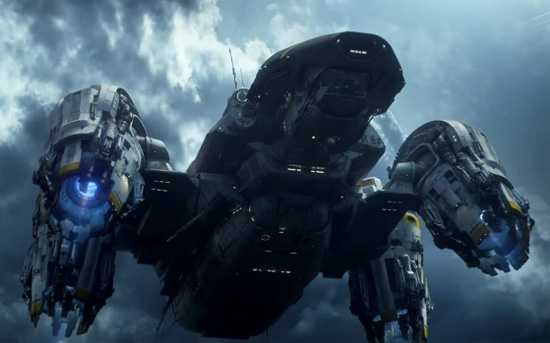
A running theme among the half-dozen trailers that have teased Ridley Scott's 'Prometheus' is that they've tended to be more alluring and spectacular when focused on the numerous eye-catching shots of spaceships and strange alien worlds, whilst offering only fleeting glimpses at the story and characters. It turns out that's because 'Prometheus' has no story or characters. It has a basic sort of "plot", I suppose: astronauts head to a distant planet in order to find answers about the creation of mankind. And it has characters in the sense that there's a reasonably impressive international ensemble cast thanklessly filling the various spacesuits - including Noomi Rapace, Michael Fassbender, Guy Pearce, Idris Elba and Charlize Theron.

Yet there can be little doubt that 'Prometheus' is a triumph of design and special effects rather than human drama. The film looks stunning, with the CGI spaceships and beautifully crafted interior sets having a sort of painted concept art look. But for all its self-important posturing around issues of faith, god and the nature of creation, the film's pretense at being this summer's "thinking person's blockbuster" comes to nothing. During its few cod philosophical exchanges - some of which should make your toes curl - the film's grasp of the deeper issues never seems to want to venture beyond truisms. It's a shame because the set up suggests something much smarter, or at least more interesting.


Rapace, as scientist Elizabeth Shaw, is the ship's blindly faithful Christian, whilst her lover and fellow scientist (played by Logan Marshall-Green) is supposedly the on-board skeptic as they search for humanity's alien creator. Meanwhile, Fassbender is David, a humanoid robot whose behaviour is modeled on his creators, something he seeks to perfect by watching old films in his downtime. A wrinkly old Guy Pearce is his creator and surrogate father, as well as the head of the huge corporation financing the mission. Charlize Theron has her own nascent "creator" issues as the stern and possibly treacherous leader of the expedition. Given that this is nominally a prequel to Scott's seminal 'Alien', it's entirely appropriate that it should explore that franchise's theme of motherhood and the destructive, violent act of creation itself: it's a melting pot of strong character archetypes with competing ideologies, which seems primed to react - only there is no heat.

Potentially interesting characters die left and right with scarcely a decent scene to their name. Supposedly sensible people react in increasingly irrational and oddly inhuman ways as the film goes on, for instance when a group of characters voluntarily give up their lives without any clear indication of why (in fact they don't really even ask for one, but as a united group blindly accept death at the merest asking). The film lurches messily between fussily directed action scenes which lack either the body horror of 'Alien' or the excitement of a crowd-pleasing summer movie, almost as if the filmmakers lacked the courage to devote any screentime to the potentially divisive "let's all talk about religion" thing the movie seemed to kind of want to be about originally. There are nods to various big ideas and questions here and there, but they are extremely tentative.


Then there's the handling of the film's various alien creatures and their multiple messy incarnations which lack credibility even if you suspend a whole universe's supply of disbelief. (Those sensitive to SPOILERS might want to avert their gaze now.) How does this reproductive cycle work?:

1) There are rows of eggs full of black goo.
2) A human man eats the black goo and becomes a sort of crusty monster.
3) The crusty monster man has sex with a human woman and she quickly gives birth to a tentacle monster.
4) Left alone for (presumably) a few hours, said tentacle monster becomes enormous. It then latches onto a huge white alien and eats his face.
5) Once partly-devoured by the tentacle monster, the big white alien's body yields a chest-bursting, quadrupedal alien not dissimilar to the original "xenomorph".


Please explain how that makes any kind of sense. I genuinely want to know why I'm supposed to think anything other than "this sure is a random sequence of events" at this point. Even if you accept that this primordial gloop is simply enabling the rapid evolution of an organism (and that's a leap you have to make yourself), doesn't it sort of imply that the "xenomorph" would then also become something else entirely different the next step along the chain? So then why do all the Aliens in the sequels look the same? Are they supposed to represent the pinnacle of evolution? I'm honestly not trying to be pedantic in the least - I just want to know how this could possibly make sense, even in the limited way a film about sexy future-spacemen warrants.

A friend of mine said that (one of) his problem(s) with 'Prometheus' is that it raised far more questions than it answered, at least pertaining to the way it links into 'Alien' continuity. I disagree. It's not a problem that the film raises more questions than it answers - after all, so does '2001'. The problem is that the questions it raises are invariably very silly, all relating to the who-could-care-less world of the 'Alien' mythos. Whilst it labours to provide trite and convoluted answers to the grander, more universal questions that are perhaps best left enigmatic. It should have been the other way around.

'Prometheus' is out now in the UK, rated '15' by the BBFC.

Tuesday, 29 May 2012

'Moonrise Kingdom' review:


The story of two young and "mentally disturbed" lovers who run away from home during the summer of 1965, 'Moonrise Kingdom' packs all the wit and whimsy of director Wes Anderson's other work whilst also feeling entirely fresh. Everything is in keeping with his very deliberate and composed signature style, but some of it's been tilted slightly, adjusted just enough to let some air into the room. It's the same elaborate, four-poster bed you've enjoyed sleeping in several times up to now, but he's changed the sheets (or something metaphorical like that). The cinematography here, though still by long-serving Robert Yeoman, has a washed-out, almost instagram look, though each frame still bursts with bright colours and retains that children's book illustration look.

Music also plays a slightly different role here, moving away from chic 60s/70s alt-rock tunes and towards a unifying theme which subtly likens the ensemble cast to sections of an orchestra. Though regular composer Mark Mothersbaugh and music supervisor Randall Poster are still involved, Alexandre Desplat takes on main scoring duties following his work on the animated 'Fantastic Mr. Fox'. It's also perhaps his least dialogue driven of his films to date - the screenplay once again co-written with Roman Coppola still full of memorable lines, but with the storytelling often completely visual. At no point more so than at the film's emotionally charged climax, where the shot choices and movement of the camera are sublime.


The cast too has been shaken up very slightly. Though Bill Murray (in every film since 'Rushmore') and Jason Schwartzman are still on hand in small supporting parts, this is the first Wes Anderson movie not to involve at least one Wilson brother. As a sweet-natured scout master with a note of sadness behind the eyes, Ed Norton ably takes on the role which might otherwise have gone to Anderson's former writing partner Owen Wilson. The best of the new additions to Team Anderson is undoubtedly Bruce Willis, who underplays his role wonderfully, though Bob Balaban is also very funny as a sort of meteorologist-cartographer-narrator. These changes are signposted even before you get passed the credits by the very deliberate change in font from his beloved futura to something yellow, squiggly and italicised.

All the same preoccupations and stylistic flourishes are present though, from that one moment of expertly timed slow-mo to the tale of a dysfunctional family, populated by wounded and disappointed people struggling to connect. At times the young runaways - Sam (Jared Gilman) and Suzy (Kara Hayward) - and their armed boy scout pursuers could be mistaken for members of the Max Fischer Players, mounting an ambitious production of 'The African Queen' by way of Lord of the Flies, as the film riffs on a 12 year-old version of pampered rich girl meets man of the earth on romantic wilderness adventure. Like all of Anderson's films to date it's earnestly kind without ever coming close to twee, and nostalgic without seeming kitsch or staid. There are moments of heart-breaking melancholy and times where the humour verges on black, but it's primarily an innocent and joyful experience.


Though I personally loved 'The Life Aquatic' and 'Darjeeling Limited', those films seemed to represent Anderson's movies becoming bigger and, to some extent, less tightly focused. The star-studded ensemble is no less eclectic here but 'Moonrise Kindom' instead feels stripped back somewhere closer to the simplicity and economy of 'Rushmore'. It's a change that's kept the director's formula from wearing thin, coming at the right moment. It's a film that makes Wes Anderson exciting again, as opposed to the master of an increasingly predictable framework (however lovely). I used to say that 'Bottle Rocket' was my favourite but conceded that 'The Royal Tenenbaums' was Anderson's most mature and accomplished film. 'Moonrise Kingdom' calls into question both ends of that statement.

'Moonrise Kingdom' is out now in the UK, rated '12A' by the BBFC.

Wednesday, 23 May 2012

'Red Tails' and 'Iron Sky' reviews:


Two kitsch, CGI-filled action films about African American heroes biffing Nazis are hitting UK cinemas today. Receiving a limited release is the Finnish comedy 'Iron Sky' - which sees a black US astronaut battle against the combined forces of Sarah Palin (in all but name) and space Nazis from the dark side of the moon. It's very, very silly indeed and a lot of the jokes fall flat - but there are a lot of jokes, so many of them do find the target. It's best described as Mel Brooks meets Dr. Strangelove... in space! I reviewed that one for What Culture when it played at this year's Berlin Film Festival and you can read about it here.

'Iron Sky' is released today in the UK and is rated '15' by the BBFC.


The second is far more earnest and, as a result, far more boring despite its good intentions: the George Lucas produced WWII flier movie 'Red Tails'. That film receives its UK premiere today before a wide release on June 6th. Based on the true story of the Tuskegee Airmen - a pioneering, ace squadron comprised of black fighter pilots - the action scenes are spectacular but the human drama is simplistic and uninspiring. It's a pity because this story clearly means a lot to Lucas and the real-life events do sound genuinely fascinating. You can read my review on What Culture, as published here.

'Red Tails' is released on June 6th and is rated '12A' by the BBFC.

Tuesday, 22 May 2012

Trailer: Paul Thomas Anderson's 'The Master'


It's been five long years since Paul Thomas Anderson released 'There Will Be Blood', but now his long-awaited follow-up 'The Master' finally has a trailer. Fans of Anderson will immediately recognise his use of oppressive and rhythmic music which creates tension and discomfort, as best exemplified in this clip from one of my favourite all-time movies. It's also great to see the return of Jaoquin Phoenix in his first film since 2010's mockumentary 'I'm Still Here' - a film that took about four years out of his career all told. He looks great here in another wholly transformative role. What's really impressive about this trailer is that it's immediately involving. That the film looks this good before we've even seen Phoenix's co-star Phillip Seymour Hoffman is something to be very excited about!

'The Master' about a religious cult led by Hoffman, thought to be based on Scientology. It was thought cancelled a year or so ago but has reemerged and now looks set to be released in prestige season - so expect to see it December/January time.

Monday, 21 May 2012

'The Dictator' review:


'Borat' was hilarious. A much weaker follow-up, 'Bruno' still had its moments. But 'The Dictator' - the latest comedy character creation from Sacha Baron Cohen - is just dreadful from start to finish, lacking atmosphere, laughs and heart. The story concerns a North African despot who is forced to go to an emergency UN summit in New York or face war over his pursuit of weapons grade uranium. However, Admiral General Aladeen is betrayed by his scheming uncle (Ben Kingsley more or less reprising his thankless role from 'Prince of Persia') and replaced by a simple goat herder with an uncanny resemblance. He then finds himself lost in the Big Apple, plotting to sneak back into the summit in order to unmask his betrayers and take back the fictional nation of Wadiya - a plan which involves ingratiating himself with Anna Faris, the manager of a small ethical produce store improbably tasked with catering the big event.

Baron Cohen's shtick has long been divisive, since the earliest days of iconic street wigga Ali G on British television critics have been split over whether he's a genius satirist or merely a man without shame, determined to say whatever offensive thing he could in order to get a cheap laugh. I have never been in that latter camp, believing even his most extreme comic bits came from a good place, with a social conscience that enabled him to lampoon bigotry rather than simply being a bigot. For instance, the palpable respect and uncharacteristic solemnity Ali G reserved for legendary Labour MP Tony Benn during one of his comedy interviews seemed to support the belief that Baron Cohen's integrity ran deeper than the pursuit of easy giggles.


Yet the target of the satire in 'The Dictator' is hard to locate and the level of wantonly offensive humour seems unjustified as a result. I feel like an arch and humourless Daily Mail reader writing that, but (and call me a busybody, PC square) I don't get what's funny about Aladeen playing a fictional 1972 Olympics massacre video game on the Nintendo Wii, mimicking the slaying of Israeli athletes. I don't get what's supposed to be funny about a dialogue exchange in which Aladeen talks about his sexual abuse of 14 year-old boys.

I'm not offended, even if (crucially) I don't find moments like these particularly funny, imaginative or inspired - my monocle hasn't fallen into my champagne flute in disgust that he dare joke about such things - but what does trouble me is that there doesn't seem to be any intellect or conscience behind his comedy at this point. He's just a man shouting "AIDs", "look, a black man!", "look, a gay!". He's becoming the unthinking school bully or the boorish workplace loudmouth, only with a budget of millions and a great deal of acting talent. He seems locked in a battle of one-upmanship with himself, in which he now feels the need to top each "shocking" and "taboo-defying" moment with another of increased savageness.


What is the point of 'The Dictator'? Is he perhaps standing up and saying "dictators do/say/think some pretty bad things don't they?!" If this is his point then I'd question whether it's really the work of a brave and near-the-knuckle comedy pioneer to satirise the world's most loathed dictators for the exclusive benefit of pre-existing enemies. Too often Baron Cohen seems content to indulge in broad racial stereotyping, such as when he arrives in America riding a camel. Jokes like these used to be defensible as sending up our expectations and prejudices, but here it just seems to be another throwaway idea and not a particularly original one. There is one moment near the film's climax where, perhaps inspired by Chaplin's similarly earnest speech in 'The Great Dictator', an oddly neutered Baron Cohen attempts to draw parallels between his evil dictator and the government of the United States. It could have been the film's redemptive moment but there's no real venom or force behind it and instead it comes off very weak.

It's also sad that in Admiral General Aladeen we have the least interesting character created by Baron Cohen to-date, the upshot is that we don't really even get to enjoy his Peter Sellers-like chameleon powers at their fullest. Then there's the litany of tired and (already) dated cultural references that jeopardise the film's long-term relevance: a play on the title of a reality TV series here, a dig at the expense of the Kardashians there; a cameo from Megan Fox. Perhaps the one bright spot, aside from a genuinely funny if overplayed sequence on a tourist helicopter, is the presence of low-rent comedy mainstay Faris as the love interest. Like everything else in the film she is characterised broadly and her comic moments are either crass or obvious, but she rises above the material to create an appealing character nonetheless.

'The Dictator' is out now in the UK, rated '15' by the BBFC.

Friday, 18 May 2012

'Dark Shadows' review:


It's not big and it's not clever to reject the latest film from Tim Burton out of hand. Though it's fair to say that he hasn't done anything good in a while (and nothing truly great since the mid-90s) the man who brought us 'Edward Scissorhands' and 'Beetlejuice' always deserves a fair crack of the whip - even when the trailer for his most recent feature looks beyond dire. This was the case with promos for long-gestating passion project 'Dark Shadows': a broad comedy with Gothic horror trappings, loosely based on a cult late-60s soap opera series of the same name, that reunites the director with an increasingly irksome Johnny Depp. And though the film is slightly better than trailers suggest, it's still a baggy, barely cohesive mess of style over substance - a joint vanity project for a distinctive visual artist and his showboating leading man.

Where Depp was once the most exciting and unpredictable actor of his generation he is now, post his Jack Sparrow rise to pop culture ubiquity, restricting himself to the immensely lucrative "lovable oddball" side of the market. His Willy Wonka and Mad Hatter - themselves in two of Burton's most risible movies - are Halloween costumes more than characters. They are funny voices and affectations in brightly coloured hats around which Depp can construct another peculiar, pantomine creation. This time Depp inhabits the gloomy make-up and wardrobe of Barnabas Collins: an eighteenth century fishing magnate-turned-vampire who is dug up after nearly two centuries underground to discover the multi-coloured, drug-infused wackiness of the 1970s. Fish out of water hilarity ensues, ticking every box you might expect given the setting, with Barnabas encountering lava lamps, Alice Cooper and college stoners. Just what will he make of it all?!


Perhaps this is why the Depp/Burton partnership was proven so long-lasting: both men now seem unable to go below the surface of whatever weird character or world they are presenting on screen. If Depp is increasingly drawn to playing broad, wacky cartoon creations in over-designed costumes, then Burton is rapidly jettisoning what little interest he ever had in story in favour of elaborate set design and showy visual flourishes. As Barnabas first re-enters his stately mansion house after his lengthy absence, he immediately begins to describe in detail the pillars, the chandeliers, and the Florentine marble fireplace. It's as if he's breaking the fourth well to compliment the film for its art direction and set design. Which he may as well do because that is all this film is.

One genuine bright spot is a scene-stealing performance from Eva Green as the villain - the witch who turned Barnabas into a vampire for rejecting her advances and who now dominates the fishing industry of his small town (that's the story by the way). Otherwise it's populated by decent actors in thankless parts, with key characters going unaccounted for during the entire second act (Michelle Pfeifffer's matriarch and supposed central love interest Bella Heathcote) and the young Chloe Moretz overtly sexualised to no real end. Johnny Lee Miller plays an absent father to similarly little payoff, whilst Helena Bonham Carter continues her unbroken 7-film Burton streak as a live-in therapist whose every scene could be excised from the plot in a way which would only impact on the bloated running time. There are perhaps a half-dozen different versions of this film on a hard drive in an edit suite somewhere and perhaps one of them makes for a coherent movie.


I didn't hate or even strongly dislike 'Dark Shadows' (slap that on the DVD cover) and, if I've given that impression, it's only because - despite the low quality of his last decade's worth of work - Tim Burton still apparently has the capacity to disappoint. But this is certainly no worse than 'Planet of the Apes', 'Alice in Wonderland' or 'Charlie and the Chocolate Factory'. It probably belongs in the next category up, alongside the instantly forgettable 'Corpse Bride' - more "Burtonesque" than Burton. Like that drab animation, 'Dark Shadows' feels less like the genuine article and more like the work of an art school student excessively influenced by the most showy aspects of his visual style.

However, there are a few nice visual touches and neat ideas, most of which benefit from the clear affection the film has for traditional vampiric tropes, as it refreshingly eschews all revisionism of monster lore prevalent since the hip and post-modern 'Buffy the Vampire Slayer'. It must also be said that among the obvious gags about disco balls, automobiles and television sets, there are also a few very funny moments involving the time-displaced bloodsucker - such as when he first encounters tarmac.


'Dark Shadows' is out now and rated '12A' by the BBFC.

Tuesday, 8 May 2012

'Damsels in Distress' review:


"It felt longer than it was" said one cinema patron, checking the time on his way out of a showing of 'Damsels in Distress'. Never a good sign. But even worse when you consider Whit Stillman's hyper-stylised indie comedy - his first film in over a decade - lasts scarcely 99 minutes. Yet it really does outstay its welcome despite a beguiling first half and another fantastic performance from mumblecore queen Greta Gerwig, as the defacto leader of a gang of female students selflessly seeking to improve those deemed below their station. It's not that 'Damsels' is without charm, wit or laughs, indeed it's easy enough to see why many cite Stillman as an influence on the likes of Wes Anderson, but it's so resolutely deadpan that it can't sustain beyond the first hour.

It's also at times difficult to locate the target of Stillman's American college satire, with many of his characters so broad and extreme that they seem to lack a clear real-world analogue. There's, for example, the American girl who has affected a British accent after a brief period of study in London and the rich fraternity boy who never learned the difference between colours. Sometimes the film seems a wholly ironic putdown leveled at the vapidity and pretension of youth, yet it could also be seen as entirely earnest and sympathetic towards its off-beat gang of co-eds: the suicidally depressed, the confused, and the tragically dim. It might be that there's something really rewarding and ingenious at the centre of 'Damsels' for those prepared to weed it out. I remain at a loss.

'Damsels in Distress' is out now in the UK, rated '12A' by the BBFC.

Friday, 4 May 2012

Superhero Trailer Special: 'The Dark Knight Rises' and 'The Amazing Spider-Man'


I haven't been updating here a lot recently, for several reasons. I've become slightly addicted to Marvel comics in the wake of 'The Avengers', for a start. Then there's the fact that Football Manager Handheld is now out on Android, which means I spend most of my time glued to my recently acquired tablet pretending to manage Portsmouth (for some reason). I've also been helping to write the programme for a European festival happening within the next two months, so that's taking all the time that isn't spent doing the other two things.

I saw George Lucas' 'Red Tails' yesterday but that's under embargo for the best part of a month. So, in lieu of anything else to talk about, I'll do what I always do when there's nothing left to say: I'll post trailers!

Below are the latest 'The Dark Knight Rises' and 'The Amazing Spider-Man' trailers followed by a bit of shallow chitchat filler. Yes, I'm obsessed with comic book superheroes at the moment, but then so is "the industry" at large. 'The Avengers' looks set to break that billion dollar mark during its run - it opens in the US today having already achieved a significant chunk of that milestone after a week playing internationally - so this summer look set to be dominated by the costumed hero more than any in memory.

Anyway, here's the third trailer for Christopher Nolan's third Batman movie: 'The Dark Knight Rises':


These Nolan Batman trailers - like anything else - lose impact viewed on a computer screen, as I found when I saw the previous trailer projected in IMAX in front of 'The Avengers'. There is an understated quiet to the way they are marketing this movie to date that benefits from the big screen treatment, pulling you into this world the way only a darkened room and a massive screen can. It's with this in mind that I say I'm not exactly over-enthused by this latest peek at the culmination of Nolan's trilogy, viewed at home and in daylight. But I'm not on the whole discouraged.

'The Dark Knight' is one of the best films of the last ten years and - prior to Marvel's latest - the last film to really excite me with its action scenes, so I'm sure 'Rises' will be (at the very least) good. But Bane as the main villain? That's not exactly inspiring, despite the presence of Tom Hardy, though Anne Hathaway is always good value which should make Catwoman interesting.

As for the trailer itself, it's hard to escape the feeling that they're now throwing all the major set pieces at us: the football field sinking into the ground, the mid-air hijack of (presumably) Wayne's plane, and the destruction of a bridge - though each of these moments looks excellent, let's hope there are some surprises left for the final film. Intriguingly, there is still nothing here overtly showing off Liam Neeson reprising his character from 'Batman Begins', so perhaps there's a whole side to this movie we still know nothing about. I hope so.

Also, the flying vehicle at the end of the trailer (as previously glimpsed in fleeting shots of the previous promo) looks decidedly un-Nolan. These Batman films have been all about stripping the series of fantasy elements (in the comics Batman has some truly weird villains) and going "real" and "gritty" with it. Yet this crazy flying car thing is clearly not of our reality. Taken along with rumours of the Lazarus Pit being used as a plot device, along with the possible resurrection of Neeson's Ra's al Ghul, could this mean Nolan's Batman is heading in a slightly less determinedly realistic direction?

Next up, Marc Webb's 'The Amazing Spider-Man' AKA 'The Pointless Reboot Nobody Asked For':


I'll lay my cards on the table from the off: I didn't like Marc Webb's last film, '(500) Days of Summer', at all. Smug, charmless, contrived, high on its own farts. Rubbish. I also don't see why 'Spider-Man', as established so well on the screen by Sam Raimi, needs a "re-boot" when it's so recent. 'Spider-Man 3' wasn't so bad that we all need to start again and find out who Peter Parker is, and see him get bitten by the spider, and see Uncle Ben get killed all over. That said, I do like Andrew Garfield and think he could do great things with the iconic role.

In this trailer we get a glimpse of Garfield as Spidey from the comic books, as the jokey, wise-ass. Him taunting the car thief about his small knife is funny and is the first real indication that this movie could work. However... everything else we've been shown so far is horrible.

Why is this movie all about Peter Parker trying to learn the truth about his parents? Since when was that a major preoccupation of Spider-Man? And his new suit looks so ugly: garish and over-designed. And, worst of all, the film's villain - the Lizard (Rhys Ifans) - looks appalling both in terms of design (where he looks more like a dinosaur than any previous incarnation of the comic book character) and in terms of the shoddy CGI. It's a far cry from the motion captured excellence of the Hulk in 'The Avengers'. And therein lies the film's biggest problem.

Nolan's Batman trilogy is its own thing, and whilst journalists will inevitably measure its success against that of Marvel's team-up monster hit, tonally and in terms of how it handles the subject matter it's likely to appeal to a different audience (albeit with a sizable overlap). Spider-Man, on the other hand, is a colourful Marvel hero and this film will (by the looks of things) suffer from comparison to either film - especially as it aims to take on an amount of Nolan-esque "gritty". It looks as though 'The Amazing Spider-Man' won't equal the escapist thrills and laughs of 'The Avengers' whilst also failing to convince those who hunger for increased realism and "darkness". In short, it'll please nobody. Then again these sub-zero expectations could see it become a very pleasant surprise.

I'll naturally still go and see it, but that's because I'm increasingly a Marvel comics fanboy. But boy do I wish Marvel owned the cinematic rights to this and several other flagship properties (Fantastic Four, X-Men, Daredevil), as they have really lead the way in terms of making book-accurate super hero movies that are neither excessively camp nor po-faced.

Thursday, 26 April 2012

'The Avengers'/'Marvel Avengers Assemble' review:


Regular readers of this blog will know that I've long been a shameless, rambling cheerleader for this summer's first major comic book movie, Marvel's ambitious 'The Avengers': a film which brings geek-friendly comic book-style continuity to the big screen in a way never previously considered possible. It's a bold move from the company, recently acquired by Disney, which - had it failed - might easily have sent the entire house of cards tumbling down, risking tentpole solo properties 'Iron Man', 'The Incredible Hulk', 'Captain America' and 'Thor' in the process. In fact combining these heroes in one movie should have been an almighty mess and perhaps one for fanboys rather than the diverse cinema audience required to enjoy global mega-success.

Yet 'Buffy the Vampire' creator Joss Whedon has, as director and co-writer, delivered not only the best Marvel movie to date (not a bad accolade in itself), but also the very best (or at least the most enjoyable) superhero movie ever. It's a relentlessly thrilling and frequently laugh-out-loud funny affair which manages to provide each of its characters just enough to do to avoid feeling like a clumsy bag of cameos. It's a rare beast that exceeds the two hour mark and yet leaves you craving more and, as has been noted by almost all who have seen it thus far, it manages to pull off the feat of making the Hulk interesting. Mark Ruffalo is cast as the irradiated Dr. Bruce Banner/lumbering green rage beast and does an exceptional job both in the flesh, as an anxious and introverted genius, and in CGI mo-cap as the show-stealing titan.


The other Avengers combine well, in terms of their disparate skill sets and distinct personalities. Pleasingly each even finds time to grow and complete their own small arch. Captain America (Chris Evans) is still the guileless embodiment of goodness that struck such a pleasant note in last year's solo vehicle, though now he's learning to assert himself as the natural born leader familiar to readers of the comics. Thor (Chris Hemsworth) remains that slightly haughty man from another world with a penchant for grand, almost Shakespearean turns of phrase, now faced with the embarrassment of having his brother Loki (Tom Hiddleston) at the head of an alien invasion of Earth. And Robert Downey Jr is still a terrific force of nature as cocky billionaire, playboy philanthropist Tony Stark (AKA Iron Man), here learning a thing or two about subjugating himself for the greater good whilst chiding his more obviously noble teammates.

Even Black Widow and Hawkeye (Scarlett Johansson and Jeremy Renner), who have yet to benefit from their own solo features, are given ample time to demonstrate their prowess and (though not as developed as the others) both feel like interesting and valuable parts of the ensemble. This time we even get to see a little more of Samuel L. Jackson as eye-patch sporting S.H.E.I.L.D director Nick Fury, getting involved in the action and playing a genuine part in events as opposed to being a bombastic guest star in another person's adventure. Alongside Fury are the returning fan favourite Agent Coulson (Clark Gregg) and new supporting character Maria Hill (Cobie Smulders) - who doesn't get a lot to do but whose inclusion presents an interesting option for writers of the probable sequels, for those that know her from the books.


'The Avengers' succeeds on every level it's trying to and gets everything right when it comes to making the ideal comic book movie. The various superpowers are used (and combined) imaginatively, the balance between action and dialogue is perfect, and Hiddleston's villain is deliciously charismatic, every bit as entertaining as the heroes. The gags work and even moments of pathos find the target when they arrive. It's a very different beast to Christopher Nolan's 'The Dark Knight' - commonly acknowledged as the holder of the "best comic book movie" crown - being unabashed, escapist fun rather than a rumination on The Patriot Act or an exploration of how a costumed vigilante might really be viewed by the world as we know it. But in being so proud of its pulpy routes, giving us daring deeds painted broadly and in bright colours - as Norse gods battle men in Star-Spangled spandex - it's arguably a far braver and much tougher movie to get right. And Whedon gets it completely right, painting this epic battle on a suitably large canvas.

It helps that Whedon, a past writer of Marvel comics (notably an acclaimed run on Astonishing X-Men) knows and loves this world. From a fan point of view, he ensures that Captain America takes the lead rather than the more commercially popular Iron Man and that S.H.E.I.L.D's motives are uncertain, with the organisation not truly trusted by the gang. He knows that fans want to see Thor smash his hammer upon Cap's shield and see Iron Man hold his own against the Asgardian prince and promptly delivers this spectacle without it seeming like the most cynical act of fan service, probably because he wants to see all this just as much.

'Marvel Avengers Assemble', known internationally as 'The Avengers', is out now in the UK, rated '12A' by the BBFC.