Showing posts with label British Cinema. Show all posts
Thursday, 15 August 2013
'Alan Partridge: Alpha Papa': review
'Alan Partridge: Alpha Papa' - Dir. Declan Lowney (15)
It's a familiar story by now: the successful UK TV sitcom - usually a small-scale, charmingly parochial comedy of manners or subtle character study - gets blown up to epic proportions for cinema screens, in a way that can't help but detract from what made the series work in its original form. That's not to say many of these films aren't fun to watch, especially for fans deprived of fresh TV episodes, but this tried and tested formula rarely results in anything that holds a candle to the small-screen original.
'The Inbetweeners Movie' could be held up as a good example of this well-worn trope working well: that film taking its teenage cast on a summer holiday to Crete is completely in keeping with the characters and the result is something very much in the spirit of the show. Though perhaps Armando Iannucci's 'In the Loop' does the best job of maintaining the spirit of its source, BBC TV series The Thick of It, in spite of transporting the back-room dealings and ineffectual PR spin antics of its British cabinet minister to Washington, DC. So, on a first glance, it would seem a shame that another Iannucci TV creation would be catapulting themselves rights over the shark on their debut big-screen outing.
'Alan Partridge: Alpha Papa' - a new vehicle for Steve Coogan's long-running character co-created with Iannucci (among others) for radio comedy On the Hour, and the star of several TV series and specials since - sees the middling local radio DJ caught up in a hostage crisis and forced to become an unlikely negotiator between disgruntled, shotgun-toting DJ Pat Farrell (Colm Meaney) and the East Anglia police force. It seems like a set-up slightly off-kilter with the former chat show host's world, as gleaned over the years in shows like I'm Alan Partridge, but it doesn't play that way in practice. Happily this movie Partridge is as nuanced as ever and - though there are some broader moments to satisfy the film's wider audience - all the best moments stem from the character's trademark small-minded asides and from little character moments: for instance as he bemoans people who insist on keeping eggs in the fridge.
Fan favourite characters like troubled, ex-army Geordie Michael (Simon Greenall) and beleaguered, unappreciated personal assistant Lyn (Felicity Montagu) also benefit from nice, little bits of business which are simultaneously funny and which enhance these already rich characters - from Michael's revelation that he sleeps in a cupboard because "sometimes me brother wants the whole bed to himself" to Lyn's heartbreaking reaction to the fact that somebody is going to make a cup of coffee for her. For his part, as the nominal antagonist, Meaney's Pat is another subtle and surprisingly developed character, worthy of as much sympathy as derision - making him a fitting addition to the ensemble.
There are a few times when it falls a little flat in translation to a feature film format, with some gentle parody of Hollywood movies that comes off like B-Team 'Hot Fuzz', but for most of its length 'Alpha Papa' feels like a very good episode of the TV series. For some that might seem like an example of damning with faint praise but, as a fan of the character, nothing could be further from the truth. It's nice to spend an hour and a half with the infuriating, selfish, egotistical character that is Alan Partridge: rooting for him against our better judgement and sometimes even finding yourself touched by that ever-present, underlying sense that somewhere inside he's all too aware of his inadequacy. There's something very humane and humble about Coogan's Alan Partridge: on one level a figure of fun and a satirical assault on middle aged Top Gear viewers everywhere, but on another a strange testament to empathy and understanding of even the most wretched people.
Labels:
Alan Partridge,
Alpha Papa,
British Cinema,
comedy,
Review,
Steve Coogan
Thursday, 1 August 2013
'The World's End' and 'The Wolverine': review round-up + Interview with 'Frances Ha' director Noah Baumbach
My laptop went and broke the other day, so that's why (or, should I say, the latest reason why) I haven't been updating. Got a quiz to write for tonight (if you're Brighton-based, and fancy a challenge, get to Dukes at Komedia for 6.30ish), so I'll keep this short.
First up, I did an interview with director Noah Baumbach a little while ago for What Culture. That's available to read online here. Next up, reviews:
'The World's End' - Dir. Edgar Wright (15)
Full disclosure: I didn't grow up with Spaced and have only ever rated 'Shaun of the Dead' and 'Hot Fuzz' as "alright", so take my opinion of this conclusion to Edgar Wright's "Cornetto Trilogy" with a larger than usual pinch of salt. This one takes on aspects of the sci-fi genre as a small town's inhabitants are slowly replaced with, what I'm going to call (to make it easier to explain in shorthand), robots - though in a way that feels like the zombie horde from 'Sean' meets the strange, rural-folk conspiracy stuff of 'Fuzz'. In 'The World's End', Simon Pegg plays Gary King, a middle-aged man who hasn't moved on since the greatest night of his life: attempting "the golden mile" - a 12 pub crawl across his home town - with his closest mates. However, decades later, everything has changed except for Gary.
The pubs themselves are now identikit chain pubs and all his mates have moved on with their lives and moved away from the small town of their youth. Many of them, including Nick Frost's Andy, actively hate Gary - making things all the more uncomfortable as he pathetically attempts to get the gang back together for one last crack at the mile. It doesn't go well and only gets worse when the robots turn up. That was originally meant as descriptive, but actually forms a pretty good anchor point to start my critique because, for me at least, the film was far more entertaining and engaging before the science fiction elements kicked in. The "former friends coming back together in their sad little home town for a pathetic pub crawl" story was actually really well worked for the first half-hour, with nuanced characters and genuine pathos for Gary: a complete prick, but one you feel crushingly sorry for nevertheless. With his mates played by Paddy Considine, Eddie Marsan, Martin Freeman and the ever-dependable Frost, the film trundled along very nicely for the first 30 minutes as a bitter-sweet comedy-drama.
And then the film gets lost in long (admittedly well choreographed) fight scenes, exposition about this alien/robot threat and all manner of other things that actually detract from what's really appealing and interesting about the film as was: the human drama and the character arc of Gary King - who, reservations about the overall film aside, I think is the year's best original character [more on that to follow at a later date, when I have time]. Gary's arc is maintained and still carries the film, of course, but it gets bogged down in everything else that's going on. It also doesn't help that the film - nominally a comedy - isn't really very funny. It has a few chuckles and it's never less than pleasant to watch, but it's uncharacteristically gag-light by the standards of the creative team. I will say this for it though: what this film has to say about friendship is far more mature and rewarding than pretty much ever other "bromance" movie. There are a lot of similarities between this and the summer's US comedy 'This is the End' - yet, whilst that film is far funnier, this one is the more interesting and emotionally affecting.
'The Wolverine' - Dir. James Mangold (12A)
It's the wrong side of the two-hour mark and goes by extremely slowly - with far more green tea-sipping than claw-knucked action - but 'The Wolverine' is watchable and oddly compelling if mainly because of Hugh Jackman's charisma as the title character. Loosely based on Chris Claremont and Frank Miller's celebrated and far-better-than-this-movie 1982 mini-series, which sees Logan on a solo adventure in Japan, the film takes the character out East where he becomes embroiled in the familial intrigue of a large corporation, a few fights with the Yakuza, and a punch-up with an unconvincing CGI robot samurai. There's a neat action sequence on a train and some nice moments for fans of the character (he even throws in a "bub" at one point), but James Mangold's film - strangely reliant on the maligned 'X-Men: The Last Stand' through extensive Jean Grey (Famke Janssen) dream sequences that might have been better left on the cutting room floor - requires prior investment in the character to be of any interest.
There are some odd cinematic allusions to great Japanese works, for instance one ninja fight sequence borrows imagery from Kurosawa's Macbeth adaptation 'Throne of Blood', and these might help explain the logic behind the film's mannered style and extremely slow pacing. This is probably the quietest blockbuster made this century - and that's admirable and makes for something weirdly fascinating, even if it doesn't really work as intended. It feels boring rather than intense or dramatic, but it's clear (and, again, admirable) that they were really trying to make a character-driven movie about regret and coming to terms with loss. I'm left wondering if they might have succeeded had Darren Aronofsky accepted the long-rumoured offer to direct, but - like his aborted 'Batman Begins' - it was sadly not to be. I will say this for 'The Wolverine' though: if modern superhero movies exist in large part as extended trailers for their inevitable sequels then the film did its job. Even before the post-credits scene, the film left me more excited about next summer's 'X-Men: Days of Future Past' than I was going in.
Tuesday, 25 September 2012
'The Imposter' review:
On a conceptual level, a documentary that turns a very real tragedy into a slick, edge-of-your-seat thriller occupies distinctly grey moral territory. Especially considering the tragedy at the heart of Bart Layton's 'The Imposter' is the disappearance (and presumed death) of a 13 year-old child, Texan Nicholas Barclay, and the French confidence trickster who stole the boy's identity three years later. Yet the film just about carries it off without seeming crass, partly because it focuses on the titular imposter and his gripping story, but mostly because it is so very well made. Energetic, well-paced, stylishly edited together: 'The Imposter' is an entirely cinematic documentary and highly entertaining - even if that ultimately feels a little twisted.
The film tells the remarkable, scarcely credible, true story of how Frédéric Bourdin fooled -among others - the Spanish police, the FBI, US immigration officials (who issued him an American passport) and, depending on your viewpoint, the Barclay family themselves into believing he was the missing Nicholas - all in spite of his thick French accent and wildly different appearance (including having different coloured eyes). It tells how, not satisfied to have merely gotten away with that impressive swindle, he courted the attention of the American media and gave interviews telling a harrowing story of how he was abducted as part of an international military conspiracy, procuring children for the sexual gratification of officers - an outlandish claim which led to an official government investigation into the matter.
Throughout its twists and turns, the film poses questions about the Barclay's apparent willingness to be deceived: did they simply want to believe they had found their child? Or rather, did the family decide to use Bourdin's claim in order to cover up their own murder of the boy? That's a question the filmmakers can't answer definitively, with no evidence ever brought against the family and with Nicholas still officially a missing person, yet the question of how Bourdin had been able to con them - and so many others - despite his own obvious mental fragility and flimsy cover story, hangs over the entire movie.
For his part Bourdin makes for a compelling narrator, telling his story with an infectious enthusiasm, whilst the decision to inter-cut interview footage with polished re-enactment segments only adds to the sense that this is a great true crime thriller that only happens to be a documentary.
'The Imposter' is out now in the UK, rated '15' by the BBFC.
Labels:
British Cinema,
Documentary,
Review,
The Imposter
Tuesday, 18 September 2012
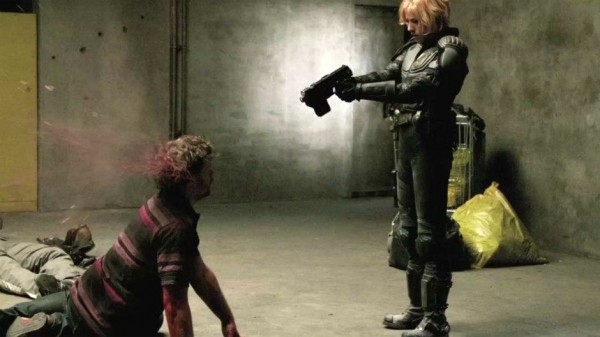
'Dredd' review:
Last year, I interviewed filmmaker José Padilha, who had at that point only recently been announced as director of next year's new 'RoboCop' movie. Naturally, in this age of vapid re-boots, I was concerned that the humour and political commentary of Paul Verhoeven's 1987 classic might be lost, with the film re-tooled as a straight action movie. A fear he swiftly countered, saying:
“The satire element of RoboCop is, I think, needed today... That kind of social, aggressive satire I haven’t seen done well in movies lately. And it’s almost like the politics and violence in the world is asking for this: 'Someone please make some satire now!' So we’re going to keep that edge.”He is entirely right: the world - with its financial meltdown, government austerity measures, resurgence of right-wing politics and rapidly advancing technology - is practically begging for something like a vintage Verhoeven movie. We sorely needed a 'RoboCop' or 'Starship Troopers' to come along and savagely poke fun of things, whilst also shamelessly indulging in ultra-violence and gore for our entertainment. An old-school 18-rated science fiction movie, the like of which we haven't really seen since the '12A' certificate was ushered in by comic book movies a decade ago.
Yet, ironically, a comic book adaptation has beaten Padilha to the punch. With the Brazilian's film still nearly a year from release, British television director Pete Travis has swooped in from left-field to deliver all of the above with 'Dredd' - based on 2000AD's Judge Dredd series. Here Karl Urban dons the helmet of the titular fascistic "street judge" in a dystopian future, in a film which is deliciously satirical, whilst also being horrifically and uncompromisingly violent. Like a Verhoeven movie of old, the high-minded political business is indistinguishable from the exploitative, sickeningly fun action stuff. It's funny and sleazy and rarely subtle, with well choreographed action and a tight, disciplined structure. Yet Alex Garland's screenplay is also pretty smart once you get past some (perhaps intentionally) cringe-inducing one-liners.
Dredd himself - a cop, judge, jury and executioner (for those unfamiliar with the character) - is an uncompromising individual, obsessed with enforcing the law to the letter and without question or a shred of compassion. He is a walking Daily Mail column with fire-power, free to threaten the most vulnerable in society from an assumed position of moral authority: he harasses the homeless and sees every law-breaker as nothing more than a scumbag beneath contempt and, often, in need of a good state-sponsored murdering. Yet Garland and Travis tip us off to the fact that we shouldn't necessarily be uncomplicatedly on-side with the protagonist in a number of ways.
The most obvious is the fact that they give us a rather more relatable and warm character in the form of rookie Judge Anderson (Olivia Thirlby), who goes through the movie questioning and undermining her superior's harsh methods and views on society - even going against the rules to spare a criminal's life. Being from the slums herself, and from a marginalised community of psychic mutants, Anderson is less quick to (literally) judge those who transgress the law. Perhaps her psychic abilities give her more empathy than her sociopathic colleagues? What's more, in stark contrast to the unflappable Dredd, she feels remorse at having to kill. As well as Anderson, we're are also given plenty of other reasons to be suspicious of this world's justice system.
For instance, it's clear that giving police the power to murder criminals on sight has not acted as a deterrent against violent crime. In fact, we see that the Judges of Mega-City One are only able to respond to a small percentage of the crimes occurring at any given time. We also see how those fleeing from the cops of this world have little choice but to resort to all out warfare with the authorities. With no chance of reprieve, or anything like a considered trial, the drug dealers and pimps of this reality take to unloading their sub-machine guns and mowing down pedestrians as soon as they see Dredd in their rear-view mirror. If this wasn't a clear enough critique of right-wing ideology, then the scene in which Dredd and Anderson go to arrest a man for being homeless - only to barely react as he's pulverised by a huge mechanical door - is a pretty clear indication of how skewed the "good guys" of this movie are, from a moral standpoint.
Then there's the fact that Lena Headey's crime boss, Ma-Ma, is pretty clearly a victim of repeated sexual abuse and a drug addict. She's pretty cruel, guilty of lots of bloody crimes and seems to take sadistic pleasure in skinning her victims alive, but she's not uncomplicatedly "evil". She's undoubtedly messed up, yet she arguably needs sectioning rather than murdering. And her major vice is arguably less socially harmful than the law's reaction to it: her gang is responsible for putting a new drug called Slo-Mo on the streets - a chemical which causes the user to experience this grey, concrete world in glittery, multi-coloured slow-motion. It actually seems pretty appealing in context.
Where the movie really shines is that this high-minded and timely political commentary is ever-present without being heavy-handed or suffocating how much sheer fun the movie is. The action is brutal and bloody in a way you really don't see any more - even in stuff like 'The Expendables', which exists solely as a throwback to that 1980s action era. It's handled imaginatively, never gets repetitive and there are plenty of clever twists along the way. It's also fantastic that the premise of this movie is so small-scale: basically, our "heroes" get trapped in a gang-controlled skyscraper and have to fight there way to the boss at the penthouse - much like you might in a 90s SEGA arcade brawler. In many ways it's like a feature adaptation of 'Streets of Rage 2', in a very good way.
This is, in effect, the movie Padilha seemed to promise last year, when talking up his handling of 'RoboCop'. That film, however good it may turn out to be, is no longer being released in a vacuum. Arguably, 'Dredd' is the strongest mainstream action-satire film since 'Starship Troopers' in 1997 and one of the year's biggest surprises.
'Dredd' is out in UK cinemas now, rated '18' by the BBFC.
Labels:
Alex Garland,
British Cinema,
Dredd,
Judge Dredd,
Karl Urban,
Pete Travis,
Review,
Trailers
Wednesday, 12 September 2012
'Anna Karenina', 'Jackpot' and 'Berberian Sound Studio': review round-up
After yet another long absence, here are some more reviews (some more timely than others!). Mainly I'm interested in bigging up Joe Wright's latest, but I'll also briefly mention a couple of others from the last few weeks that I never found time to write about.
'Anna Karenina' - Dir. Joe Wright (12A)
Having leapt out of his period drama comfort zone with the bold and unconventional 'Hanna', Joe Wright has returned to more familiar ground with this adaptation of lauded nineteenth century novel Anna Karenina, also renewing his partnership with Keira Knightley - star of 'Pride & Prejudice' and 'Atonement'. Yet his treatment of Tolstoy's Russian Lit classic is more reminiscent of his under-appreciated 2011 action-thriller than might have been expected, retaining much of that film's dynamism and editing panache. As with 'Hanna', and 2009's patchy misfire 'The Soloist', sound and image are inseparable here, with the line between diegetic sound and Dario Marianelli's score hard to determine.
Wright's bravura camera-work - at times a little self-conscious, but always technically impressive - is now indelibly linked to the soundtrack in a way only matched in contemporary movies by Paul Thomas Anderson. Because Wright continues to develop this approach, 'Anna Karenina' feels like the evolution of his style rather than a retreat back to the comfort zone. In fact, if anything, the way Wright has chosen to stage this adaptation feels more experimental and imaginative than anything he's attempted previously. The whole thing is presented as though it's occurring within one old theatre, with the sets changing around the actors. Yet the film never feels stage-bound or overly theatrical, with this conceit instead increasing the sense that this tragic love story is larger than life. This stylistic choice (which could sound irksome on paper) never seems in the least contrived or heavy-handed either, carried off with a disarming lightness of touch. It's consistently implemented, yet it never upstages the story or characters.
Of course, at just over two hours in length, this is an abridged version of the story, told in broad brush-strokes, yet that is also to its great credit. This isn't an overly literal adaptation, committed to bringing the book's events to the screen in as much detail as possible, but rather Tom Stoppard's deft screenplay boils the thing down to its essential elements and Wright uses the tools of his trade to incite the viewer to feel Anna's all-consuming passion for Aaron Taylor-Johnson's dashing Count Vronsky - and all the feverish madness that it brings. It's a visceral and emotional telling of the story, rather than an intellectual one, but it works extremely well. Arguably Tolstoy's command of realism and his political/spiritual consciousness is a casualty of this treatment (though neither is wholly absent), but this version gets everything else right.
It certainly works as a character study, supported by a fine central performance from an actor in form, with Knightley impressing recently in films are varied as 'Never Let Me Go' and 'Seeking A Friend for the End of the World'. It also benefits from an eye-catching supporting turn from Jude Law as Anna's jilted husband, confirming once and for all his chops as an interesting character actor when not asked to be a leading man (for another example of this phenomenon, see: Colin Farrell). And, though I don't usually mention costumes, hair and make-up (things I generally have little interest in and next to no understanding of), the work here is uniformly brilliant, with a range of interesting hairstyles and moustaches to suit every finely tailored cavalry officer's uniform. I can't vouch for whether or not real Russian aristocrats of the era looked like they'd stepped off the cover of Sgt. Pepper's, but these guys look fantastic. Special mention goes to Matthew Macfadyen's extraordinary and enviable facial hair (below).
'Jo Nesbø's Jackpot' - Dir. Magnus Martens (15)
Spinning out of the decidedly un-Tolstoyan literary world of ubiquitous Norwegian scribe Jo Nesbø, whose work inspired the bewildering WTF-fest that was 'Headhunters', comes 'Jackpot': another Scandinavian crime thriller of indeterminable earnestness. This strange Christmas movie (released in the UK at the height of summer), sees a collective football bet - between some leather jacketed nutters who work in a Christmas tree factory and their meek friend - end in betrayal and bloody violence, with the now customary mix of ultra-violence, bizarre comic interludes, lost in translation regional humour and gritty social realism. As with 'Headhunters' earlier this year, I enjoyed it without really understanding a) whether I was watching it properly, b) what was going on at all on a plot level and c) whether it was supposed to be hilariously funny.
I don't know whether either film is objectively "good", but both are utterly insane and highly watchable. Both made me cry from laughing and neither go where you would expect them too. What's more, the characters are, to a man, morally bankrupt and generally quite foolish - with the most appealing in this case being Henrik Mestad's sarcastic and world-weary detective. All in all, a good time at the pictures.
'Berberian Sound Studio' - Dir. Peter Strickland (15)
An interesting curiosity that leaves much to be unpacked and pondered upon, Peter Strickland's second feature - following his roundly-praised low budget Romanian debut 'Katalin Varga' in 2009 - is a psychological thriller of sorts. In it Toby Jones plays a nebbish sound technician from the UK, whisked to Rome in order to create sound effects for a Dario Argento style horror movie. The tone and look of this 70s-set piece is pitch perfect, with a lot of fodder for cinephiles in the details. Jones, so often a scene-stealing supporting player in bigger budget movies, excels in the central role. The story, however, is incredibly slight and the whole thing is aimed at the intellect rather than the heart. That isn't a criticism exactly, but it perhaps explains why I have difficulty getting excited about it beyond appreciating the excellence of its constituent parts. Highly polished and completely unique, but more to admire than love here.
Tuesday, 21 February 2012
'Shadow Dancer' Berlinale (Out of Competition) review:
Andrea Riseborough has long been a star in search of a fitting vehicle. Though she certainly has the screen presence, acting chops and good looks required to be considered a big deal, to date Riseborough has been unlucky in terms of her choices, with her most high-profile lead roles being in 2011's stomach-churningly awful adaptation of 'Brighton Rock' and playing the infamous Wallis Simpson in this year's 'W.E', directed by Madonna (and also shredded by critics). But she needn't live in fear of a fatal third strike, for she has finally snared a starring role in a film of very fine pedigree indeed, as a Northern Irish member of the IRA, forced by MI5 to spy on her staunchly republican family.
Whilst planting a bomb at a London underground station, single mother Colette McVeigh is detained by Mac, a British secret service officer played by Clive Owen. He presents her with an ultimatum she can't easily ignore: she can either spend the next 25 years in prison and lose her young son, or she can return to Belfast and gather intelligence on her brothers Gerry (Aidan Gillen) and Connor (Domhnall Gleeson) - suspected as being responsible for a number of political murders and terrorist attacks. Already conflicted about her brothers' violence (she "forgets" to arm the underground bomb) and unwilling to be separated from her child, Colette reluctantly agrees to help Mac.
Of course, this decision places Colette in fresh danger, with her quick escape from the authorities in London and sudden unexplained visits to the local telephone box attracting attention from within the organisation. Soon a local IRA enforcer is hot on her trail, seemingly convinced that she is a mole and waiting for her to slip up. The result is a straight thriller about an informant caught in the middle between two forces to whom she is equally dispensable: Mac tries his best to reassure her of her safety, but his boss (Gillian Anderson) sees Colette as an expendable asset, whilst her the IRA won't hesitate to put a bullet in her head the minute they learn the truth. Soon it dawns on Mac that Colette is simply being used a bait to detract attention from another mole. Will he manage to pull her out of this situation before she's sold down the river? The final twenty minutes, full of unexpected twists and turns, is incredibly tense.
Directed by James Marsh, better known as the documentary filmmaker behind 'Man on Wire' and 'Project Nim', 'Shadow Dancer' is an extremely taut and gritty piece of work which is less about examining "the troubles" as it is the increasingly paranoid mental state of a character who's powerless escape her situation. Clive Owen is dependable as ever, whilst Gillen is a quietly menacing presence as the more hardline of the two brothers, but it's Riseborough who owns the film. She gives exactly the sort of subtle, layered performance required for this film to work, convincing both as a street-smart, lifelong IRA idealist and a mother scared out of her wits.
Labels:
Andrea Riseborough,
Berlin,
British Cinema,
Clive Owen,
Festivals,
James Marsh,
Review,
Shadow Dancer,
Trailers
Friday, 27 January 2012
FilmQuest 2012 (5/30): 'The Full Monty':
It's been just over a week since I started the emphatically named "FilmQuest 2012" column and I've already seen five of the thirty arbitrarily selected major movies that I had been so woefully ignorant of. This time around it's the turn of 1997's 'The Full Monty' - that small ($3.5 million budget) British comedy that ended up an international box office sensation (earning just under $258 million) and became a surprise rival to 'Titanic' at that year's Academy Awards (nominated for Best Picture, Director and Original Screenplay, winning one for Anne Dudley's score).
In Peter Cattaneo's film six Sheffield lads decide to become male strippers in a society where that seems to be the most dignified remaining option. The disintegration of the city's once-booming steel industry casts a shadow over all the characters, from the suicidal Lomper (Steve Huison) - who lives with his elderly mother - to the mill's former manager Gerald (Tom Wilkinson), whose wife has been in the dark about his joblessness for the last six months. Gerald has bought into the middle class dream and stands to lose his ski holidays, tanning bed and various object d'art. Meanwhile loveable hustler Gaz (Robert Carlyle), the brains behind the stripping scheme, is in equally desperate need of income: in danger of losing access to his son (William Snape) if he can't start making child support payments to his ex-wife.
In fact way back in 1997 Robert Carlyle and Mark Addy (who plays Gaz's portly mate Dave) were not only shown on the dole, but they could even be seen to shoplift VHS tapes (I told you it was old) from ASDA without fear of losing audience sympathies. We route for them and are never encouraged to doubt their good intentions and kindly character, even as they're also shown to turn down several offers of employment considered demeaning.
Gaz rejects his ex-wife's attempts to get him doing unskilled labour for a (pre-minimum wage) sum of £2.50 an hour, whilst Dave is mocked for taking up work as a security guard at the aforementioned supermarket: a job he eventually runs away from, shoplifting as he does so, with the moment depicted as liberating rather than debauched. And yet the film somehow never implies that they aren't serious about looking for work. More than anything all of the characters long for their old jobs back. So much so that a good portion of 'The Full Monty' sees its characters hanging out in the abandoned steel mill, with seemingly nowhere else to go. They are a displaced class of men who no longer feel of use or relevance.
Particularly effective (probably the best scene in whole movie) is the look on Gaz's face when he realises he's potentially sabotaged Gerald's efforts at securing a new job. Tom Wilkinson's public breakdown is one of many tender moments that prevents the film from taking unemployment and its pitfalls too lightly. It's overwhelmingly sensitive and kindly disposed towards its characters. A fact which ensures this comedy is never less than watchable even if (to me at least) the jokes aren't very funny.
Sunday, 22 January 2012
'Black Pond' review:
An eye-catching debut from co-directors Tom Kingsley and Will Sharpe, 'Black Pond' tells the story of a middle class family who are accused of murder after a disheveled stranger comes to dinner and asks them to bury him in the woods. We don't see very much of this event enacted, with most of the drama being split between time before and after Blake (Colin Hurley) dies. Mockumentary style interviews with members of the Thompson family talk us through the aftermath, whilst more straight forward drama sees us through the days prior. There is also an imaginatively shot dream sequence, some primitive but effective animation and a sub-plot involving a friend of the family, Tim (played by Sharpe), undergoing very odd psychological analysis under the care of comedian Simon Amstell.
If this sounds like a bit of an uneven mish-mash of styles, it's because it is - though never less than entertaining and interesting. These different strands don't gel smoothly and the tone is inconsistent, though each isolated sequence is shot with an ambition that belies the film's patently low budget. What binds it together is the entirely consistent and rigorously explored theme, with all the stories - of the Thompson family, Tim and Blake - about the tragic impermanence of life and love. A theme which is developed with subtle humour, brilliantly observed depictions of human behaviour (in particular, middle class family dysfunction) and in a way which is genuinely heartfelt.
Among a uniformly impressive cast, former 'The Thick of It' star Chris Langham, unseen on our screens for several years due to a damaging and widely reported court case, is especially stunning as the father. It's great to have him back. As with his under-siege government minister on that TV political satire, he plays a good-natured blunderer - a sweet man whose shortcomings (in this case his inability to express love to anyone other than the family dog) play as tragic. You get the sense he is always trying his best and repressing any negative feeling at his own expense. Both characters struggle vainly to maintain a sense of order and propriety. Both characters are also very funny, with Langham a master of comic timing who can be relied upon to make the smallest moments count.
Yet the film's emotional centre is arguably represented by Colin Hurley, whose shambling, detached, emotionally distant character is portrayed with the utmost sensitivity. He's slightly weird without ever being dangerous, with Hurley never overplaying the crazy or maudlin aspects of Blake. It's a rounded, sincere and gimmick-free performance worthy of accolades.
Like Ben Wheatley's unsung gem 'Down Terrace', 'Black Pond' suggests the emergence of some exciting talents whose next moves will surely be watched with increased interest.
'Black Pond' is rated '15' by the BBFC. Though given a limited release in November, it's still playing one-off shows around the country.
Monday, 16 January 2012
'Dreams of a Life' review:
In 2003 a 38 year old woman named Joyce Vincent died watching television in her small London flat, situated above a shopping centre in Wood Green. She wasn't discovered for nearly three years - and then only by people seeking her eviction from the premises for failing to make rent payments. When they found her the TV was still on, playing to Vincent's skeletal remains, which were surrounded by unopened Christmas presents. Immediately questions were raised.
Why hadn't anybody noticed her missing? Didn't her family wonder where she was? Why didn't any of her neighbours report the smell? Or question the why the television had been on constantly for so long? Why hadn't the electricity been disconnected? If she were so isolated, who had she planned to spend Christmas with? What did her story say about British society? Questions abound, prompting documentary filmmaker Carol Morley to run a newspaper ad asking for anybody who knew Vincent - in any capacity - to get in contact.
The result is 'Dreams of a Life': a haunting and moving look at Vincent's life as seen through the eyes of ex-boyfriends, colleagues and acquaintances told almost as a stream of consciousness. Early on Morley establishes that we might never know the facts surrounding her death in any detail: Vincent's body was so badly decomposed by the time of its discovery that a cause was not ascertainable (though a possible asthma attack is one theory), whilst insight into her past is limited by the fact that surviving relatives preferred to remain anonymous. With this in mind the film is a patchwork of often contradictory accounts which reveal far more about the nature of friendships - and how little we know about the people around us - than they do about Joyce Vincent, who remains something of a tragic enigma.
Depending on who is speaking she was either too trusting or had problems trusting others. People similarly can't agree on whether or not she was a decent singer, where she worked or who was in her circle of friends at any given time. Several speculate that she lived several parallel lives, having multiple 21st birthday parties with different sets of mates all oblivious to each other's existence. One man considers her the great love of his life, whilst another bestows that honour upon himself. She was a bubbly, happy, confident person - or perhaps a deeply damaged, reclusive individual. Did she quit a high paying office job in order to go travelling abroad with 20 mates or did she simply start working as a cleaner? Maybe all of these things are true. Possibly few of them are.
What is clear is that Joyce was an attractive and capable woman with aspirations of being a professional singer. At one time in her life she apparently rubbed shoulders with Nelson Mandela, conversed freely with Isaac Hayes and dined with Gil Scott-Heron. She was well liked, had a wide circle of friends and, by all accounts, the manner of her death came a huge surprise to those she knew who couldn't believe the lady from the newspaper reports was their Joyce.
This raises an eerie question which, once contemplated, is difficult to erase from your mind: could this happen to you? It also causes you to ponder how much your friends really know about you and, even, the transitory nature of friendship itself. In many ways her story, whilst extraordinary, is understandable. After all, she was young and fit - if one of your friends of a similar age stopped responding to text messages or hadn't been down to the local pub in a while, would you ever wonder whether they had died? I suspect you'd assume they'd moved away, gotten a new job or - for one reason or another - changed their phone number. You'd probably imagine they just didn't like you any more long before you ever considered anything as drastic as Vincent's chilling story.
Morely's film works well as a loose, dreamlike musing on isolation and the fallibility of memory. I think it deliberately seeks to raise more questions than it answers and it succeeds if accepted on these terms. I expect it's rather less satisfying if you're seeking a straight examination of "the facts". In which case the speculative dramatised reconstructions of Vincent's life up to her death, in which she's played by actress Zawe Ashton, are certain to grate.
These sequences are hit and miss in any case, with the worst far too obvious and maudlin - such as when Vincent is imagined singing "My Smile is Just a Frown" into a hairbrush for several minutes before breaking down in tears in her depressing flat. But they can't spoil this thought-provoking glimpse at the cold anonymity of 21st century city life taken to a horrifying extreme.
'Dreams of a Life' has recieved a limited release in the UK, rated '12A' by the BBFC.
Labels:
British Cinema,
Carol Morley,
Documentary,
Dreams of a Life,
Review,
Trailers
Sunday, 15 January 2012
'Shame' review:
From Steve McQueen, Turner Prize winning video artist and director of the universally acclaimed 'Hunger', 'Shame' is a stylishly shot, cold and uncomfortable look at an empty existence defined by the nebulous disorder commonly known as "sex addiction". New York executive Brandon (Michael Fassbender) spends his every waking moment watching porn, soliciting prostitutes and masturbating in the work toilets. He can't so much as look at a woman on the subway without straying into a world of crass sexual fantasy from which the film offers no escape.
He is handsome, lives in a clean modern apartment and the women he beds are uniformly gorgeous yet his sexual encounters are framed as dirty and sinister. Brandon takes seemingly no pleasure in what he's doing, with sex reduced to a shameful compulsion and a barrier preventing the development of lasting relationships with people - who include his equally fucked up sister Sissy, played by Carey Mulligan. The problem is most of the people in his life - from his irritating sibling to his arrogant jock prick of a boss (James Badge Dale) - prevent this from seeming like too much of a loss.
Co-written with 'The Iron Lady' screenwriter Abi Morgan, the film's view on sexuality seems the product of deep, unhealthy repression - the sort of judgemental, prudish take on sex that we've spent the last decade or so trying desperately to move away from as public discussion of all-things bodily becomes increasingly frank. The way the film attempts to paint Brandon's acts as depraved is absurd at best. We're first encouraged to view his sexual appetites with suspicion after he asks a woman to undress "slowly". "What a sicko!" seems to be the message, backed up by Harry Escott's suitably ominous and rueful score. Later Brandon is shown to reach his spiritual, emotional and ethical nadir as he enters a gay sauna and is felated by a male stranger - a plot point which feels as homophobic as it does judgemental. Who cares where he sticks his nob so long as it's consensual?
Accepting for a moment that hyper-sexuality is a modern social ill and meeting the film on its own terms for a moment, I still think it's ill-conceived: a ponderous bore. McQueen favours long close-ups which, I suppose, might be said to provoke discomfort or even (and I think this is supremely condescending) give the audience time to think about what they're seeing. The effect is that we are often shown over a couple of minutes what we might have just as easily discerned over a couple of seconds - inflating the running time at the expense of engagement.
'Shame' is out now in the UK, rated '18' by the BBFC.
Saturday, 7 January 2012
'The Iron Lady' review:
There are few political figures hated more vehemently than Margaret Thatcher. She has her defenders, but even twenty years after being forced from power by her own party, Thatcher's name provokes strong emotions. Perhaps now - with public services again being cut as the country lives through recession and mass unemployment - isn't the most sensitive time to release a biopic celebrating her life. And yet here comes 'The Iron Lady', courtesy of writer Abi Morgan and Phyllida Lloyd, the director of 'Mamma Mia!'.
The film - as everybody surely knows - stars 16-time Oscar nominee Meryl Streep as a softer, prettier, more smiley version of Thatcher, who exists somewhere under ten pounds of make-up. Taking power in 1979 she comes over as something like Julia Child (the ungainly, nasal TV chef Streep impersonated in 'Julie & Julia') with pre-emptive missile strike capability and big hair. More effective are the scenes in which Streep plays a modern day version of the former leader: an old lady grappling with dementia alone in her flat. It'd be difficult for even the most ardent socialist not to see the humanity here, which in some respects makes the film resemble 'Downfall' - the German film that chronicled the final days of Hitler.
It's strongest in these moments, as frequent backflashes through Thatcher's political life are oddly neutered in a way which should infuriate her supporters and detractors in equal measure. Possibly mindful of the divisive nature of her politics, this Weinstein-backed Oscar bait prefers to see her life through a less complex prism: one of the first female leader of a Western power - an undeniable watershed achievement, even if she did little to aid working women during the 80s. But with Thatcher's social policies still felt by Britain's poorest communities, making a film predominantly about Thatcher's gender - and her girl power rise to the forefront of a male dominated world - feels roughly equivalent to focussing on Hitler's vegetarianism.
There is some stuff here about whether or not she was so guided by principle and singular conviction as to be obstinate (a word she gets right away in a crossword), whilst Morgan's screenplay even deserves some credit for its framing of the sinking of the Belgrano as a terrible decision which prolonged the Falklands war and caused the deaths of many British serviceman (as well as 300 Argentine sailors). But otherwise, beyond presenting protesters and Labour MPs as red-faced shouty men, the film tries very hard to run away from politics. Prominent Tories have been irked by the film's portrayal of Thatcher's mental decline, with the leader shown going very clearly mad during a cabinet meeting (the film's strongest sequence), but it's overall unlikely to offend anybody too severely.
How you feel about Streep's Thatcher will no doubt have more to do with your politics going in than anything in the film itself, which isn't helped by its tepid ITV drama atmosphere. Perhaps the most damning indictment of 'The Iron Lady' is that it isn't even attempting to be as incendiary as its subject. We might have expected a film that would, at the very least, provoke discussion. I'd be very surprised if too many audience members found themselves thinking about this disposable pap too long after the fact. Though it should go without saying by now that Olivia Coleman is brilliant as daughter Carol, while Jim Broadbent, who plays husband Dennis, is good value as ever - only Streep's reputation and inevitable Academy Award nomination (and possible win) are keeping this film from cultural oblivion.
'The Iron Lady' is on a wide release now and rated '12A' by the BBFC.
Friday, 23 December 2011
'Arthur Christmas' review:
The second computer animated feature from beloved British stop motion specialists Aardman, 'Arthur Christmas' is a thoroughly enjoyable family movie which, in the tradition of festive films, sees an enthusiastic youngster try to save the holiday against all odds. Our Christmas-loving hero of the hour is the titular Arthur (voiced by James McAvoy) - the youngest son of the incumbent Santa (Jim Broadbent), himself the latest of a hereditary line of jolly, present-giving fat men dating back to the original Saint Nick.
Something of an overlooked, accident-prone outcast on the North Pole, Arthur customarily spends this time of year replying to children's letters in the shadow of his older brother Steve (Hugh Laurie): the brains behind the family business, groomed as their father's successor. But in Steve's increasingly soulless, mechanised version of Christmas - where presents are delivered via a spaceship manned by teams of high-tech elves - one child has been accidentally overlooked due to technical error. Arthur is horrified when told that Steve - who swears the evening has been a statistical success - won't be going back to deliver little Gwen's (Ramona Marquez) bicycle and takes it upon himself to ensure she wakes up to a gift from Santa, lest her fragile heart be broken.
This daring, covert mission involves pairing up with a former Santa - Arthur's cranky, old fashioned 136 year old grandfather (Bill Nighy) - to pilot a forgotten reindeer-powered sleigh and make the hazardous journey to the girl's Cornwall home before sunrise. But without the benefits of Sat Nav they end up rocketing across several continents facing danger and petty inconvenience along the way - evading everything from hungry African lions to British military fighter jets whilst careening between city streets and mountain ranges in set pieces of effective 3D spectacle.
Aside from the guileless, faultlessly good-natured Arthur, each member of the Christmas clan is written with a touching degree of subtly, with none overtly heroic or particularly villainous. The grandfather is the most fun, constantly coming out with opinions and anecdotes which are well observed, if exaggerated, versions of the sorts of (often offensive) things people of "the greatest generation" say. Meanwhile Broadbent gives his slightly rubbish Santa a touching air of vulnerability. The whole thing benefits from a cynicism free spirit of fun, with action scenes, earnest character development business and everything in between peppered with inspired visual gags, deftly written one-liners and delightfully daft concepts. The result is something that's surprisingly laugh out loud funny, as co-written by long-time Armando Iannucci collaborators Peter Baynham and director Sarah Smith.
'Arthur Christmas' is rated 'U' by the BBFC and is out now in the UK.
Labels:
3D,
Aardman,
Animation,
Arthur Christmas,
British Cinema,
Review,
Trailers
Tuesday, 13 December 2011
'My Week With Marilyn' review:
It begins with a sizzle: Michelle Williams is introduced as Marilyn Monroe during a sultry song and dance routine, watched by our besotted, film-obsessed protagonist Colin (Eddie Redmayne) on a cinema screen, in the company of a dozen or so other lecherous men. It's no exaggeration to say Williams makes love to the camera and the sensitive, indie movie actress convinces totally, becoming the hyper-sexual 1950s bombshell before our eyes. Here Colin's leering does something to suggest not only the appeal of Monroe, the movie star, but also the terms upon which she was judged and the slightly sinister way in which audiences implicitly came to own her. Sadly Simon Curtis' movie goes rapidly, dramatically downhill from there.
'My Week With Marilyn' feels like an overwrought Biography Channel drama operating on an unusually high production budget. The presence of Williams - not to mention Kenneth Branagh, Judi Dench, Dominic Cooper, Toby Jones, Derek Jacobi, Emma Watson and Dougray Scott - is all there is to remind us that this is in fact a piece of Weinstein-produced Oscar bait and not a straight-to-DVD knock-off. The film follows Monroe during the time she spent in England in the summer of 1956, starring opposite Sir Lawrence Olivier (Branagh) in light comedy romp 'The Prince and the Showgirl' - the production of which was apparently run like a Gulag under the stage legend's Stalin-like gaze and (in one bewilderingly pointless scene) the tyranny of a unionised workforce.

Based on the memoirs of the young Colin Clark, the fraught production's lowly third assistant director, the film sees Redmayne's Colin very much as the centre of attention: instantly loved by Monroe and soon indispensable to Olivier. A key mediator in the ensuing war between the two actors, he's the reason the film is completed. It is even implied he prevented the troubled, pill-guzzling sex symbol from committing suicide - six years before her eventual overdose. By the end of this alternately zany and maudlin adventure he's improbably become trusted confident and bestest friend in the world to both stars. Along the way he also finds time to casually reject the affections of Emma Watson's doe-eyed wardrobe assistant and becomes accustomed to receiving knitwear from an appreciative Dame Sybil Thorndike (Dench), for some apparent off-screen kindness that's best left unimagined.
The film is so obsessed with our old Etonian everyman hero Colin that the more interesting figures who surround him are only painted as wafer thin archetypes. Olivier, who Branagh parodies with 'Wild Wild West' levels of restraint, is glimpsed several times in dramatic, slow-zooming close-up reciting Shakespearian verse - just like Olivier must have frequently done in real life. You know... because he was famous for doing Shakespeare.
Meanwhile Williams is a more troubling proposition as Monroe, playing her emotionally withdrawn moments as though she were a fay, mentally deficient cousin of Mickey Mouse. She may have been troubled, depressed and paranoid but Marilyn Monroe was, by most accounts, a very witty woman and not likely a ditzy airhead. Yet here Monroe is shown as barely able to recall who Leonardo Da Vinci is, let alone correctly identify his picture of "the smiling woman". Fair enough if you're going to be casual with historical figures, but this doesn't make sense within the context of a movie in which an early press conference scene has Monroe wowing British journos with her quick-witted charms and clever turn of phrase.

In isolated moments Williams nails the quiet vulnerability of the character, just as she turns the vivacious sexpot persona on and off, yet these feel like separate extreme caricatures rather than parts of a fully formed, if conflicted, whole. As with 'The Life and Death of Peter Sellers' or Andy Kaufman biopic 'Man on the Moon', 'My Week With Marilyn' is content to paint a reductive (and only superficially deep) picture of its complicated subject. Yet the performances, though campy turns rather than real human beings, are at least watchable. What really kills the film is Adrian Hodges' literal-minded screenplay.
A good 'My Week With Marilyn' drinking came would involve taking a shot 1) whenever someone tells you exactly what they're thinking or feeling; 2) whenever a character explains who somebody is or reminds you what has just happened; or 3) when something is said to underline a point already made through the characters' on-screen actions. The writing is needlessly descriptive, always telling rather than showing (or showing and then telling just in case). Dialogue often sounds like scene-setting narration rather than speech, whilst Olivier and Monroe routinely self-analyse in embarrassing cod psychology.
In 'My Week With Marilyn', the film star's life is presented as one long tragedy, hidden from public view behind moments of immense, if superficial, glamour. This, it turns out, is a very effective metaphor for the film itself, which only attains any sort of life when Williams is called upon to perform as a woman giving a performance.
'My Week With Marilyn' is out now in the UK, rated '15' by the BBFC.
Wednesday, 23 November 2011
'Weekend' review:
The bitter-sweet story of two men spending as many days together following a one night stand, 'Weekend' is not only a touching and gently funny love story, but a rumination on what it means to be gay. More broadly speaking it's about identity and the conflict between how we see ourselves and how we wish to be seen by others. Here the introverted, determinedly anti-camp Russell (Tom Cullen) finds himself attracted to his opposite: the loud, confrontational and highly politicised artist Glen, played by Chris New.
Russell seeks the path of least resistance where sexuality is concerned - being quiet about his sexual escapades, even in private, and rejecting public displays of affection altogether - whereas Glen is comfortable meeting prejudice with well reasoned debate or juvenile insults as the situation warrants. He bravely seeks to challenge the heteronormative society in which he lives, but he is also pretentious, insensitive and emotionally immature: Russell likens him to a teenager at one stage, even as he regards him with thinly veiled admiration.

Director Andrew Haigh's naturalistic screenplay, along with the fine performances of both leads, brings to life a film of emotional substance and nuance, in which neither character is judged by the filmmaker even as they judge and contradict each other. Glen's cynical take on marriage, as a sort of fay middle class obligation, is every bit as persuasive as Russell's suggestion that the ritual represents a bold public declaration of love. In this way the lengthy, often drug-fuelled, exchanges between them - as they discuss art, sex and gay rights of passage - are always interesting, funny and heartfelt - never sentimental or contrived.
From within a drab block of flats which, as surrounded by security cameras, feels at times like something out of Andrea Arnold's 'Red Road', it is easy to identify with Russell's less overt, less militant homosexuality. Without a single scene of physical violence, Haigh still manages to create an intimidating atmosphere as brainless insults are directed at the protagonists from off-camera. In this way the unseen villain of the piece is not anything as extreme or jarring as a punch in the face, but in the words people use so thoughtlessly - and in the culture itself, as people channel directionless anger into anti-social behaviour. The decision not to show the haters is also arguably a political gesture in of itself: this isn't their movie after all and their place in it, whilst necessary, is marginal. What's far more important is how Russell and Glen react differently to this ever-present oppression as opposed to any specific instance of confrontation.

That it's to some extent broken free of the "Queer cinema" ghetto and achieved modest mainstream box office success - in the UK and US, where it won awards at several festivals - has taken the industry by surprise, with cinemas notably slow on the uptake: forced to carry the film after date in response to audience demand. It might seem odd - and even like evidence of institutionalised homophobia - that it's faced such an uphill battle even in spite of overwhelmingly positive reception in the mainstream press. Yet it's arguably evidence of a fear raised in the film itself, as Glen contemplates the future of his own vaguely defined art project: an installation which will centre on the frank discussion of gay sex in a public forum.
Of that taboo-defying piece he muses that homosexuals won't be interested because it's not at all pornographic, whilst "straights" won't come because it's not about their world. 'Weekend' is challenging these restrictive, intellectually and emotionally stifling lines in the sand in ways even its director couldn't have foreseen, becoming one of the year's stand-out films on its own terms. Whether or not this will have a lasting impact on the exhibition industry, clearing the way for wider distribution of similarly accomplished gay cinema in the future, remains to be seen. But in an industry typically turned on the identification and immediate assimilation of trends (superheroes, J-horror remakes, 3D), I'd be very surprised if distributors weren't at this very moment actively seeking out the next 'Weekend'. The trouble for whichever film inherits that mantle is that Andrew Haigh has set the bar unreasonably high.
'Weekend' is out now in the UK and rated '18' by the BBFC.
Labels:
Andrew Haigh,
British Cinema,
Queer cinema,
Review,
Trailers,
Weekend
Monday, 14 November 2011
'Wuthering Heights' review:
If you read certain newspapers you could be forgiven for thinking that things are getting worse by the day: that society is regressing and life on Earth is more miserable now than it was for our grandparents. This truism is, aside from being quite annoying, potentially destructive and alienating. Its effects can be seen in our most culturally conservative films: that of the "heritage" cinema. In the British heritage cinema, with its eyes set on international box office, we see this idea applied to the nineteenth century time and time again, where people are invariably more refined, elegant, witty and polite than ourselves. They live in magnificent houses surrounded by beautiful things and speak the clearest (and often most verbose) form of English.
In this cinema we not only play up to international expectations of what "Britishness" (or really "Englishness") is, but we portray ourselves as we wish to be seen. This it at its most troubling when it comes to representations of race - where black faces are erased from British history in spite of the fact that London has been a multicultural city since before the time of Shakespeare - and, of course, social class. There have certainly been handsome and enjoyable period films over the years but there can be little doubt that the genre is staid and in need of a shake-up. Luckily Andrea Arnold, the director of 'Red Road' and 'Fish Tank', has done just that with a dirty, sweary and determinedly working class adaptation of 'Wuthering Heights'.

In this tale of doomed romance she recasts the central role of Heathcliff, an enigmatic social outsider, as black whilst Cathy and her family speak with thick regional accents. It's the 'Batman Begins' of period movies: a gritty game-changer that injects realism into a genre more commonly resembling fantasy. The dimly lit interiors speak of a time before electricity and our restricted view of the world (the whole thing takes place in one rural community) creates a sense of isolation. Use of anachronistic swear words and racial slurs, along with dynamic handheld cameras, also paints the past in such a way that it feels alive and the people real. The decision to again cast many non-actors (which worked so well in 'Fish Tank') also ensures there is little chance of mistaking this for an episode of 'Downton Abbey'.
These divergences from the standard tropes of period film are not merely cosmetic but help tell the story - and in lieu of any lengthy dialogue, displaying an admirable confidence in the power of images above the spoken word. Admittedly my knowledge of Emily Brontë's nineteenth century novel extends only as far as the Kate Bush song, but the director's vision seems faithful to that of the Gothic novel as far as I can tell. The story is stripped to the bear essentials, but the elemental animal passion of the characters comes across, especially in the first half of the film depicting childhood. Having a black Heathcliff serves to imbue scenes with deeper significance - such as when he is treated as a domestic servant, beaten and locked up - whilst it also strengthens the feeling that he and the white Cathy will never be accepted as lovers.

The tragedy of Cathy and Heathcliff's destructive love-hate relationship and unconsummated love comes across vividly, as does the fecund and windswept setting, marking this as a successful adaptation of the story. But the greatest achievement - and hopefully most lasting influence - of the piece is in Arnold so boldly shaking the British costume drama by the shoulders. There will always be an audience for glossy nineteenth century literary adaptations about gaudy dresses and well-maintained topiary (and they will likely always generate more money than Arnold's film), but this is the clearest evidence since Kubrick's 'Barry Lyndon' that this most stagnant of genres can be as gutsy and relevant as any other.
'Wuthering Heights' is out now in the UK where it is rated '15' by the BBFC.
Labels:
Andrea Arnold,
British Cinema,
Review,
Trailers,
Wuthering Heights
Friday, 14 October 2011
'Retreat' interviews: Bell, Murphy, Newton & Tibbetts!

Just over a year ago I visited the set of thriller 'Retreat' in glorious North Wales. Over at What Culture are the interviews from that trip - embargoed until today - with Cillian Murphy, Jamie Bell, Thandie Newton and first-time writer-director Carl Tibbetts. I'll post a review of the film itself in the near future.
'Retreat' is on limited release today in UK cinemas and comes out on Blu-ray and DVD from Monday. It's been rated '15' by the BBFC.
Sunday, 9 October 2011
'Tyrannosaur' review:
Olivia Colman is lovely isn't she? I don't know her personally, but what I mean is she seems lovely on the telly. Turning up in TV sitcoms, as Sophie in 'Peep Show' or the vicar's wife in 'Rev', I am never in any doubt that her characters are basically good and beyond harmless, probably in part thanks to her big, friendly eyes. She certainly isn't someone you want to see beaten, raped and literally pissed on by Eddie Marsan in a grim, socially real, British movie about social isolation and domestic violence. But here we are.
I'm fairly sure, unless you're some sort of psychopath, there aren't any people you wish to see in that situation, but for me that goes doubly for lovely, smiling Olivia Colman. Which is one of the many reasons Paddy Considine's debut film as a writer and director, 'Tyrannosaur', can be pretty hard to take. Terrifically acted and deeply moving, but a tough watch indeed.

In it Colman is Hannah, a devout Christian woman who leaves her middle class house every day to work in a drab charity shop on the rough side of town - probably just to get away from her vicious husband James, played by an especially scary Marsan. James is possessive and spiteful and some of the things he does to Hannah defy belief, existing outside the realms of even your cruelest imagination. The violence in 'Tyrannosaur' may be less explicit and frequent than scenes in the similarly grim 'Kill List' (also from Warp Films), or even the recent thriller 'Drive', but it's far more hard-hitting because it's based in a deeply upsetting reality. And it somehow keeps getting worse, with the level of abuse suffered by Hannah still being revealed right up to the very end.
It is working at the charity shop that Hannah meets Joseph played by Peter Mullan, who is the sort of unpredictable, violent and all too recognisable old drunk that spends his days drinking in the corner of his local boozer, babbling incomprehensibly to himself. He is the opposite of harmless and when we first see Joseph he is kicking his dog to death in the street. After a chance encounter he befriends Hannah and we get to glimpse the underlying tragedy of this disturbing individual you'd be wise to cross the street to avoid. Both characters - and even the sickening James to an extent - are depicted with considerable compassion and deeply affecting empathy, with neither straying into caricature.

Mullan is for all intents and purposes the star of the film, which mostly takes his point of view - and he is excellent in it, with the sometime director (of 'The Magdalene Sisters' and recently 'Neds') able to portray this dog-kicking racist as rounded and human without undergoing some unlikely third act u-turn. With that in mind it seems unfair to single out Colman in this review, but there is nothing to be done about that because, for me at least, she is the heart of the movie and the key ingredient. It is really something that she can play this doe-eyed Christian victim without making her infuriating or wet in the least, and the more we care about Hannah the more wretched much of what you see will likely make you feel.
On this first showing, it would seem Considine is a very comfortable director of actors and an intelligent writer of characters. If he has displayed any similarity with his friend and frequent collaborator Shane Meadows, then it is in the fact that he has used his debut feature to take the side of elements of society most would not willingly gravitate toward, and he has done so with confidence and a keen eye for social detail.
'Tyrannosaur' is rated '18' by the BBFC and is on general release in the UK.
Labels:
British Cinema,
Olivia Colman,
Paddy Considine,
Peter Mullan,
Review,
Trailers,
Tyrannosaur
Tuesday, 13 September 2011
World Film Locations: London available now

A while ago I began contributing reviews and essays to a number of glossy film publications from Intellect. The first of these was released yesterday: World Film Locations: London, edited by Neil Mitchell. I've not seen the final version, but I wrote an essay about the way Richard Curtis films - 'Notting Hill' in particular - have used London and how they represent it as a cultural space.
I'm really impressed by the reviews the book has received so far and feel really privileged to have been a part of it:
'Handsome and intriguing, like an elegant ghosthunter's companion to a world that is - and isn't -there. ' – Francine Stock
'A superb book, indispensable for any cinephile interested in London's psychogeography. I could pore over it for hours.' – Peter Bradshaw
Why not purchase the book here?
Sunday, 11 September 2011
'Tinker Tailor Soldier Spy' review:
After years spent playing campy villains in Luc Besson movies and focus-stealing support characters in blockbusters, the great Gary Oldman stars in one of this year's most interesting and entertaining films: the 70s set Cold War thriller 'Tinker Tailor Soldier Spy'. Here the animated and charismatic actor is cast as an older man, giving a restrained and nuanced performance as retired British senior intelligence officer George Smiley - a man charged with investigating his former colleagues to find a Soviet mole at the top of "the circus" (the film's name for MI6). An impressive ensemble cast also includes John Hurt, Benedict Cumberbatch, Tom Hardy, Mark Strong, Kathy Burke, Ciarán Hinds, Toby Jones as well as recent Academy Award winner Colin Firth.
Based on a best-selling novel by John le Carré, which was also subject to a fondly remembered 1979 BBC TV series staring Alec Guinness as Smiley, this adaptation has been helmed by the Swedish Tomas Alfredson, feted director of 2008 horror hit 'Let the Right One In'. Both films share Dutch cinematographer Hoyte van Hoytema and along with him an austere, cold colour palette as well as the director's uncanny eye for period detail. On the way to uncovering the enemy informant, Smiley is shown sucking on Trebor mints and dining at a decidedly retro branch of Wimpy. But aside from being charming reminders of a time and place, these banal, slightly drab references also highlight one of this film's primary delights.

This is not a glossy, establishment picture of Britain we're being sold. It's a world very alien from that James Bond inhabits, as our spies juggle with mundane concerns and petty office politics as well as the very real risk of death at the hands of enemy agents. It's a film where our heroes spend most of the movie secretly investigating their friends and, in effect, battling their own government whilst (ironically) trying to catch out one charged with doing the same. Seldom have the words "we're not so very different you and I" seemed less like hollow cliche as they do here, as Smiley - not an idealist or ardent anti-communist by any standard - ponders on the moral equivalence of it all.
As with 'Let the Right One In', 'Tinker Tailor Soldier Spy' has brief, brutal moments of bloody, visceral violence, but it's more concerned with characters and mood than it is about revelling in the pleasures of its given genre. Spy thrillers tend to place plot above all else, but this one is less about the Cold War, and the search for the traitor within the ranks of the circus, as it is about personal feelings of betrayal and isolation. Homosexuals forced to love in secret, shambolic marriages and private regrets are the real focus of this contemplative and moody slice of espionage intrigue.
'Tinker, Tailor, Soldier, Spy' is out in the UK from Friday (16th September)and is rated '15' by the BBFC.
Friday, 2 September 2011
'Kill List' review:
Ben Wheatley's superior British horror 'Kill List' came out today and I've a review of it up on What Culture. If you want to hear what the 'Down Terrace' director had to say about the film, check out the recently recorded 64th Splendor Cinema Podcast.
I've just returned home to Brighton after two hype-filled days at one of the world's biggest consumer electronics shows - Berlin's IFA (Internationale Funkausstellung Berlin). I was there to look at Epson's freshly unveiled new line of home cinema projectors - which were very impressive indeed - and I'll be writing a full report on those for What Culture in the week. A splendid city, some exciting tech (including Sony's new handheld gaming console Vita and the affordable 3D PlayStation TV) and superior company made for an amazing last couple of days. It almost compensates for not being in Venice this time around!
Labels:
Ben Wheatley,
British Cinema,
Kill List,
Review,
Splendor Cinema,
What Culture
Subscribe to:
Posts (Atom)