
'The Hobbit: An Expected Journey' - Dir. Peter Jackson (12A)
The first of three(!) instalments of Tolkien's short and sweet prelude to Lord of the Rings, as envisaged by the enemy of brevity Peter Jackson, is as punishingly long as you might expect. Factoring in twenty minutes or so of ads and trailers, this first hit represents over three hours at the movies. You would think that would give ample time to tell the entire story as written, but the money men and Jackson's own inflated ego - which has seemingly survived 'King Kong' and 'The Lovely Bones' unscathed - intervene to instead sell us what feels like a mix of DVD deleted scenes from his previous trilogy along with countless, interminable minutes of battles which feel like you're watching somebody else playing a video game. The various skirmishes that take place between the merry band of Dwarves and assorted ugly (and therefore expendable) sentient lifeforms - such as orcs and goblins - are bland and uninvolving, with no sense of jeopardy at all and even less sense of time and space. As ever it feels less like Tolkien and more like the imitators his imagination inspired, such as Warhammer or World of Warcraft.
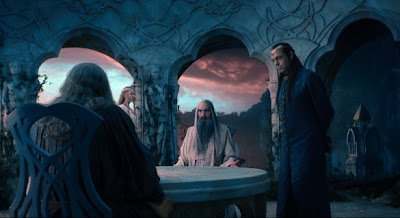
Whilst Jackson and company had to condense the previous trilogy in order to turn it into films, here the decision to expand upon a much slimmer volume leads to a baggy narrative filled with incidental remembrances and incidents either wholly made up or pulled from obscure references in the appendices of LOTR. This accounts for why we spend fifteen minutes or so watching Sylvester McCoy, as Radagast the Brown, mug his way around a forest, on a rabbit-pulled sled, saving adorable CGI hedgehogs from god knows what. It's all entirely pointless. As is the scene in which Gandalf (Ian McKellen), Galadriel (Cate Blanchet), Elrond (Hugo Weaving) and Saruman (Christopher Lee) meet up to have a conversation that isn't in the book at all - much like half those characters - just so they can hint at the grim future events previously seen in a separate set of films. It's fan service for a film made less than ten years ago and on a huge budget. In fact, it's basically the last ten minutes of 'Revenge of the Sith' all over again - and that's probably the best way to describe this entire film, as it attempts to play off nostalgia rather than doing anything new.

Jackson's 2nd unit again attempt to dazzle us with grand helicopter shots of Great Men walking across New Zealand's mightiest mountains, but it feels like a greatest hits re-run - ironically making it the exact opposite of inspirational. Even the riddle sequence with Gollum (Andy Serkis), which is closely lifted from the book and forms the film's highlight, is stretched out and provides too many opportunities for Serkis to riff and showboat, capitalising on his character's popularity, with straightforward storytelling never the film's primary motor.
The increased length of the piece also means that, this time around, we aren't spared adaptation of Tolkien's song/poems (the bits you traditionally skip over when reading the books). And so the Dwarves sing a jaunty washing up song like something out of a Disney parody and then they hum an ominous hymn with uncomfortable earnestness. Later the Elves gaily prance and play the pan pipes and serve vegetarian food and speak in breathy tones and dare you to smash them in the face with a rusty spade. It's all quite high on it's own imagined cultural significance and emotional power, yet that doesn't stop the filmmakers from filling the screenplay with awful jokes and slapstick comedy that would make 'Attack of the Clones' era C-3P0 die of shame. Literally the gags include: small man on a horse and fat man eating food (and later: fat man climbing tree).
I just posted this on Facebook, but I think it's a decent summation of this review and my feelings for the whole 'Lord of the Rings' movie oeuvre:
The wikipedia entry for The Hobbit (book) sums up the difference between Tolkien and Peter Jackson beautifully: "Beorn never actually shape-shifts between man and bear-form during the narrative of The Hobbit book: he is encountered in both forms, but his actual transformation appears "off-screen", away from the point of view of the main characters. Comments made by [special effects company] Weta Workshop indicate that in the adaptation, Beorn's transformation from man to bear will be a major special effects sequence." And probably one lasting twenty minutes accompanied by soft-focus and pan pipes and Enya set in the idyll of a cheese ad and filmed on top of a mountain, as captured by a 2nd unit helicopter crew.On the positive front, Martin Freeman makes for an appealing Bilbo Baggins and does a very good (and subtle) impression of Ian Holm - who plays the elder version of the character, in the previous films and at the beginning here. Much like Ewen McGregor in 'The Phantom Menace'.
NOTE: I wasn't able to see the film in the higher frame-rate that's attracted so much negative criticism, so I couldn't possibly comment on that. However, I think the 3D is pretty good, for whatever that's worth. Clearly shot with stereoscopy in mind and never gimmicky.

'Alps' - Dir. Giorgos Lanthimos (15)
Speaking of directors coasting of memories of their previous films, Greek filmmaker Giorgos Lanthimos channels a lot of what made 'Dogtooth' so great into his follow-up, which follows a group of people who impersonate deceased loved ones in order to aid the grieving. The strange, stilted style of dialogue, phrasing and delivery continues here, as does his clinical, cold and detached aesthetic. Yet it doesn't work so well a second (or third, for those who saw the risible copycat that was 'Attenberg') time, perhaps chiefly because the sterility of 'Dogtooth' seemed entirely appropriate in the context of a story about adult-children who had never left the house and consequently had been unable to socialise in a normal way. Watching that film you could imagine that outside the gates of their sheltered family home you'd find a normal, recognisable world. Yet 'Alps' makes that stylistic choice feel like an affectation rather than commentary. So it's a follow-up that not only borrows heavily from a previous work but also diminishes it by association.
Whereas 'Dogtooth' seemed theme-rich and entirely clever, 'Alps' feels aimless and hollow: all style. There are moments where it really works - where the disconnected protagonists with their monotone voices say and do things which are really funny - but it's difficult to care overall. I'm at a loss for what it's about, to be completely frank. It might be saying something about acting as a profession: positing the trite idea that actors are all lost and shallow people without identities, who perform out of a desire to become somebody else and to please people. In this case becoming not only someone other than themselves, but doing it to please another and in doing so live vicariously off that affection.
Or perhaps, with its repeated a theme of dominant male characters (like 'Dogtooth', 'Alps' has a few violent patriarchs), it's saying something about the role of women in society? Pressured into conforming into various roles and so forth. A reading supported by the opening scenes which focus on female characters whilst disembodied male voices bark instruction. But in either case, it isn't effective or particularly thought-provoking, since it's hard to care at all when the characters themselves are so remote and unaffected.

'The Hunt' - Dir. Thomas Vinterberg (15)
Danish Dogme 95 pioneer Thomas Vinterberg directs the stellar talent that is Mads Mikkelsen in a taught and gripping drama about a primary school teacher in a small village who is (wrongly) accused of sexual assault by a child in his care. To make matters worse, the little girl in question is his best friend's daughter, very much leaving him without friends in town where his reputation goes from charming, eligible bachelor to paedo scumbag overnight. It's immensely frustrating to watch as a good man's reputation is disintegrated without reprieve or the hint of redemption, though that unhappy scenario does at least afford Mikkelsen the opportunity to give another stunning performance in a year in which he has also starred in the excellent 'A Royal Affair'.
A hard watch but a timely one, in an age where paedophile moral panic is at its greatest and media witch hunts routinely assassinate the character of public and private individuals. What makes the film so strong is that you believe that this one lie - spoken in anger by a troubled child - is all it would take to turn everyone you know against you and totally ruin your life as you know it. Perhaps the message of 'The Hunt' is that we shouldn't be so quick to pass judgement and join a hate mob based on hearsay and speculation - even if it seems to be coming from a source of authority: here in the guise of the well-meaning head mistress to whom the lie is first told. Though social media doesn't factor here, it is easy to relate this story to the world of Facebook and Twitter where such band-wagon jumping campaigns are able to gather steam like never before and with increasing frequency.
Perhaps this is why we, curiously enough, never see the trial or the justice system in action during 'The Hunt', with that taking place during a rare stretch of the film in which Mikkelsen is absent. This is a film about mob rule, in which guilt is assumed the moment the accusation is made and sustained even when all the facts go against it. In that way it would make a good companion piece to the similarly themed American film 'Doubt', though scenes of the character's day to day life in town following the trial reminded me most of Tilda Swinton's guilt-wracked mother in the aftermath of the events of 'We Need to Talk About Kevin' - incidentally, another film that deals with heinous culturally taboo crime perpetrated against children.

'Seven Psycopaths' - Dir. Martin McDonagh (15)
The most common complaint I've heard directed at 'Seven Psycopaths' is that it isn't as good as writer-director-playwright Martin McDonagh's earlier 'In Bruges' - and it isn't. But then what is? The main thing is that, whilst the film is certainly a little baggy and unfocused, it is still riotously funny. It stars Colin Farrell as probable author insert Martie - a screenwriter struggling to write a film out in LA, joined by Sam Rockwell as his actor best friend Billy and Christopher Walken as Hans, a quiet and philosophical religious man who makes a living from stealing and subsequently returning rich peoples' dogs. However the trio become enemies of a gangland psychopath played by Woody Harrelson when Billy steals his prized Shih Tzu and attempts to ransom the dog back. Things get messy, with tragic consequences as Hans and Martie are pulled into the conflict. All the while Martie is gathering material for his screenplay: 'Seven Psychopaths' - which becomes a sort of film within the film/self-fulfilling prophecy a la 'Adaptation'. And Tom Waits is in it too.
It's frequently hilariously funny, with Rockwell and Walken both particularly brilliant and Farrell clearly relishing working under McDonagh again, not least of all because this is a rare American film in which he is allowed to retain his Irish accent. A sequence in which Rockwell gives his account of how the shoot-out at the end of the film should play out is particularly inspired and brilliant and McDonagh's screenplay is every bit as uncompromisingly darkly funny as 'In Bruges', even if it misses the smaller scale two-men on the road setting. It's perhaps too big and there are too many characters, with the connections between some of them fairly tenuous, but you can't fault the writer for ambition. And if that sounds like a contradiction of my above review of 'The Hobbit', then chalk that up to 'Seven Psychopaths' being half as long and infinitely more fun to watch.


