Showing posts with label Captain America. Show all posts

Sunday, 28 December 2014

My Top 30 Films of 2014: 20-11

Films 30-21 on the list can be found here.

20) Captain America: the Winter Soldier, dir. Anthony Russo & Joe Russo, USA

What I said: "[It's] is tonally very different to the rest of the Marvel Studios oeuvre to-date... this one is more of a conspiracy thriller and - without going all Nolan Batman and jettisoning fun and colour - it's a comparatively gritty and grounded affair. Much like the Ed Brubaker run in the comics, which introduced this film's antagonist the Winter Soldier, it does a neat job of including lots of outlandish and far-fetched comic book elements - from the winged exploits of Anthony Mackie's Falcon to the newly computer-bound consciousness of Toby Jones' Arnim Zola - with something altogether more grounded and grave... The action is hard-hitting, well choreographed and visceral, whilst the main players exhibit the sort of good chemistry needed to make all the bits in between fun. Especially Chris Evans in the starring role - an actor who imbues the title character with as much subtle depth as he does obvious decency."


The increasing confidence of Marvel Studios was demonstrated earlier this year - even before they released a wacky sci-fi comedy about a wise-cracking racoon - as the Disney-owned comic book moguls proved how versatile their superhero properties can be whilst remaining in a shared cinematic universe. 'Winter Soldier' is a sequel to both the nostalgic, World War II-set Joe Johnston movie 'The First Avenger' as well as Joss Whedon's mega-blockbuster 'The Avengers', two very distinct superhero movies with vastly different tones, and it succeeds in following both whilst again being completely different: in this case a 70s-style espionage thriller. It's a very good one, even if it has to go headlong into an explosion-fest for the final 20 minutes, with a tense atmosphere and - in Chris Evans and Scarlett Johansson - two terrific lead actors.

19) Two Days, One Night, dir. Jean-Pierre Dardenne & Luc Dardenne, BEL/ITA/FRA

What I said: "Subsisting on the sort of tight concept I tend to love, the Dardenne brother's latest stars the always-excellent Marion Cotillard as Sandra: a severely depressed woman who is ready to return to work only to discover that her colleagues have voted her out of a job [after] her bosses decide to cut costs by making staff choose between Sandra and their annual bonus payment... When Sandra convinces them to recall another vote after the weekend she has the titular timeframe to convince each individual to back her over personal financial gain... It's an interesting moral question which the film explores in all its complexity as Sandra visits each person in turn and makes the same basic argument with mixed results... Perhaps the film treats an attempted suicide too casually and Sandra's apparent defeat of bed-ridden depression by the credits is a little too sudden, but this is a complex and original film which deserves to be seen. Especially as the Dardenne's again display an impressive knack for marrying social realism with something more hopeful and optimistic than that term usually suggests."


One of the best ideas for a movie this year, there's not a lot to dislike about this small-scale, entirely humanist drama which essentially features a dozen versions of the same conversation all playing out differently. It could easily be a little slight but instead Marion Cotillard helps imbue the whole thing with a consistent and palpable edge of emotional turmoil that prevents it from getting stale.

18) Her, dir. Spike Jonze, USA

What I said: "You meet somebody for the first time and instantly hit it off. As feelings develop, you nervously pursue a romantic relationship. The early days of that relationship are filled with laughter and a spirit of adventure - you never want to be apart from that person, who now occupies all your waking thoughts. Months go by and you settle into a bit of a muted groove. You get a phone call from that person whilst at work, and they can tell you don't want to talk. It's become slightly awkward all of a sudden, or at least there's a strange distance developing between two supposedly intimate people. Eventually it ends, possibly when one of you has outgrown the other. In Spike Jonze's 'Her', Jaoquin Phoenix's Theodore Twombly experiences something exactly like this with Samantha (portrayed by Scarlett Johansson) - the difference being that Samantha is a sophisticated OS (operating system) rather than a traditional human partner. But the rhythms and patterns and core experience of the relationship seem to be exactly the same in Jonze's non-judgmental and highly plausible account of the not too distant future."


A movie released last year in the US and included in the Oscars last March, so it feels ancient at this point, but (with the exception of 'Snowpiercer' which has still not been released here theatrically) I base my list on UK release dates, so here it is! 'Her' is like a schmaltzy episode of Black Mirror, which I mean in a good way. There's shades of grey and room for debate about how healthy or real Joaquin Phoenix's romance with a Scarlet Johansson voiced AI is, but mostly it's an uncommon story of optimism about technology and the future. It's non-judgemental and sweet whilst still being smart.

17) The Wind Rises, dir. Hayao Miyazaki, JAP

What I said: "In almost every Miyazaki film to date his passion for machines, engines and, especially, aircraft has loomed large... so in many ways, though it is less fantastical and magical (and it does still have those qualities stylistically), 'The Wind Rises' does have the air of a great passion project and represents an extremely personal sign-off. In the dream sequences, which are many, Miyazaki indulges his childish imagination, creating wondrous and impossible aircraft and contriving to have two of his heroes converse in what is ultimately aviation hobbyist fan fiction... Miyazaki's obsessions enter the film in other ways too, with Jiro's drive and single-minded dedication to pursuing his chosen profession, perhaps at the expense of his personal life, another recurring theme... At its core it's a film about choosing to pursue your creative dream even if it might be appropriated for nefarious purposes. Some have criticised the director for not going far enough to address the fact that Horikoshi ultimately designed efficient engines of war and destruction which were quickly put to devastating purpose in expanding the Empire of Imperial Japan... That said, given some of that negative reaction I was surprised how much the oncoming war underpins the entire film from its opening dream sequence (interrupted by bombs and destruction) to it's bittersweet final moments as Jiro finally perfects his plane only to be suddenly overwhelmed by the reality of what it will be use for next."


It's not Miyazaki's best film (in fairness it faces tough competition for that title) but he's never made anything so obviously personal. Nominally it's an animated biopic, about a controversial aviator no less, but it isn't hard to see parallels between the loosely adapted life of Jiro Horikoshi and Miyazaki's own - with it very easy to substitute famed aircraft inventor with famed animation director. Seeing as fictionalised regrets about his personal life take centre stage near the end, perhaps this has more to say about the filmmaker's own reflection on a life lived in obsessive pursuit of dreams. Being the legendary filmmaker's final work before retirement (though he said that a decade ago) it seems fitting that it's his most reflective and melancholic. Special mention must go to the film's understated and quietly terrifying depiction of the Great Kanto Earthquake, which stands out as one of the finest sequences Miyazaki ever devised.

16) American Hustle, dir. David O. Russell, USA

What I said: "It's been trailed like a derivative, Scorsese-influenced crime film, but David O. Russell's 70s-set 'American Hustle' is best viewed as a black comedy. Every brilliant performance, every hackneyed line, every haircut, every sequence is a little warped, a little odd - from Jennifer Lawrence doing the housework whilst miming along to Live and Let Die to Christian Bale's pot-bellied, comb-over sporting conman seducing Amy Adams in the lost property room of his dry cleaning establishment. That doesn't mean to say it isn't a decent and occasionally tense crime film, with its share interesting twists and turns in the plot, but it reminded me more of the Coen Brothers than 'Goodfellas', being about a group of variously flawed, morality bereft shysters who are often as pathetic and incompetent as they are resolutely unlikable. It's saying something that Jeremy Renner's charismatic local mayor is the only one of the bunch with any integrity and he's the victim at the centre of the big con."


As with 'Her' this is another one of those movies from the last Oscars that just about slips onto this year's list with it's early 2014 UK release date. Viewed as this year's answer to 'Goodfellas' it's a little overblown and trivial-seeming, but seen as (I think intended) as a black-comedy populated by uniformly messed-up, unlikable characters I think it works brilliantly. It is operatic and over the top but Jennifer Lawrence's housekeeping scene, not to mention everything to do with the "science oven", is amazing. It's also great to see a movie that isn't completely cynical about politicians and their intentions, which is a real rarity in popular culture at large. Jeremy Renner is corrupt as the flashy, local mayor, but he is also the nearest thing the film has to a good guy. He might get his hands dirty but he's doing it with solid gold intentions. It's easily the most interesting part he's had since 'The Hurt Locker' made him a star.

15) X-Men: Days of Future Past, dir. Bryan Singer, USA

What I said: "They have fixed the X-Men movie franchise and in a classy way that makes it possible to make new movies with the 'First Class' cast without fear of bumping into any of the old baggage that once lay in the way. It's a smart movie that celebrates the past, but definitively makes way for the future. It's a rare sequel/prequel that actually elevates everything that came before and makes it all seem, finally, like it all sort of makes a certain fuzzy kind of sense. I like problem movies, which is to say movies which seem to have set themselves a problem and solved it... this movie seems to have been conceived as a way to address continuity mistakes and to help rejuvenate and reboot the franchise. It's a placeholder movie, paving the way for new stories with a couple of hours of energetic rebuilding work, basically. Yet it also works on its own terms somehow, and is fast-paced, fun and contains terrific fight scenes not matched by any X-Men movie and, possibly, by any superhero movie to date. For the first time I'm excited to see a new X-Men movie... It's not often movie number seven is the best in the franchise, but Fox's X-Men just got really good and it only took about 15 years to get there."


This probably benefited from sub zero expectations on my part. I've never been overly enthusiastic about Fox's X-Men franchise - with its drab, leather-clad versions of colourful comic book heroes and Wolverine-centric narrative - even disliking the widely praised 'First Class'. Yet Bryan Singer's return to the franchise he launched over a decade ago (and without which there might never have been a Marvel Studios or Sony Spider-Man franchise) has proven hugely beneficial, with the director using a time travel story as the vehicle to strip away almost everything terrible that happened in the previous movies (most notably the events of 'X-Men: the Last Stand') and leave the whole thing in a place where I'm actually excited to see what they do next. Also, between the slowed-down Quicksilver (Evan Peters) set-piece and the imaginatively implemented portal-opening powers of the obscure Blink (Fan Bingbing) this movie had the stand-out action moments of 2014. At least outside of 'The Raid 2' (if you're curious: it didn't make my list on account of being way too long and not interesting at all outside of the punching scenes).

14) Under the Skin, dir. Jonathan Glazer, UK/USA/SWI

What I said: "A masterclass in editing and sound design, Jonathan Glazer's 'Under the Skin' stars Scarlett Johansson as an alien who takes on the form of a human female and uses this guise to seduce lonely, socially isolated men, who she then traps and harvests for... some reason probably much clearer to those who've read the Michel Faber novel. Though I'd argue the question of why she captures these men and what exactly becomes of them is a secondary concern in a film that works primarily on the level of visceral, sensory experience. In lieu of much specificity or explanation, this is simply the story of an outsider assimilating and attempting to fit in (albeit with nefarious intent), learning a certain degree of compassion for humanity and gradually becoming more unsettled by and attached to her newly acquired body...Moments of intense body horror and a heart-pounding finale combine with this playful casting and Glazer's technical mastery to create something truly memorable - potentially even destined for cult status."


Strange, unsettling, almost unknowable. I haven't read the book but I suspect, like a Kubrick movie, the novel might have been more of a loose jumping off point than the basis of a strict adaptation. I might be wrong, but this movie is '2001' levels of oblique in a way I can't imagine the book being. Nothing is really explained and it's not certain at times what is literally taking place, though that doesn't make the imagery any less haunting or powerful. The scene on the beach, with the baby left on its own, is easily one of the most shocking of the year. Meanwhile, Scarlett Johansson disappears so convincingly into her role as an alien that whole sequences appear to have been shot with the mega-famous actress blending in entirely amongst an unsuspecting public. It's also responsible for some of the year's best moments of horror, even though it isn't really a horror movie, with lots of nightmarish stuff happening with bodies.

13) The Past, dir. Asghar Farhadi, FRA/ITA/IRN

What I said: "In a style familiar to fans of his earlier films, such as 'A Separation' and 'About Elly', director Asghar Farhadi's maiden effort outside of Iranian cinema is still a tightly wound and faultlessly humane drama, peppered with extraordinary revelations and populated by nuanced and fully-formed characters who are lead by circumstance to ponder profound ethical questions... After a half-dozen twists and turns we come to understand the various conflicting points of view all involved in the unfolding crisis, which this time revolves around the theme of forgiveness and moving on from what has happened before - of leaving an old life behind as you head into another. Something which none of the characters can quite face doing, at least without difficulty and heartache. Nobody in contemporary cinema (at least that I know of) is quite as brilliant as Farhadi when it comes to creating ensemble casts in which every character is so complex and well drawn. As with his other films, the four central characters here - along with another three or four supporting cast members - are each worthy of audience investment and sympathy, portrayed and written with great compassion."


Filmmaker Asghar Farhadi ventured outside his native Iran to make this French-set drama, but all of his hallmarks and concerns are still palpable with trademark focus on multifaceted, complex characters struggling with questions of morality. It's not quite got the gut-punching hook of his masterpieces 'About Elly' and 'A Separation' but it's still top-tier drama with faultless performances from its ensemble cast. I'll take a minor Farhadi movie over the best work of a lot of other filmmakers every single time.

12) The Grand Budapest Hotel, dir. Wes Anderson, USA/GER

What I said: "If the move from 'Bottle Rocket' to 'Rushmore' onto 'The Royal Tenenbaums' marked a gentle progression of his style, Wes Anderson's subsequent films - 'The Life Aquatic', 'The Darjeeling Limited' and even the animated 'The Fantastic Mr. Fox' - took the recognised tropes of that style and crystallised it into something that often flirted with self-parody. Then 'Moonrise Kingdom' came along and seemed to indicate a maturation of his by now well established visual motifs, storytelling themes and even the highly stylised performances drawn from his familiar band of recurring actors. It was a refreshing change of pace... At a first glance his latest, 'The Grand Budapest Hotel', superficially resembles a return to the larger-scale, ensemble-driven fare that directly preceded 'Moonrise Kingdom', though it's actually a subtle synthesis of the two being expansive, broad, imaginative and, well, grand, whilst also being restrained, focused and tightly wound... Even as its focus remains on character detail and small-scale interactions, it's easily the most traditionally plot-heavy of Anderson's films - helping again to separate it from what's come before - and, even if death and grief play a part in all but one of his other movies, it's also one of the saddest - with an overriding feeling of entropy and a sense of sadness at the passing of time."


As a long-time fan of Wes Anderson his films have always touched me on an emotional level that I gather they just don't for a lot of people. I get that: they could easily seem cold and detached. Yet the emotional stuff is usually in the details, like Anthony agreeing to wear a yellow jumpsuit in 'Bottle Rocket' when he sees the guileless and enthusiastic Dignan faced with the unbearable cynicism of Futureman. Or Steve Zissou throwing away his earring petulantly when he overhears somebody laughing at it, only to sheepishly pick it back up again moments later. Or all of 'Moonrise Kingdom'. But the emotional stuff is much more evidently to the foreground in 'The Grand Budapest Hotel', which has a consistent elegiac tone and features more than one death. Told from what might be a fourth person perspective, coming decades after the events of the narrative, in a world in which the titular hotel is crumbling into the ground, the whole thing is really very sad indeed. Something punctuated by Ralph Fiennes extremely funny and charismatic central performance as the last of a dying order.

11) Guardians of the Galaxy, dir. James Gunn, USA

What I said: "When the film was announced a couple of years back, it was regarded as a make or break movie for Marvel's growing cinematic universe: can the studio that started with the (relatively) gritty and grounded 'Iron Man' convince us of a talking raccoon and tree double-act? There was no going back and I'm sure the spectre of Jar Jar Binks must have loomed over the project, at least for nervous studio executives. Well they've more than gotten away with it and, after this, you'd have to wonder if there's too much in the company's comic book continuity they couldn't now bring to the screen with well-placed confidence."


In terms of pure enjoyment at the movies this year, 'Guardians of the Galaxy' would be right at the top of the list. That's not to say, with a note of condescension, that James Gunn's Marvel blockbuster is merely 'enjoyable' rather than 'good' - it is a very good film all ways around (great comic performances, entertaining action, a whip-smart script, stand-out soundtrack) - just that on balance the immediate thrills and (multitude of) laughs have been eclipsed by a bunch of films which gave me a lot more to think about and talk about after the credits. That's not to denigrate 'Guardians' though. It's definitely a contender for the best Marvel comics adaptation to-date, my teary-eyed love of 'Captain America: the First Avenger' notwithstanding, and given the consistently high quality of those movies I mean that as high praise indeed.

Come back soon for the top 10.

Wednesday, 2 April 2014

'Captain America: the Winter Soldier', 'Under the Skin', 'The Past', and 'Starred Up': review round-up


'Captain America: the Winter Soldier' - Dir. Anthony & Joe Russo (12A)

A sequel to both Joe Johnston's charmingly Spielbergian WWII-set origin story 'Captain America: the First Avenger' and Joss Whedon's superhero team-up crowd-pleaser 'The Avengers', 'Captain America: the Winter Soldier' is tonally very different to those films and indeed to the rest of the Marvel Studios oeuvre to-date. Directed by the Russo brothers, this one is more of a conspiracy thriller and - without going all Nolan Batman and jettisoning fun and colour - it's a comparatively gritty and grounded affair. Much like the Ed Brubaker run in the comics, which introduced this film's antagonist the Winter Soldier (alluded to by the writer's cameo as one of the scientists behind his creation), the film does a neat job of including lots of outlandish and far-fetched comic book elements - from the winged exploits of Anthony Mackie's Falcon to the newly computer-bound consciousness of Toby Jones' Arnim Zola - with something altogether more grounded and grave.

The casting of Robert Redford as the political face of world peacekeeping force SHIELD, Alexander Pierce, is one of many nods to the classic thrillers of the 70s, as this film delves into more morally grey territory than its predecessor. Where once there was a struggle between the 'greatest generation' and the Nazis, Cap (Chris Evans) now finds himself in a world he doesn't recognise and which has seemingly abandoned the principles of freedom he fought so hard for in the 40s. Now SHIELD is starting to look like something more tyrannical and oppressive than it seemed when Nick Fury (Samuel L Jackson) first burst onto the scene at the end of the first 'Iron Man' film - creating huge, automated airborne battleships capable of detecting and erasing threats before they happen: in an obvious nod to both modern drone warfare and the NSA surveillance scandals of the last few years.

Against this background is a well-crafted superhero romp, which is also something of a mini-Avengers team-up as Cap unites with the aforementioned Falcon and Scarlett Johansson's espionage specialist Black Widow to stay one step ahead of SHIELD and discover the truth behind the agency's corruption - thwarted at every turn my a mysterious new enemy with a link to Cap's own past: the Winter Soldier (Sebastian Stan). The action is hard-hitting, well choreographed and visceral, whilst the main players exhibit the sort of good chemistry needed to make all the bits in between fun. Especially Chris Evans in the starring role - an actor who imbues the title character with as much subtle depth as he does obvious decency.


'Under the Skin' - Dir. Jonathan Glazer (15)

A masterclass in editing and sound design, Jonathan Glazer's 'Under the Skin' stars Scarlett Johansson as an alien who takes on the form of a human female and uses this guise to seduce lonely, socially isolated men, who she then traps and harvests for... some reason probably much clearer to those who've read the Michel Faber novel. Though I'd argue the question of why she captures these men and what exactly becomes of them is a secondary concern in a film that works primarily on the level of visceral, sensory experience. In lieu of much specificity or explanation, this is simply the story of an outsider assimilating and attempting to fit in (albeit with nefarious intent), learning a certain degree of compassion for humanity and gradually becoming more unsettled by and attached to her newly acquired body.

Johansson is perfectly cast in the role, especially as the film is set in Scotland and she adopts a clean, regionally non-specific English accent when talking to her co-stars - mostly comprised of non-actors, supposedly oblivious (at least at first) to the fact they were part of a film. The audience is aware that she's a Hollywood movie star pretending to be English and, even if they don't consciously realise it, those she approaches must also have sensed this unease with and disconnect from the star in their midst: familiar yet just different enough to sow seeds of doubt. She's an impostor playing an impostor and it works brilliantly, especially as she glides around British high streets and shopping centres in her black wig and incongruous fur coat.

Moments of intense body horror and a heart-pounding finale combine with this playful casting and Glazer's technical mastery to create something truly memorable - potentially even destined for cult status.


'The Past' - Dir. Asghar Farhadi (12A)

In a style familiar to fans of his earlier films, such as 'A Separation' and 'About Elly', director Asghar Farhadi's maiden effort outside of Iranian cinema is still a tightly wound and faultlessly humane drama, peppered with extraordinary revelations and populated by nuanced and fully-formed characters who are lead by circumstance to ponder profound ethical questions. Ali Mosaffa stars as Ahmad, an Iranian man who travels to France to finalise a divorce from his wife Marie (Berenice Bejo, star of 'The Artist') from whom he has been separated for four years. Whilst there he is immediately thrown, quite against his will, into an unfolding family drama that he otherwise has nothing to do with, as Marie begs him to have a heart-to-heart with her eldest daughter from a previous marriage, Lucie (Pauline Burlet), in order to find out why she's taken against her mother's new partner Samir, played by 'A Prophet' star Tahar Rahim.

After a half-dozen twists and turns we come to understand the various conflicting points of view all involved in the unfolding crisis, which this time revolves around the theme of forgiveness and moving on from what has happened before - of leaving an old life behind as you head into another. Something which none of the characters can quite face doing, at least without difficulty and heartache. Nobody in contemporary cinema (at least that I know of) is quite as brilliant as Farhadi when it comes to creating ensemble casts in which every character is so complex and well drawn. As with his other films, the four central characters here - along with another three or four supporting cast members - are each worthy of audience investment and sympathy, portrayed and written with great compassion.


'Starred Up' - Dir. David Mackenzie (18)

Muggin' everybody off, and generally causing no small amount of bovva on his cell block, in this gritty British prison movie is rising star Jack O'Connell as damaged, young offender Eric Love - a teenager prematurely moved up to big boy jail because of how violently he behaves. In service of drama, Eric is improbably moved to the same prison, and indeed the same wing, as his equally unhinged father Neville (the always intense and brilliant Australian Ben Mendelsohn) where he comes face-to-face with his past and some the issues which have played a part in his becoming a violent offender in the first place. Without explicitly stating it, there's undoubtedly a history of physical and mental abuse between them that's telegraphed mainly in how O'Connell's body language and demeanor change when confronted by his old man. Apparently known to audiences for his role in teen drama Skins, O'Connell makes an impressive transition to the big screen here: as charismatic as he is frightening and unpredictable.

The central drama concerns how Eric becomes a pawn in a broader game played between a powerful fellow inmate (Peter Ferdinando, who was excellent in the low budget crime film 'Tony'), a crooked and cruel prison warden (Sam Spruell), and a well-meaning volunteer psychologist (Rupert Friend). Friend's psychologist lobbies the skeptical prison establishment to get Eric placed in his self-help group (which they want to see fail for reasons of pantomime vindictiveness), where he can talk through his problems and learn to deal with his emotions without resorting to violence, whilst the prison authorities mostly just want to smash his face in - to the extent where all the police seem like irrational villains. It's the interactions between the various prison staff that ultimately bring the film down, though scenes between inmates (and especially those in Friend's group) are often gripping and compelling.

Thursday, 26 April 2012

'The Avengers'/'Marvel Avengers Assemble' review:


Regular readers of this blog will know that I've long been a shameless, rambling cheerleader for this summer's first major comic book movie, Marvel's ambitious 'The Avengers': a film which brings geek-friendly comic book-style continuity to the big screen in a way never previously considered possible. It's a bold move from the company, recently acquired by Disney, which - had it failed - might easily have sent the entire house of cards tumbling down, risking tentpole solo properties 'Iron Man', 'The Incredible Hulk', 'Captain America' and 'Thor' in the process. In fact combining these heroes in one movie should have been an almighty mess and perhaps one for fanboys rather than the diverse cinema audience required to enjoy global mega-success.

Yet 'Buffy the Vampire' creator Joss Whedon has, as director and co-writer, delivered not only the best Marvel movie to date (not a bad accolade in itself), but also the very best (or at least the most enjoyable) superhero movie ever. It's a relentlessly thrilling and frequently laugh-out-loud funny affair which manages to provide each of its characters just enough to do to avoid feeling like a clumsy bag of cameos. It's a rare beast that exceeds the two hour mark and yet leaves you craving more and, as has been noted by almost all who have seen it thus far, it manages to pull off the feat of making the Hulk interesting. Mark Ruffalo is cast as the irradiated Dr. Bruce Banner/lumbering green rage beast and does an exceptional job both in the flesh, as an anxious and introverted genius, and in CGI mo-cap as the show-stealing titan.


The other Avengers combine well, in terms of their disparate skill sets and distinct personalities. Pleasingly each even finds time to grow and complete their own small arch. Captain America (Chris Evans) is still the guileless embodiment of goodness that struck such a pleasant note in last year's solo vehicle, though now he's learning to assert himself as the natural born leader familiar to readers of the comics. Thor (Chris Hemsworth) remains that slightly haughty man from another world with a penchant for grand, almost Shakespearean turns of phrase, now faced with the embarrassment of having his brother Loki (Tom Hiddleston) at the head of an alien invasion of Earth. And Robert Downey Jr is still a terrific force of nature as cocky billionaire, playboy philanthropist Tony Stark (AKA Iron Man), here learning a thing or two about subjugating himself for the greater good whilst chiding his more obviously noble teammates.

Even Black Widow and Hawkeye (Scarlett Johansson and Jeremy Renner), who have yet to benefit from their own solo features, are given ample time to demonstrate their prowess and (though not as developed as the others) both feel like interesting and valuable parts of the ensemble. This time we even get to see a little more of Samuel L. Jackson as eye-patch sporting S.H.E.I.L.D director Nick Fury, getting involved in the action and playing a genuine part in events as opposed to being a bombastic guest star in another person's adventure. Alongside Fury are the returning fan favourite Agent Coulson (Clark Gregg) and new supporting character Maria Hill (Cobie Smulders) - who doesn't get a lot to do but whose inclusion presents an interesting option for writers of the probable sequels, for those that know her from the books.


'The Avengers' succeeds on every level it's trying to and gets everything right when it comes to making the ideal comic book movie. The various superpowers are used (and combined) imaginatively, the balance between action and dialogue is perfect, and Hiddleston's villain is deliciously charismatic, every bit as entertaining as the heroes. The gags work and even moments of pathos find the target when they arrive. It's a very different beast to Christopher Nolan's 'The Dark Knight' - commonly acknowledged as the holder of the "best comic book movie" crown - being unabashed, escapist fun rather than a rumination on The Patriot Act or an exploration of how a costumed vigilante might really be viewed by the world as we know it. But in being so proud of its pulpy routes, giving us daring deeds painted broadly and in bright colours - as Norse gods battle men in Star-Spangled spandex - it's arguably a far braver and much tougher movie to get right. And Whedon gets it completely right, painting this epic battle on a suitably large canvas.

It helps that Whedon, a past writer of Marvel comics (notably an acclaimed run on Astonishing X-Men) knows and loves this world. From a fan point of view, he ensures that Captain America takes the lead rather than the more commercially popular Iron Man and that S.H.E.I.L.D's motives are uncertain, with the organisation not truly trusted by the gang. He knows that fans want to see Thor smash his hammer upon Cap's shield and see Iron Man hold his own against the Asgardian prince and promptly delivers this spectacle without it seeming like the most cynical act of fan service, probably because he wants to see all this just as much.

'Marvel Avengers Assemble', known internationally as 'The Avengers', is out now in the UK, rated '12A' by the BBFC.

Thursday, 8 March 2012

Splendor Cinema Podcast #89: 'The Avengers' Retrospective


As mentioned last week, I am pant-wettingly excited about the upcoming 'Avengers' movie. Now called 'Avengers Assemble' in the UK, it's out here on the 27th of April and is the climax of an ambitious (and, yes, potentially highly lucrative) project which will see comic book style continuity coming to the big screen adaptations; uniting the heroes of 'Iron Man', 'Thor', 'Captain America' and 'The Incredible Hulk' under the banner of a super-powered dream team headed by Samuel L. Jackson AKA Nick Fury: Agent of Shield.

In fact, for those looking to get equally psyched about the whole thing, I've recorded a podcast about these movies, which you can download in iTunes here or stream here. I've talked/written about all them at length previously, so I'll just briefly sum up my feelings on each of them here and then say a little bit about what I'm hoping for from 'The Avengers' next month.


'Iron Man' (2008): Exciting, with an incredibly charismatic lead performance (from Robert Downey Jr), Jon Favreau's movie established the tone for the Marvel Cinematic Universe to date and its success made the whole 'Avengers' thing (first teased in a post-credits sequence on the original movie) possible. It's inherently right-wing, with its privitised vigilante using his lucrative weapons contractor business to sock Afghan terrorists in the jaw, but it was a thrilling movie - albeit with a weak finale. What a waste of Jeff Bridges, though wasting talented actors as thinly developed villains is a trend that would continue over the next two Marvel movies.


'The Incredible Hulk' (2008): Far less successful (commercially and artistically) was Louis Leterrier's Ed Norton starring attempt to re-boot the Hulk following Ang Lee's much derided earlier version. It's brash, ugly and a little incoherent, with Norton adding little of the acting heft to Bruce Banner that we might have hoped for - particularly as he helped write the script. Tim Roth is likewise wasted as the baddie, whose evil equivalent of the Hulk (Abomination) contributes to the boring (yet oft-repeated) spectacle of two CGI monsters punching each other a lot. On a side note, the film does at least feature a Downey Jr cameo, as Tony Stark comes to discuss the "Avenger Initiative" with William Hurt's General Ross. Which is nice.


'Iron Man 2' (2010): Favreau's sequel is, to put it kindly, a mixed bag. On one hand, Mickey Rourke is underused as the villain (Whiplash), and there is too much fluff in there building up the Avengers movie which does nothing to advance the main plot (the coffee shop scene with Jackson's Fury and the introduction of Scarlett Johansson as Black Widow). Yet on the other, it's nice to see Lt. Col. Rhodes (Don Cheadle replacing Terrence Howard) getting the chance to don his own suit and become War Machine. Sam Rockwell is also good comedic value as Stark's business rival Justin Hammer. A government committee into Stark's private use of his advanced weaponry is also interesting, even if the film's thesis is that the technology is better off in the hands of a private individual than Big Government (as represented by Garry Shandling). There's also the first real look at Tony Stark's legendary descent into alcoholism (which, in the comics, represented the first time a mainstream super hero suffered such a real world problem) A bit of a mess of a movie but there's plenty to enjoy.


'Thor' (2011): Kenneth Branagh did a lovely job with Thor, successfully turning one of the most outlandish characters - a Viking deity from outer space, with a magic hammer and a suit of armour - into someone who could reasonably fit in with Iron Man and company. As a stand alone movie it's probably the strongest of Marvel's efforts to date, boasting powerhouse performances from Anthony Hopkins, Tom Hiddleston and Natalie Portman, as well as a star-making turn from Chris Hemsworth as the titular hero. It looks gorgeous, it's pretty funny, the human drama actually has gravitas, and the project overall seems imbued with immense love and respect for the source material. The only slight gripe is a clunky scene in which Jeremy Renner's Haweye is established in a few otherwise needless shots. But that's a very small gripe.


'Captain America: The First Avenger' (2011): I fell in love with Joe Johnston's WWII-set film the first time I saw it and have seen it several times since. Not in the least bit annoyingly patriotic or militaristic, the film set up Steve Rogers (Chris Evans, who previously played Marvel's Flaming Torch in the ill-received Fantastic Four movies) as a really nice, sweet-natured guy who doesn't want to kill Nazis: he just doesn't like bullies. Despite a few commonly acknowledged flaws (an ending, and montage-reliant second act, geared more towards setting up 'The Avengers' than serving this one movie) the film actually makes me a little emotional, with its kindness and cynicism-free attitude. As a result it was one of my very favourite films of last year.


On 'Avengers Assemble': My hopes are set very high for this summer's tentpole movie, but here are a few things it has to do to avoid being a disappointment:
  • Black Widow and Hawkeye, who haven't had the benefit of their own movies, need to be developed - potentially as a duo (seeing as how the are frequently paired up in the comics).
  • This should add the human drama/character growth element that ought to be missing regarding the remaining heroes: we've already had entire movies introducing these guys so - beyond the issues that might be thrown up from their interactions together - I don't want to be told again who any of them are. With the possible exception of Bruce Banner, who has a new actor (Mark Ruffalo) and so perhaps needs to be re-established.
  • However each character does have their own ready-made sub-plot waiting to bear fruit: Iron Man needs to learn to sacrifice his ego for the good of the team; Captain America will doubtless be dealing with the whole "everyone I ever knew and cared about is dead" thing; Bruce Banner needs to get control of his powers; whilst Thor has to deal with the fact that the film's super villain is his brother, Loki (Tom Hiddleston) - which might lead to some resentment from his teammates, as well as calling his loyalty into question.
  • I hope writer/director Joss Whedon doesn't make the characters speak like teenagers. He needs to retain the characters' already established voices, whilst resisting the no doubt strong temptation to make Cap more cynical. sarcastic and snarky this time around. If he has him quipping one-liners, that'll pretty much ruin the whole movie for me. A lot rests on the continuation of Steve Rogers as an unshakable pillar of integrity and niceness.
  • There needs to be more to the movie than the trailers have so far suggested. Is Loki the only baddie? He's pretty awesome, but I hope not. The Avengers are called together when the odds are stacked too far against any one individual, but we've already seen Thor defeat Loki - so what else is there to this story? Who is behind the gigantic robots and spaceships seen in the trailers? They don't seen very "Asgardian".
  • I'd also like to see some mention or screentime for supporting characters from each individual hero's film. Will Thor be dealing with his unresolved love for Natalie Portman's Earth-based scientist, or are they saving that for his sequel? Will the Warriors Three aid him on this quest in any form and, if not, why not? Or his father, Odin? What of Iron Man's newly equipped buddy War Machine? Surely he should be helping these guys out? I'm sure many of these characters won't feature, but there needs to be some statement of why.
  • Likewise, and at the risk of being a little too cute and contrived, it'd be nice to see some acknowledgment of the fact that the peril New York is facing in this film is not attracting any aid from any of Marvel's other premiere super heroes. The X-Men, Fantastic Four, Spider-Man and Daredevil (to name a few) all live and operate in New York City. So, aside from the fact that Marvel don't own any of their rights as far as movies go, why aren't they lending a hand? It only takes a line.
Anyway, that's the last I'll go on about anything 'Avengers' related until release late next month.

Oh, and here's the German-language trailer which, for massive geeks, contains a few shots previously unseen in English-language versions (I know how sad that sounds... I'm sorry):

Wednesday, 29 February 2012

'The Avengers'/'Marvel Avengers Assemble' trailer:


I'm about as excited for the upcoming 'Avengers' superhero movie as it's possible to be, and the latest trailer (above) has done nothing to diminish my anticipation. In fact, my girlfriend and I are going on holiday to Rome at the end of April and I'm honestly more excited about getting back just in time for the film's April 27th UK release date. Which is pretty sad, I guess.

Now titled 'Marvel Avengers Assemble' on these shores, presumably to avoid confusion with the British 1960s spy series 'The Avengers' (already adapted into a universally panned mid-90s movie), the film sees Captain America (Chris Evans), Iron Man (Robert Downey Jr), Hulk (Mark Ruffalo), Thor (Chris Hemsworth), Black Widow (Scarlett Johansson), Hawkeye (Jeremy Renner) and Nick Fury (Samuel L. Jackson) combining forces to fend off a threat to our planet - with Tom Hiddleston's Loki, brother of Thor, so far the only known villain. If this is a big hit then it could be a real game changer - ushering in a new era of inter-film continuity projects, particularly in the superhero genre. Once Christopher Nolan finishes with Batman this summer, perhaps Warner Brothers will attempt a similar arrangement with the DC heroes?


It's certainly an ambitious move and it remains to be seen whether director/writer Joss Wheadon can make a satisfying individual movie juggling so many characters. Will he feel the need to introduce all the heroes again and, in so doing, undermine the previous movies? Or will the film be inaccessible for those not already versed in the Marvel universe? It's an intriguing problem and I look forward to seeing how (if at all) it has been solved.

With this, 'The Amazing Spider-Man' and 'The Dark Knight Rises' all sharing a single summer, 2012 looks set to be another year dominated by comic book heroes.

Sunday, 18 December 2011

My Top 30 Films of 2011: 10-1

This is the concluding part of my 2011 top 30 films list. You can read the previous entries here: 30-21 and 20-11.

10) Pina, dir Wim Wenders, GER

What I said: "[Wenders'] use of space, the way he stages the action, is just incredible and wholly new, whilst the cinematography and camerawork is beautiful to behold. 'Pina' is a technical masterpiece and a bold piece of work all ways around. Watching it I was struck by how conceivably any film characterised by incredible blocking and interesting use of space would not only work in [3D] but would in fact be enhanced by it... 'Pina' proves there is a place for 3D in the arthouse and in the hands of auteurs."


3D adds depth, obviously, but is that useful and if so how? Its advocates often compare stereoscopy to the additions of sound and colour, yet it seems clearer to us what those advancements have enabled filmmakers to convey from a dramatic or artistic standpoint. A Marx Brothers comedy would simply not work if we couldn't hear Groucho's rapid-fire one-liners, whilst 'The Wizard of Oz' would probably not dazzle us so much if it remained in black and white after Dorothy set foot in the fantasy realm of the title. But, by comparison, what does 3D offer and what do we stand to lose without it? How can the addition of depth be used beyond the initial spectacle, in order to assist a director in telling a particular type of story or giving a very specific experience?

This year 3D has been used by some heavyweight talents, whose movies are perhaps more familiar to arthouse patrons than mass audiences. Werner Herzog used the technique to give us a rare glimpse inside the Chauvet caves in 'Cave of Forgotten Dreams', whilst Martin Scorsese had a lot of fun with its possibilities making 'Hugo' (more on that below). But it's really Wim Wenders who has provided the most compelling evidence that 3D can undeniably add something to a cinema experience that you'd miss greatly if it were taken away. I'd watch most other 3D movies in 2D with minimal complaint, but to me it seems central to what made Wenders' 'Pina' work.

A quasi-documentary, the film is a tribute to the late experimental dance artist Pina Bausch, bringing together a series of dance sequences as performed by her troupe. These expressionistic pieces range from harrowing to comical to downright bizarre and are separated by passionate monologues delivered by those who knew her, talking about Bausch's character and attitude to art. The 3D allows us to appreciate the dances more fully than we might otherwise, giving a proper sense of how the performers negotiate space. Wenders shoots almost every scene from a slightly elevated angle that emphasises the depth of each frame and gives us the best possible view of Bausch's inimitable choreography.

9) The Skin I Live In, dir Pedro Almodóvar, SPA

What I said: "When reviewing so-called "World Cinema" you often encounter brilliant films that you know stand next to no chance of reaching a wide audience. For most 'Of Gods and Men' would be far too austere and ponderous, whilst even 'The Tree of Life' was far too esoteric for the crowds that flocked to see "that Brad Pitt movie". Yet 'The Skin I Live In' has such tremendous, heartening potential for cross-over appeal, thanks to its tight, well-paced and surprise-filled story. It's never less than engaging for a single frame and, with its ruminations on identity and moral complexity (to put it lightly), must also rank among the year's most intelligent and thought-provoking films."


It's a slightly tawdry premise in keeping with the bulk of director Pedro Almodóvar's filmography, handled with the same mix of black humour, cheerful amorality and brightly lit, intensely colourful cinematography. In 'The Skin I Live In' a mysterious prisoner (Elena Anaya) is kept locked up within the mansion of a mad scientist (Antonio Banderas). He's a world class plastic surgeon and it becomes clear that this beautiful woman has undergone extensive, experimental surgery transforming her unrecognisably from whoever she once was. But who is she?

Seldom does a plot twist have this much impact on me, but 'The Skin I Live In' kept me guessing all the way through and, when the big reveal is made, left me gasping. Almodóvar very cleverly misdirects the viewer, making them draw conclusions throughout which, with each passing scene, make events seem more outrageous and Banderas' character seem ever more psychotic. But beyond this guessing game the film is surprisingly profound as an exploration of identity. To what extent are we defined by what we look like and how people treat us? Are we much more than the skin we inhabit?

8) Rise of the Planet of the Apes, dir Rupert Wyatt, USA

What I said: "'Rise' is a dramatic story first and an action film second and this all comes courtesy of [Andy] Serkis and WETA. It is a combination of a skilled character actor and tremendous animators that creates such a compelling and credible character in Caesar. A chimp adopted by James Franco's scientist after his mother is killed in the lab, he is the focus of the entire film and we follow him from newborn to energetic teenager, before he is brutalised and locked away. Caesar then (perhaps reluctantly) takes up the mantle of revolutionary leader to free apes from their human oppressors, grappling with moral and existential concerns along the way. What nuance the film has is in this journey, as key moments include subtle looks in the ape's eyes as we see his worldview change wordlessly."


The human characters - who include James Franco and Freida Pinto - might be a little bland, but 'Rise of the Planet of the Apes' is all about the titular chimps as they get smart and begin a revolution which will (eventually) lead to the crazy, upside down world of the original 60s movie. As nominal head of the ape revolution, Caesar is the focus of the story - as played by Andy Serkis in a masterpiece of motion capture performance - and we see events through his eyes, coming to empathise with the apes rather than our own kind. But it's more than just an animal welfare story, with the apes' rise emblematic of how a mistreated underclass may act if pushed too far. That the press screening I attended coincided with the London riots was lost on no one.

I think a large part of my loving it also came from the film's use of the city of San Francisco, where I had been only weeks before the screening. Hitherto unknown director Rupert Wyatt shoots the city in a way which is entirely consistent with the real layout and - although the climactic (magnificently staged) battle takes place on the Golden Gate Bridge - he doesn't overdose on landmarks. I was also really amazed by how credible Wyatt's movie is able to make the entire 'Apes' premise. How is it possible for chimps to organise the overthrow of mankind, with all our guns and helicopters? This is how.

As the marvellously dystopian credits rolled, my cheering for the apes gave way to the realisation that it would soon be curtains for mankind. Proof if it were needed that we will basically root for anything if asked to by a filmmaker.

7) Hugo, dir Martin Scorsese, USA

What I said: "'Hugo' is not the most exciting, consistent or perfectly structured children's film you'll ever see. In fact it often seems like a slick piece of educational programming rather than a fun family movie - with the slapstick chases around the station the least effective sequences. It's almost as if Scorsese has engineered a self-indulgent piece of fan fiction as a clandestine way to educate children about the art form he loves and give some of his favourite film clips a fresh airing for a new audience. But as a fellow lover of cinema I find this entirely admirable. It's heartening to see such an unabashed celebration of art."


It's perhaps not an entirely successful family film, seeing as how every person I've spoken to saw it with only half a dozen middle aged men for company, but 'Hugo' made me smile with its brazen, unapologetic love for cinema. It's less a children's adventure story than an excuse for Martin Scorsese to show us all his favourite silent movie clips and even stage an overdue lifetime's achievement evening for cinema's first magician Georges Méliès. Though it hardly matters when the result is this joyful and affirmative about the importance of art - as well as the preservation, history and criticism of that art.

I worry that it's ended up only preaching to the converted, though I fancy a lot of kids would find themselves inspired by Martin Scorsese's beautiful cinema history lesson, even if just as many were bored to tears. And whilst not as experimental or accomplished as that in 'Pina', the use of 3D here is another powerful statement of intent from a respected pro. Scorsese may be approaching 70 but he's clearly still every bit as excited about the future and the possibilities of his medium as anyone.

6) Hanna, dir Joe Wright, GER/UK/USA

What I said: "The first time we hear anything of the intricate, energetic Chemical Brothers score is when Hanna makes a conscious decision to leave the safety of life with he father and accept her deadly mission. The music makes her anxiety and excitement palpable, and every time we hear it subsequently – such as when she is escaping from a military facility in a spectacularly choreographed light show – it forms part of a hyper-stylised representation of Hanna’s psyche. When soldiers surround her log cabin near the start of the film, the score stands for the nervous anticipation of first contact with people other than her father. In this way 'Hanna' is an example of proper cinema which, rather than being a slave to dialogue, tells its story through the harmonious marriage of sound and image – and with magnificent economy."


An exuberant, hi-octane modern fairytale, 'Hanna' is a coming of age story about one young woman whose years in near isolation are ended suddenly, opening up a new world of senses, sounds and experiences. The titular teen assassin (Saoirse Ronan) spans Europe, running for her life to a breathless Chemical Brothers score, chased by a wicked witch (Cate Blanchett's obsessive CIA operative) and her campy German goons (led by Tom Hollander). Director Joe Wright tells a very simple story with singular vision and confidence, with sound and image merging together in a way that makes the hairs on the back of my neck stand on end.

I liked it the first time I saw it, especially because of its immensely capable if socially challenged heroine, but only really started loving it on repeat viewing where it all started to make much more sense. It's the sort of film I find literally mesmerising, in that I'd be compelled to continue watching it if I saw a single scene.

5) Tinker Tailor Soldier Spy, dir Tomas Alfredson, UK/FRA

What I said: "This is not a glossy, establishment picture of Britain we're being sold. It's a world very alien from that James Bond inhabits, as our spies juggle with mundane concerns and petty office politics as well as the very real risk of death at the hands of enemy agents. It's a film where our heroes spend most of the movie secretly investigating their friends and, in effect, battling their own government whilst (ironically) trying to catch out one charged with doing the same. Seldom have the words "we're not so very different you and I" seemed less like hollow cliche as they do here, as [protagonist George] Smiley - not an idealist or ardent anti-communist by any standard - ponders on the moral equivalence of it all."


The source of more violent disagreements than any other on this year's entire top 30 list, Tomas Alfredson's follow-up to 'Let the Right One In' is not to everybody's taste. It's cold, slow, complicated and packs little action. There isn't much to be gained here by trying to guess who the Soviet spy is either, with little effort made to plant seeds, and I don't think that's the intention anyway: the reveal is supposed to be anti-climactic and disappointing (a fact which is clear in the novel). For a film which, on the face of it, promises to be a Cold War thriller, it isn't exactly thrilling. It's in many ways the anti-Bond, where spies live quiet, unfulfilled lives and never get the girl. Yet as a study of isolation and faded idealism it can't be beat.

I enjoyed Afredson's adaptation so much that I read John le Carré's original novel (which I also enjoyed greatly) straight afterwards and discovered, to my delight, that the film version still holds up incredibly well. The novel is, of course, much bigger: with more detail, more incident and a greater number of characters. But viewing the film subsequently I don't think there's anything important missing, as Peter Straughan's screenplay combines with Alfredson's eye for the smallest detail to ensure everything is there, even if it's only captured in a glance or a brief close-up. 'Tinker Tailor Soldier Spy' is a film that rewards those who watch films with both eyes open and their brain switched on. It desires to be read, studied and actively engaged with - not merely because of the labyrinthine plotting, but because Alfredson shows all and tells almost nothing.

It needn't be said that Gary Oldman gives a performance of understated brilliance as protagonist George Smiley (a man of more advanced years than his own), whilst everyone else, from Colin Firth to Mark Strong, is also terrifically cast and linger in the memory even with minimal screen time. Especially Tom Hardy as cocky maverick Ricki Tarr and Benedict Cumberbatch as Peter Guillam, here re-conceived as a closet homosexual.

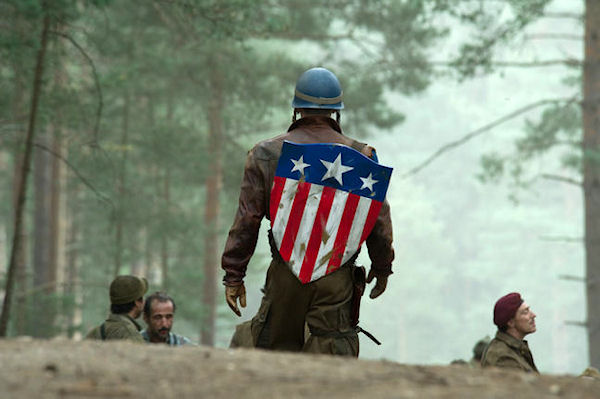
4) Captain America: The First Avenger, dir Joe Johnston, USA

What I said: "The best thing about Johnston’s Captain America is that it’s completely earnest... Chris Evans’ Steve Rogers is played almost completely straight. Other characters make jokes about his shrimpy pre-experiment figure, but Steve himself is on the level. When asked why he wants to kill Nazis he delivers what is, for me, the film’s key line of dialogue: “I don’t want to kill anybody. I just don’t like bullies.” Laugh if you want but that’s a glorious sentiment at a time when cold-hearted revenge movies are at a premium. It also serves to ensure that Steve’s wish to go to the front isn’t because he is some kind of wide-eyed boy adventurer who never read any Wilfred Owen... He isn’t an alpha-male douchebag, he’s a little guy motivated by a desire to protect the weak from the strong. His motivations are pretty much that simple and it makes for a likable, surprisingly compelling character, with Evans a thoroughly engaging presence from beginning to end."


My most controversial choice here, by some distance, 'Captain America: The First Avenger' is not a film I suspect will register on the best film lists of even the most blockbuster-friendly critics. But it's no fluke that I've put it here. I've seen it four times since release at the time of writing, and I've enjoyed it just as much on each occasion. In fact the last time I saw it I was moved to tears (I honestly was) by its simple, honest charm and unimpeachable good nature.

You see, as someone who was bullied and carries a certain amount of insecurity and anxiety with him as a result, a hero like Steve Rogers (Chris Evans) means a great deal. He's a man defined by weakness of body and faltering health; a man whose every day has been lived as the butt of every punchline. Yet he's kind and compassionate to a fault in spite of it all. This is his greatest strength: he is basically a nice guy. Living in 40s New York, Steve believes in everything America represented and without question. He believes in the idea of America regardless of the reality and this is something Joe Johnston's comic book adaptation allows this unambiguous hero to do without sniggering and covering its ass with irony.

It's completely earnest and totally lacking in cynicism. Which is - beyond being admirable - disarmingly brave in an age where ironic distance is a knee-jerk response for so many. When Rogers is made a beefcake super soldier, and assumes the mantle of Captain America, we don't hate this newly muscle-bound Adonis because he remains at heart the same weedy kid with wide-eyes and good intentions, not intent on killing enemies but solely set on protecting the weak against the strong.

But beyond the fact it clearly touched me on a personal level, it also made me smile - almost more than anything else this year. Alan Silvestri's triumphant score accompanies daringly stylised visuals from Johnston, reminiscent of his 90s flop 'The Rocketeer' and with a definite Steven Spielberg's 'Amazing Stories' vibe. There is even a song, with lyrics by Disney veteran Alan Menkin, sung by chorus girls during a sparkly USO show (my favourite section of the film). In 2D the special effects look somehow much less impressive - and the ending is more about setting up next year's 'The Avengers' than closing Johnston's movie - but I could care less. I just plain love this movie.

3) Hara-Kiri: Death of a Samurai, dir Takashi Miike, JAP

What I said: "With '13 Assassins' Miike playfully mocked Japanese tradition and criticised the country's historic cultural values. He questioned why honour and death are so often linked and had his heroes kick dirt in their enemies faces - fighting for survival rather than as part of some slickly choreographed pageant. Here these criticisms are foregrounded. Social class, poverty and a culture of obligation are targets, as well as the wisdom of bushido. And just as the child-murdering, woman-deforming lord in '13 Assassins' represented all that's contradictory about a society which saw swordplay as equivalent to penmanship and poetry - outwardly representing all that was considered beautiful - in 'Hara-Kiri' such vanity is attacked again."


Takashi Miike is fast becoming one of my favourite active filmmakers, having produced two masterful samurai epics (probably the greatest of all genres) in as many years. I find it hard to choose between this and '13 Assassins' (high up on last year's list) but at the moment I'm leaning towards regarding 'Hara-Kiri: Death of a Samurai' as the superior film - even if it's far less exciting in terms of visceral bloody action.

What I really like about 'Hara-Kiri' is that it takes Miike's subversion of tradition and satire of violence to new levels as he abandons his usual fun, anarchic sensibility to make a heartfelt and passionate period melodrama. In this deeply humanist film, Miike contrasts real honour and courage with the pretence of honour, found in ritualised (dehumanising) behaviour. I don't want to repeat myself, so I'll just put a link to my review here - if you're interested in how he subverts feudal Japanese values and why I loved it so much.

The film is also notable in that it's the first straight drama I've seen designed for 3D (in fact it's the first 3D film in history to play in competition in Cannes) and it works very well. It seems entirely appropriate that a film involving the elaborate and precise staging of a ritual should wish to fully exploit depth and create a sense of space, though this also has a dramatic effect, distancing our hero from those who sit in judgement and occupy more lofty positions in society.

2) A Separation, dir Asghar Farhadi, IRN

What I said: "[A Separation] is a tightly made ensemble piece that is as enthralling as it is tear-inducing. It is quite simply the best film I have seen so far this year and the first film to really knock me for six at [this year's Berlin Film Festival]. A human story of great social relevance as well as unmatched depth of feeling. Sincere, passionate and intelligent."


I feel as though I've been going on about this one all year - since even before it had a localised English title and I was still calling it 'Nader and Simin: A Separation' - following its triumph in Berlin. It was, without doubt, the best film I saw at that festival, though that's taking nothing away from the competition because 'A Separation' is a film of singular greatness. It tells a morally complex story populated by well-rounded, fully-formed characters. It would be possible to pick any character and side with them fully in this feud between two families (divided by class and religion) who go to a "family court" in Tehran to solve a highly complex dispute.

Director Asghar Farhadi reserves judgement on proceedings almost entirely, allowing his camera to act as an impartial observer and in doing so gives us a very humane, apolitical account of life in his country. It isn't as stylishly shot as many of the other films on this list, though it's certainly handsomely made, but in this case the content more than justifies the form (making it pretty much the opposite of 'Drive').

1) Melancholia, dir Lars Von Trier, DEN

What I said: "Von Trier has long been able to dazzle critics with his technique and 'Melancholia' is an immensely beautiful film, comprised of haunting and truly spectacular images from start to finish. Taken at face value the impending apocalypse plot is also dramatic and terrifying. But more significantly, what we have here is his most candid and revealing film. It's thought-provoking, personal, earnest and far less oblique than some of his previous work."


A highly personal choice, as I hope you'll appreciate from my review (and my evangelical, hyper-passionate podcast on the subject), 'Melancholia' has divided critics this year but I was among those deeply moved and inspired by it. Having struggled with depression myself over the years I find Kirtsen Dunst's star turn here as deeply affecting as Von Trier's stunningly realised story, which works in its own right as intriguing doomsday sci-fi. Here the imminent destruction of the planet by another heavenly body is a potent metaphor for the suffocating, world-ending effects of the illness.

But forgetting my personal attachment to the themes, 'Melancholia' is also a beautiful experience full of droll satire and deftly-observed social observations. The art design and special effects are jaw-droppingly gorgeous, whilst there isn't a bad performance among the terrific cast. I can't think of a more perfect film this year. It beats out long-time frontrunner 'A Separation' by virtue of Von Trier's virtuosity and because of the deep, personal connection I feel to every minute I spent locked in this world.

'Melancholia', for me anyway, perfectly captures what it feels like to be depressed and, as a result, I can't imagine a film less depressing or more life-affirming. Often knowing that someone else is going through a similar thing can be helpful and there is no greater thrill than seeing my own scattered thoughts and feelings distilled in this way, far more competently conveyed than I could hope to do in words. He might have pissed a lot of people off with his daft comments at Cannes earlier this year, but Lars Von Trier has helped me a great deal and I will be forever thankful.

Saturday, 30 July 2011

'Captain America: The First Avenger' review:


'Captain America: The First Avenger' is out now in the UK, so I thought I'd remind y'all about my review from last week over on What Culture.

I saw the film again yesterday, partly because it's the best blockbuster I've seen in years, but also so I could catch a glimpse of the teaser for next year's Joss Wheadon directed 'The Avengers' after the credits (not attached to the press version I first saw).

Joe Johnston's film was great a second time and I'm really glad the film held up to an additional viewing. A few things I didn't mention in my review which I'll take up space with here: Red Skull (Hugo Weaving) reminded me, not only of Werner Herzog, but of 'Who Framed Roger Rabbit?' villain Judge Doom. The whole thing actually made me think of episodes of Spielberg's TV series 'Amazing Stories'.

Anyway, go see the movie if you have even a passing interest in superhero fare.

Friday, 22 July 2011

'Captain America: The First Avenger' review:


My review of 'Captain America: The First Avenger' just went up on What Culture. So check that out.

Also, I have written a DVD review for The Daily Telegraph arts section tomorrow. I reviewed 'The Lincoln Lawyer' which is apparently DVD of the Week. I've got a few more gigs with them coming up too, which is certainly a pleasure.

Monday, 4 April 2011

Trailer round-up...

I haven't posted a trailer round-up for a while - probably about six months or so - so here are trailers for some of the upcoming films I'm looking forward to. Enjoy!

Despite being underwhelmed by the last (decade of) Woody Allen film(s), I'm really looking forward to 'Midnight in Paris'. I like Owen Wilson and Marion Cotillard for one thing, plus the trailer actually looks pretty good. Wilson's delivery gets all the humour out of the writing by the looks of things and Michael Sheen seems to be playing the sort of pseudo-intellectual, New York poser Allen used to parody in his seventies heyday. It's playing in Cannes next month so we'll soon start hearing if it's any good.


After a screening in-competition in Venice last year, I fell in love with Takashi Miike's '13 Assasins' totally. It was one of the very best films on show there, with it's affectionate yet satirical riff on 'Seven Samurai' and it's critique of Japanese cultural values... and the fact that it was just really, really awesome. And it's out soon in the UK - on April 15th.


Another festival favourite was Wim Wenders' 3D game-changer 'Pina', which I saw in Berlin a couple of months ago. As excellent as it is, I don't know that I need to see it again so soon. I'm posting it here however because the trailer is really something. It's a perfect example of how trailers should be cut together.


I'll be the first to say I don't know a lot about Terrence Malick and have very little idea of what to expect from 'Tree of Life', which opens in May after playing Cannes (or before Cannes depending on who you believe), but the trailer is beautiful. He doesn't make many films - this is only his fifth since 1973's 'Badlands' - so this is sure to be a cinematic event.


And finally, I always like to throw in a wild card on these lists (previous optimistic entries have been 'The Sorcerer's Apprentice' and 'Tron: Legacy') and this time it's 'Captain America: The First Avenger' directed by Joe Johnston. It's out at the end of July and looks pretty good (at least compared to 'Thor'), though Johnston did make 'Jurassic Park 3' and 'The Wolfman'... so who knows how this one will turn out.