Here comes the final part of this year's epic list. If some of the entries seem shorter than in the last two articles, as it comes down to the very best films of the year, then that's probably because I find it harder to talk about the films I really love. It's intimidating and you want to do them justice. In some cases you don't want to spoil anything about them and in others it feels like there's little more that needs saying than "every single aspect of this is perfect".
Here is the top 10:
10) Dredd, dir Pete Travis, UK/SA
What I said: "Where the movie really shines is that this high-minded and timely political commentary is ever-present without being heavy-handed or suffocating how much sheer fun the movie is. The action is brutal and bloody in a way you really don't see any more - even in stuff like 'The Expendables', which exists solely as a throwback to that 1980s action era. It's handled imaginatively, never gets repetitive and there are plenty of clever twists along the way."
A film I wasn't looking forward to at all before it came out - I think I had possibly seen one trailer (or half of one) and been uninspired - 'Dredd' is without doubt the year's smartest comic book movie. In fact it's the year's smartest and most satisfying action movie of any stripe: packed full of bone-crunching violence and spectacle, but also neatly satirical - critical of its main character and the horrid dystopian future he inhabits. Judge Dredd, born of comic books from British publisher 2000AD, is not a character who has ever appealed to me before, perhaps due to a combination of the awful mid-90s Stallone movie and an assumption that its fascistic protagonist represented the world view of the book's authors and/or intended readership. However, it's apparent watching this adaptation that there's far more to the character than that. British TV director Pete Travis and screenwriter Alex Garland manage to get a lot of mileage out of using Dredd's uncompromising form of justice as a way to critique knee-jerk right-wing concepts of law and order, whilst also telling a really tight story. Not bad for a low-budget Brit-flick.
9) Everybody in Our Family, dir Radu Jude, ROM
What I said: "'Everybody in Our Family' could obviously be seen as a call for increased father's rights (a hot contemporary issue), with the heartbreaking reality that Otilia could stop Marius from seeing his daughter at the forefront of the drama. Yet it's equally the story about how otherwise quite gentle people might suddenly snap if pushed too far. The fact that Marius' actions, born of increased distress, are only adding to the likelihood that he'll never see his daughter again creates a sense of deep, inevitable tragedy."
Radu Jude's debut feature, 'The Happiest Girl in the World', was near the summit of this list back in 2010 and his follow-up proves that was no fluke. 'Everybody in Our Family' is every bit as naturalistic and maddening in its representation of a frustrated protagonist who seems incapable of articulating themselves. Here we follow a father as he attempts to visit his daughter at the home of his ex-wife. But a combination of the stubbornness of his ex-wife's new boyfriend - who refuses to allow him to take his daughter out - and his own obnoxious behaviour sees the situation escalate to a point where you can't see a clean way out for any of the characters. An extremely tense film, characterised by its boundless empathy and compassion.
8) Killing Them Softly, dir Andrew Dominik, USA
What I said: "It's a phenomenally violent film in short bursts, though the emphasis is on characters having conversations - about sex, money and business - against the backdrop of the 2008 recession and Obama/McCain presidential election. The whole thing is, as you might expect from the man behind 'Jesse James', shot incredibly stylishly, though without fetishising violence - again, like a Coen movie, there is an abiding humanism. There are no strictly good or bad people, just opportunists, idiots and dispassionate businessmen for whom hiring a contract killer is greeted with a world-weary sigh. Here murder, adultery and theft are just good capitalism. 'Killing Them Softly' is a modern American fable."
Smart and stylish in a way that shouldn't surprise anybody who saw Dominik's previous films - the anarchic and irreverent 'Chopper' and the elegiac, lyrical 'Assassination of Jesse James by the Coward Robert Ford' - this is the best Coen Brothers movie the Coens never made. It's very funny, with the humour coming from the repeated use of certain phrases or peculiar words rather than gags, and a really tight crime thriller to boot. There's a Coen-esque quality to the story too, as it follows bundling criminals out of their depth, pursued by Brad Pitt as an ice-cold hitman (this is a great companion film to 'Killer Joe'). But this isn't some pale imitation without any style of its own, Dominik has his own visual style, whilst the film's heavy political subtext and running critique of the American dream sets it apart.
7) ParaNorman, dir Chris Butler & Sam Fell, USA
What I said: "The stunning character animation, detailed (and gloomily lit) scenery, clever script and well-cast voices would be enough to recommend the film, but the fact that it has such a delightful message - with the baddie ultimately being intolerance and fear of difference (rather than a nefarious person) - is what sets it apart. Especially as it has the strength of its convictions and seemingly none too worried about causing offence. The film is also terrifically well paced, with an economy of storytelling reminiscent of vintage Pixar."
Coming from Laika, the animation studio behind 'Coraline', it's no surprise that 'ParaNorman is good. What did surprise me though is just how good - how funny and unexpectedly moving it is, carried off with genuine maturity and respect for its intended young audience. One early sequence depicting Norman's walk to school is so beautiful and bitter-sweet, not least of all due to Jon Brion's score, that you'd have to be some sort of black-hearted cynic not to swoon. And for a kids' horror movie with the emphasis on comedy and kooky characters, there are some really scary things at play here psychologically. Clearly the best animated film of 2012.
6) Once Upon a Time in Anatolia, dir Nuri Bilge Ceylan, TUR
What I said: "An honest-to-gods masterpiece, this Turkish drama from Nuri Bilge Ceylan has a lot in common with the almost equally excellent 2009 Romanian film 'Police, Adjective'. Both share the same fascination with the banal side of police work not usually explored in cinema, as ordinary cops perform quite boring duties. Both films have patience in common, allowing us to observe these men at work without any embellishment. But whilst the Romanian movie explored whether the semantic definition of law should hold more weight than our own understanding of morality, this feature ponders how such men can maintain their humanity when forced so often to encounter acts of barbarism."
That rare piece of European slow cinema that exceeds two hours without causing me to check the time, this is a captivating instant masterpiece. A police procedural, much of it taking place in real-time, in which you simply observe quite a lot of mundane stuff - a lot of it unrelated to police work, as colleagues chat about their home live's and whatnot. The photography is the year's most stunning, capturing natural light and Turkish landscapes in a way that leaves you in awe from the first shot.
5) The Avengers (AKA Marvel Avengers Assemble), dir Joss Whedon, USA
What I said: "'The Avengers' succeeds on every level it's trying to and gets everything right when it comes to making the ideal comic book movie. The various superpowers are used (and combined) imaginatively, the balance between action and dialogue is perfect, and Hiddleston's villain is deliciously charismatic, every bit as entertaining as the heroes. The gags work and even moments of pathos find the target when they arrive. It's a very different beast to Christopher Nolan's 'The Dark Knight'... being unabashed, escapist fun rather than a rumination on The Patriot Act or an exploration of how a costumed vigilante might really be viewed by the world as we know it. But in being so proud of its pulpy routes, giving us daring deeds painted broadly and in bright colours - as Norse gods battle men in Star-Spangled spandex - it's arguably a far braver and much tougher movie to get right. And Whedon gets it completely right, painting this epic battle on a suitably large canvas."
I don't think I've ever sat in a cinema with a bigger grin on my face than I did during this one, even on my third viewing. 'The Avengers' is the most fun I had this year doing pretty much anything, let alone in a cinema. It looks easy and straightforward now, but how Joss Whedon managed to combine characters from a half-dozen previous films without making a cluttered and uneven mess is a cause to wonder. This could so easily have been a car crash, with egos, audience testing and box office figures dictating what percentage of relevance each member of the ensemble would have - but instead we get almost equal amounts of Captain America (Chris Evans), Thor (Chris Hemsworth), Iron Man (Robert Downey Jnr) and Hulk (Mark Ruffalo) combing and playing off each other in ways both humorous and exciting. The perfect super hero movie.
4) About Elly, dir Asghar Farhadi, IRN
What I said: "We follow a group of middle-class friends from Tehran as they go on a weekend getaway to the seaside, bringing along a relative stranger - Elly (Taraneh Alidoosti) - in order to introduce her to their recently divorced friend. However, when Elly goes missing (presumed drowned), the group is forced to confront how little they really knew about their guest. There are moral dilemmas and grave twists that will be familiar to those who saw 'A Separation' (in a good way) and, like much contemporary Iranian cinema, the film is rich with social critique for those willing to look below the surface."
Released in Iran in 2009, Asghar Farhadi's film prior to the sensational 'A Separation' (2nd on last year's list) only received its UK release earlier this year. There's not a lot I'd like to say about it because, like that previous film, the less you know the better. But I will say that it's every bit as immaculately acted and written as that more famous follow-up. A supremely humanist film of ideas populated by characters of stunning depth.
3) Moonrise Kingdom, dir Wes Anderson, USA
What I said: "Though I personally loved 'The Life Aquatic' and 'Darjeeling Limited', those films seemed to represent Anderson's movies becoming bigger and, to some extent, less tightly focused. The star-studded ensemble is no less eclectic here but 'Moonrise Kindom' instead feels stripped back somewhere closer to the simplicity and economy of 'Rushmore'. It's a change that's kept the director's formula from wearing thin, coming at the right moment. It's a film that makes Wes Anderson exciting again, as opposed to the master of an increasingly predictable framework (however lovely). I used to say that 'Bottle Rocket' was my favourite but conceded that 'The Royal Tenenbaums' was Anderson's most mature and accomplished film. 'Moonrise Kingdom' calls into question both ends of that statement."
Anderson's style changes just enough so that it's still recognisably there but it feels fresh, whilst his recent excesses have been toned down to make something that still feels ambitious and imaginative but also uncharacteristically tight. It's also perhaps his best looking movie to date and one of his most touching, as it deals with young love. The gathered ensemble (including Edward Norton, Bruce Willis, Frances McDormand and Bill Murray) is perfectly cast and the young leads (Jared Kilman and in particular Kara Hayward) are revelations. Anderson's near-obsessive attention to detail and penchant for naive and wholly non-cynical characters have not been this inspiring since 'Rushmore'.
2) A Royal Affair, dir Nicolaj Arcel, DEN
What I said: "Everything about 'A Royal Affair' is stunning. Its ambitious scope in terms of subject matter, its intelligence, its brilliant cast of actors (I'll now happily watch anything with Alicia Vikander in it), and its lavish production values. I cried at the end... and I laughed far more and far harder than I have at the last dozen or so comedies. The story of a doctor who gives a king new confidence and inspires him to greater things, it could easily be billed as Denmark's answer to 'The King's Speech'. It's far better than that."
I don't know if this is any indication of how they make period movies over in Denmark, but 'A Royal Affair' is lightyears away from the staid, conservative, heritage bollocks we serve up here in the UK. If the sight of monarchs wearing ruffled shirts and extravagant ball-gowns is - not unreasonably - enough to put you off a movie by this point then you'll really be missing something special here. Along with the titular story of forbidden love, and the visceral sense of heartbreak and tragedy that goes along with it, 'A Royal Affair' is at heart a film about ideas: about compromised idealists and revolutionaries ahead of their time. It's about social change and how difficult it is to impose lasting improvements to the lot of the rest of us as long as they run counter to the wants of the super rich. It may be set in the 18th century Danish court - where it tells a sensational and scarcely credible true story - but this is a film of 2012.
1) Tabu, dir Miguel Gomes, POR
What I said: "Despite the fact the entire film is black and white, framed in a 4:3 aspect ratio, a lot of it reminded me of the hyper-colourful films of Wes Anderson: with Portuguese language cover versions of 60s popular songs, childlike romanticism of the colonial spirit of adventure, characters with obscure quasi-celebrity status, and a highly precise sense of composition. Funny, bizarre, imaginative, unique, and emotional in that way that hits the hairs on the back of your neck - I'll be surprised if [this year's Berlin film festival] goes on to present a better film than 'Tabu'."
Wow. A work of genius and a probable future contender for film of the decade. A tale of love and loss which begins in Lisbon, showing us the final days of a bitter and extremely infuriating old and lonely widow - estranged from her daughter and a drain on her neighbours - only to then spend the second portion with the same woman as an impossibly beautiful and accomplished person in her 20s, living a romanticised colonial dream in Africa. The decision to follow a different protagonist in the first half (a well-meaning, busybody neighbour), with the elderly woman seen through her eyes, is especially interesting as it positions the main character as less relevant in her old age, making the subsequent flashback tale even more interesting - and perhaps saying something about our attitudes towards older people. The vibrant and ultimately tragic second half of the film makes the first half even sadder. It says a lot that whilst 'Tabu' is entirely shot in black and white (with the second half free of dialogue save narration from an estranged lover), in my mind it exists in full colour - so evocative and powerful the imagery, so ingenious the storytelling.
If you missed the earlier parts of this list, here they are: 30-21 & 20-11
Showing posts with label Polls. Show all posts
Friday, 21 December 2012
Wednesday, 19 December 2012
My Top 30 Films of 2012: 20-11
This is the second part of my top 30 films of 2012 run-down. The first part can be found here.
Here are films 20-11:
20) Searching for Sugar Man, dir Malik Bendjelloul, SWE/UK
What I said: "Undoubtedly one of the film's that's effected and fascinated me the most this year, 'Searching for Sugar Man' is a great and stylishly put together documentary about a mysterious 1970s singer-songwriter whose unjust obscurity in the US is made all the more strange by his rock god status in apartheid South Africa. The bizarre and moving story of Rodriquez is probably best left for the film to tell in detail, but rest assured it's a compelling tale about a humble man of immense charisma. It's a less comic yet far classier version of 'Anvil', to sell it in crass marketing terms."
An interesting story told very well, 'Searching for Sugar Man' inspired me to seek out both of Rodriquez's albums soon after leaving the cinema. The subject himself is an inspiring individual, without pretension and showing no signs of bitterness after his early "the next Bob Dylan" tag never translated itself into record sales or success in his home country. It's also provides a rare and interesting look at youth counter-culture in white South Africa during apartheid, as young people sought alternative ideas and art to that provided by their conservative state.
19) Sightseers, dir Ben Wheatley, UK
What I said: "Like the two Ben Wheatley films that preceded it, 'Sightseers' could appear cold, cynical and nihilistic to some. However, the unease the director makes you feel at each killing, quickly making you question each knee-jerk laugh, shows to my mind a sort of humanism that elevates the material even further. The characters themselves maybe glib about killing and dismissive of their victims, but Wheatley's handling of each act is certain to have you torn awkwardly between horror and laughter - with no act of violence seeming to lack consequence (on friends and loved ones, if not the happy murderers)."
Very droll, as one might expect from Wheatley, 'Sightseers' is a near-perfect pitch-black comedy which should achieve long-lasting cult success. Especially given how many quotable one-liners and strange turns of phrase there are here, my favourites being "he's a pig in clothes, Chris" and "he's not a person, he's a Daily Mail reader". Very British in terms of its references and social-class based humour, it's great to see some UK filmmakers catering for the domestic audience rather than chasing the (much more lucrative) export market.
18) Amour, dir Michael Haneke, AUT/FRA/GER
What I said: "It's an accomplished film, perhaps slightly over long, but boasting terrific lead performances and painting a very complex and non-judgemental picture of both a terminally ill woman wishing to die and her distraught, occasionally rash husband - who, in one tough scene, is driven so angry by her refusal to take food that he strikes her frail and immobile body. Yet this is overall a story about love, or rather which seems to redefine love or at least view it through a different lens. It's the final days of a couple who, it seems safe to assume, have lead happy and successful lives together, and yet we focus on a man caring for his sick wife and dealing with uncaring nurses and unwanted visitors (including the couple's demanding daughter, played by Isabelle Huppert). Haneke seems to be saying this is what love is, that everything else is perhaps the build up to this the greatest test of affection and, in a sense, romance."
Is it a pro-euthanasia film or merely an extremely compassionate account of why people are driven to that measure in desperation? I'm not sure - and it probably doesn't matter. 'Amour' is a film that sticks with you, putting you in a very dark place and leaving you there to think for a while. I haven't been forced to watch the slow deterioration of an elderly couple on film in this way since 'Where the Wind Blows' - and at least the characters in that film were killed by nuclear fallout! By comparison this is an all too relatable and frightening story, given that a similar fate to that of the old timers here quite likely awaits us all. I told you it was bleak.
17) Cabin in the Woods, dir Drew Goddard, USA
What I said: "An incredibly funny and whip-smart take on the horror genre from producer/co-writer Joss Whedon and writer/director Drew Goddard. It's got the splatter horror humour of 'Evil Dead' and is similar to 'Scream' in that it deconstructs the slasher genre and subverts its tropes. But unlike 'Scream' it does this without ultimately becoming just another slasher movie: it goes much further than that, delving into what makes such movies work and questioning why they satisfy audiences in the first place. It grapples with such concepts as audience complicity in movie violence and the way young people are portrayed in American movies, as well as being hilariously funny, incredibly gory and full of imagination. When it all kicks off in the final third, I can promise you there is nothing quite like it."
Completed years ago and only belatedly released this year to cash in on writer/producer Joss Whedon's Avengers success, 'Cabin in the Woods' was left to a fate usually reserved for major duds. Yet it's genuinely one of the most surprising and inventive films of the year. One of those "Christ, I never saw any of this in the trailer" types of movies that are so rare in the post-internet world. Perhaps the fact that it lingered in a vault, seemingly forgotten for a few years, actually helped cool interest in this project enough for nobody to bother spoiling it? In any case, it's a really entertaining horror that subverts genre cliches and comments on the very existence of such movies in our culture (whilst also being a dammed good one). And comic actor Fran Kranz is exceptional.
16) Haywire, dir Steven Soderbergh, USA
What I said: "In what seems like a direct challenge to the modern action movie, Soderbergh shoots his hyper-realistic fight scenes with an unfashionably immobile camera - give or take a few lengthy tracking shots. He allows action to unfold within the frame for long spells, giving us an unobstructed view. This decision is no doubt influenced by the fact that he's not having to play tricks in the edit to convince us that Carano can kick ass: she really can and we're allowed to see that."
I fell a little bit in love with Gina Carano earlier this year, with the former MMA fighter demonstrating extreme physical skill in Soderbergh's brisk thriller - and a surprising degree of acting talent. It also doesn't hurt that she's beautiful without having a traditional Hollywood physique. By which I mean she isn't skinny. If it sounds like I'm going off on one about Carano (and I am) rather than talking about the film, that's only because Carano IS this film. 'Haywire' is really only a vehicle for her powerful and energetic fight moves, with the star-studded (mostly male) supporting cast existing chiefly to have the crap beaten from them. It's brilliant and Soderbergh really shows the rest of Hollywood how to shoot action coherently and excitingly.
15) 21 Jump Street, dir Phil Lord & Chris Miller, USA
What I said: "Hill and Tatum make for a funny and charismatic double-act, whilst the film's many in-jokes at the expense of formula cop series (like the original) and tropes of the high school comedy allow for a disarming bluntness about the stupidity of its own premise.There are perhaps too many action scenes, with car chases and gun battles now a staple of the Hollywood "dude comedy", and these do drag the film down for long spells. But when it's funny it's funny enough that you more or less forget all the bits you didn't like... and it's funny about 50% of the time."
On paper it looks like this one would be as dumb as its wannabe cop protagonists, yet '21 Jump Street' is a lot of fun thanks mainly to the chemistry of the leads. It's the film that made me laugh the most this year and I was delighted to discover, after watching it, that its co-directors are the duo behind the equally funny animation 'Cloudy With a Chance of Meatballs' - so perhaps it wasn't a fluke. This one will have you tripping major ballsack long into the credits - which, by the way, are possibly the funniest part of the film by virtue of their sheer preposterousness.
14) The Master, dir Paul Thomas Anderson, USA
What I said: "'The Master' is not, at least to my mind, an immediately gratifying film. There are immediately gratifying elements, to be sure - the cinematography and Anderson's use of camera is one of the most obvious, as are the two central performances - but this story-light script is much more of a character study and exploration of various themes (such as religion as institutionalism and whether it is truly possible to be your own master). There's nothing wrong with that at all, and in fact the most interesting films are usually about characters rather than a narrative sequence of events, but 'The Master' takes this to an extreme, with very little happening outside of its broader exploration of themes."
I'm fairly certain I'll look back in years to come and wonder why I didn't place this higher on the list, for I've only seen 'The Master' once at the time of writing and have a strong feeling it's one that will improve with repeat viewings. Not least of all as I begin to properly understand what the point of it all is. At the moment though it's here by virtue of how beautiful the cinematography is and how stellar the two lead performances are. I bow to no one in my appreciation of Paul Thomas Anderson, so when I say that several of the scenes between Jaoquin Phoenix and Philip Seymour Hoffman rank among the best things he's ever filmed, you better believe that means something.
13) The Descendants, dir Alexander Payne, USA
What I said: "It's as much about quirks of fate as it is coming to terms with loss or taking responsibility. Why should Clooney have inherited all this land through no work of his own and why should he decide what happens to it? Why did Elizabeth decide to jet ski on that day rather than drive the boat as planned? Why should Alex have stumbled upon her mother's indiscretion by chance? When Clooney finally confronts his wife's lover he is told that the affair "just happened". "Nothing just happens" is King's response, giving rise to perhaps the film's definitive line: "Everything just happens.""
Sometimes the films you see at the start of the year get lost by the time all the lists are being made and awards are being handed out, but Payne's 'The Descendants' overcomes this obstacle quite easily. A bittersweet and introspective movie about forgiveness, loss, entitlement and a whole lot more, this one is deceptively light and breezy on the surface but yields a whole lot more on closer inspection. Clooney is ever superb as the wounded male lead and the scene's featuring his comatose wife verge towards harrowing as the film reaches its end. A beautiful piece of work, not least due to its non-judgemental humanism and Payne's understanding that bleak and serious drama is not incompatible with a sense of humour.
12) Killer Joe, dir William Friedkin, USA
What I said: "Director William Friedkin and screenwriter Tracy Letts - author of the original stageplay - deliver a memorable and disturbing little picture, which culminates in a masterful third act which plays out as one scene set around the family dinner table - one which won't help drive sales of KFC and may serve as a cold shower for any ladies still breathless from seeing the lead actor parading about as a male stripper the week previous. The whole thing plays as satirical, especially in its darkest moments, though it isn't entirely clear what the target is. That would ordinarily leave me struggling to justify the ultra-violence, but 'Killer Joe' is too well crafted and cast for that to present much of a problem."
I don't know where Friedkin has been since his 'Exorcist'/'French Connection' heyday, but 'Killer Joe' is arguably right up there. Along with the aforementioned 'Carnage' - also based on a stage play - as well as the likes of 'Haywire' and 'Sightseers', there is a theme on this year's list of films that manage to go by a decent clip and come to a satisfying end in well under two hours. 'Killer Joe' is one of those, being economical and well plotted, driven by eye-catching performances (notably from McConaughey) and culminating in a scene of mind-melting tension that will linger long in the memory.
11) Seeking a Friend for the End of the World, dir Lorene Scafaria, USA
What I said: "Perhaps the year's most pleasant surprise, this apocalypse dramedy sees Steve Carell and Keira Knightley forming an unlikely friendship with only days to go before an asteroid destroys the planet. It's a sublimely sweet little movie from 'Nick and Norah's Infinite Playlist' scribe Lorene Scafaria, which skillfully combines genuine heartfelt emotion with black comedy. There are some really profound musings on love, life and regret here, but also some of the best comic moments of the year as people react to the end of days in a myriad of psychotic and self-deluding ways."
Sometimes how good a film is has more to do with your own mental state going in, and I saw this one days after being dumped out of the blue by my girlfriend of seven years. I quite honestly would have welcomed the end of the world and - like many of the characters here - would probably have taken a lot of heart from a mutual sense of misery at the futility of existence. It's all better now and I don't feel anything like that bad about the whole thing, but it was during this time that I saw and loved 'Seeking a Friend for the End of the World'. A film that was, for me, the right amount of sweet and bitter - and a disaster movie that had the strength of its convictions. It also doesn't hurt that the first half is extremely funny, depicting the mass hysteria of an oncoming apocalypse in a way I've never seen on screen before.
Check back later for films 21-11. If you missed them, check out entries 30-21.
Here are films 20-11:
20) Searching for Sugar Man, dir Malik Bendjelloul, SWE/UK
What I said: "Undoubtedly one of the film's that's effected and fascinated me the most this year, 'Searching for Sugar Man' is a great and stylishly put together documentary about a mysterious 1970s singer-songwriter whose unjust obscurity in the US is made all the more strange by his rock god status in apartheid South Africa. The bizarre and moving story of Rodriquez is probably best left for the film to tell in detail, but rest assured it's a compelling tale about a humble man of immense charisma. It's a less comic yet far classier version of 'Anvil', to sell it in crass marketing terms."
An interesting story told very well, 'Searching for Sugar Man' inspired me to seek out both of Rodriquez's albums soon after leaving the cinema. The subject himself is an inspiring individual, without pretension and showing no signs of bitterness after his early "the next Bob Dylan" tag never translated itself into record sales or success in his home country. It's also provides a rare and interesting look at youth counter-culture in white South Africa during apartheid, as young people sought alternative ideas and art to that provided by their conservative state.
19) Sightseers, dir Ben Wheatley, UK
What I said: "Like the two Ben Wheatley films that preceded it, 'Sightseers' could appear cold, cynical and nihilistic to some. However, the unease the director makes you feel at each killing, quickly making you question each knee-jerk laugh, shows to my mind a sort of humanism that elevates the material even further. The characters themselves maybe glib about killing and dismissive of their victims, but Wheatley's handling of each act is certain to have you torn awkwardly between horror and laughter - with no act of violence seeming to lack consequence (on friends and loved ones, if not the happy murderers)."
Very droll, as one might expect from Wheatley, 'Sightseers' is a near-perfect pitch-black comedy which should achieve long-lasting cult success. Especially given how many quotable one-liners and strange turns of phrase there are here, my favourites being "he's a pig in clothes, Chris" and "he's not a person, he's a Daily Mail reader". Very British in terms of its references and social-class based humour, it's great to see some UK filmmakers catering for the domestic audience rather than chasing the (much more lucrative) export market.
18) Amour, dir Michael Haneke, AUT/FRA/GER
What I said: "It's an accomplished film, perhaps slightly over long, but boasting terrific lead performances and painting a very complex and non-judgemental picture of both a terminally ill woman wishing to die and her distraught, occasionally rash husband - who, in one tough scene, is driven so angry by her refusal to take food that he strikes her frail and immobile body. Yet this is overall a story about love, or rather which seems to redefine love or at least view it through a different lens. It's the final days of a couple who, it seems safe to assume, have lead happy and successful lives together, and yet we focus on a man caring for his sick wife and dealing with uncaring nurses and unwanted visitors (including the couple's demanding daughter, played by Isabelle Huppert). Haneke seems to be saying this is what love is, that everything else is perhaps the build up to this the greatest test of affection and, in a sense, romance."
Is it a pro-euthanasia film or merely an extremely compassionate account of why people are driven to that measure in desperation? I'm not sure - and it probably doesn't matter. 'Amour' is a film that sticks with you, putting you in a very dark place and leaving you there to think for a while. I haven't been forced to watch the slow deterioration of an elderly couple on film in this way since 'Where the Wind Blows' - and at least the characters in that film were killed by nuclear fallout! By comparison this is an all too relatable and frightening story, given that a similar fate to that of the old timers here quite likely awaits us all. I told you it was bleak.
17) Cabin in the Woods, dir Drew Goddard, USA
What I said: "An incredibly funny and whip-smart take on the horror genre from producer/co-writer Joss Whedon and writer/director Drew Goddard. It's got the splatter horror humour of 'Evil Dead' and is similar to 'Scream' in that it deconstructs the slasher genre and subverts its tropes. But unlike 'Scream' it does this without ultimately becoming just another slasher movie: it goes much further than that, delving into what makes such movies work and questioning why they satisfy audiences in the first place. It grapples with such concepts as audience complicity in movie violence and the way young people are portrayed in American movies, as well as being hilariously funny, incredibly gory and full of imagination. When it all kicks off in the final third, I can promise you there is nothing quite like it."
Completed years ago and only belatedly released this year to cash in on writer/producer Joss Whedon's Avengers success, 'Cabin in the Woods' was left to a fate usually reserved for major duds. Yet it's genuinely one of the most surprising and inventive films of the year. One of those "Christ, I never saw any of this in the trailer" types of movies that are so rare in the post-internet world. Perhaps the fact that it lingered in a vault, seemingly forgotten for a few years, actually helped cool interest in this project enough for nobody to bother spoiling it? In any case, it's a really entertaining horror that subverts genre cliches and comments on the very existence of such movies in our culture (whilst also being a dammed good one). And comic actor Fran Kranz is exceptional.
16) Haywire, dir Steven Soderbergh, USA
What I said: "In what seems like a direct challenge to the modern action movie, Soderbergh shoots his hyper-realistic fight scenes with an unfashionably immobile camera - give or take a few lengthy tracking shots. He allows action to unfold within the frame for long spells, giving us an unobstructed view. This decision is no doubt influenced by the fact that he's not having to play tricks in the edit to convince us that Carano can kick ass: she really can and we're allowed to see that."
I fell a little bit in love with Gina Carano earlier this year, with the former MMA fighter demonstrating extreme physical skill in Soderbergh's brisk thriller - and a surprising degree of acting talent. It also doesn't hurt that she's beautiful without having a traditional Hollywood physique. By which I mean she isn't skinny. If it sounds like I'm going off on one about Carano (and I am) rather than talking about the film, that's only because Carano IS this film. 'Haywire' is really only a vehicle for her powerful and energetic fight moves, with the star-studded (mostly male) supporting cast existing chiefly to have the crap beaten from them. It's brilliant and Soderbergh really shows the rest of Hollywood how to shoot action coherently and excitingly.
15) 21 Jump Street, dir Phil Lord & Chris Miller, USA
What I said: "Hill and Tatum make for a funny and charismatic double-act, whilst the film's many in-jokes at the expense of formula cop series (like the original) and tropes of the high school comedy allow for a disarming bluntness about the stupidity of its own premise.There are perhaps too many action scenes, with car chases and gun battles now a staple of the Hollywood "dude comedy", and these do drag the film down for long spells. But when it's funny it's funny enough that you more or less forget all the bits you didn't like... and it's funny about 50% of the time."
On paper it looks like this one would be as dumb as its wannabe cop protagonists, yet '21 Jump Street' is a lot of fun thanks mainly to the chemistry of the leads. It's the film that made me laugh the most this year and I was delighted to discover, after watching it, that its co-directors are the duo behind the equally funny animation 'Cloudy With a Chance of Meatballs' - so perhaps it wasn't a fluke. This one will have you tripping major ballsack long into the credits - which, by the way, are possibly the funniest part of the film by virtue of their sheer preposterousness.
14) The Master, dir Paul Thomas Anderson, USA
What I said: "'The Master' is not, at least to my mind, an immediately gratifying film. There are immediately gratifying elements, to be sure - the cinematography and Anderson's use of camera is one of the most obvious, as are the two central performances - but this story-light script is much more of a character study and exploration of various themes (such as religion as institutionalism and whether it is truly possible to be your own master). There's nothing wrong with that at all, and in fact the most interesting films are usually about characters rather than a narrative sequence of events, but 'The Master' takes this to an extreme, with very little happening outside of its broader exploration of themes."
I'm fairly certain I'll look back in years to come and wonder why I didn't place this higher on the list, for I've only seen 'The Master' once at the time of writing and have a strong feeling it's one that will improve with repeat viewings. Not least of all as I begin to properly understand what the point of it all is. At the moment though it's here by virtue of how beautiful the cinematography is and how stellar the two lead performances are. I bow to no one in my appreciation of Paul Thomas Anderson, so when I say that several of the scenes between Jaoquin Phoenix and Philip Seymour Hoffman rank among the best things he's ever filmed, you better believe that means something.
13) The Descendants, dir Alexander Payne, USA
What I said: "It's as much about quirks of fate as it is coming to terms with loss or taking responsibility. Why should Clooney have inherited all this land through no work of his own and why should he decide what happens to it? Why did Elizabeth decide to jet ski on that day rather than drive the boat as planned? Why should Alex have stumbled upon her mother's indiscretion by chance? When Clooney finally confronts his wife's lover he is told that the affair "just happened". "Nothing just happens" is King's response, giving rise to perhaps the film's definitive line: "Everything just happens.""
Sometimes the films you see at the start of the year get lost by the time all the lists are being made and awards are being handed out, but Payne's 'The Descendants' overcomes this obstacle quite easily. A bittersweet and introspective movie about forgiveness, loss, entitlement and a whole lot more, this one is deceptively light and breezy on the surface but yields a whole lot more on closer inspection. Clooney is ever superb as the wounded male lead and the scene's featuring his comatose wife verge towards harrowing as the film reaches its end. A beautiful piece of work, not least due to its non-judgemental humanism and Payne's understanding that bleak and serious drama is not incompatible with a sense of humour.
12) Killer Joe, dir William Friedkin, USA
What I said: "Director William Friedkin and screenwriter Tracy Letts - author of the original stageplay - deliver a memorable and disturbing little picture, which culminates in a masterful third act which plays out as one scene set around the family dinner table - one which won't help drive sales of KFC and may serve as a cold shower for any ladies still breathless from seeing the lead actor parading about as a male stripper the week previous. The whole thing plays as satirical, especially in its darkest moments, though it isn't entirely clear what the target is. That would ordinarily leave me struggling to justify the ultra-violence, but 'Killer Joe' is too well crafted and cast for that to present much of a problem."
I don't know where Friedkin has been since his 'Exorcist'/'French Connection' heyday, but 'Killer Joe' is arguably right up there. Along with the aforementioned 'Carnage' - also based on a stage play - as well as the likes of 'Haywire' and 'Sightseers', there is a theme on this year's list of films that manage to go by a decent clip and come to a satisfying end in well under two hours. 'Killer Joe' is one of those, being economical and well plotted, driven by eye-catching performances (notably from McConaughey) and culminating in a scene of mind-melting tension that will linger long in the memory.
11) Seeking a Friend for the End of the World, dir Lorene Scafaria, USA
What I said: "Perhaps the year's most pleasant surprise, this apocalypse dramedy sees Steve Carell and Keira Knightley forming an unlikely friendship with only days to go before an asteroid destroys the planet. It's a sublimely sweet little movie from 'Nick and Norah's Infinite Playlist' scribe Lorene Scafaria, which skillfully combines genuine heartfelt emotion with black comedy. There are some really profound musings on love, life and regret here, but also some of the best comic moments of the year as people react to the end of days in a myriad of psychotic and self-deluding ways."
Sometimes how good a film is has more to do with your own mental state going in, and I saw this one days after being dumped out of the blue by my girlfriend of seven years. I quite honestly would have welcomed the end of the world and - like many of the characters here - would probably have taken a lot of heart from a mutual sense of misery at the futility of existence. It's all better now and I don't feel anything like that bad about the whole thing, but it was during this time that I saw and loved 'Seeking a Friend for the End of the World'. A film that was, for me, the right amount of sweet and bitter - and a disaster movie that had the strength of its convictions. It also doesn't hurt that the first half is extremely funny, depicting the mass hysteria of an oncoming apocalypse in a way I've never seen on screen before.
Check back later for films 21-11. If you missed them, check out entries 30-21.
Tuesday, 18 December 2012
My Top 30 Films of 2012: 30-21
It's that time again! Time for the annual top 30 film list, in which I rank my favourites. People ask me "Rob, why do you insist of compiling a top 30, rather than, say, a more traditional top 10?" And I say to those people, with limitless patience, "because even compiling this year's top 30 has seen me leave out such stunning films as 'Francine', 'Elles', 'Just the Wind' and 'Postcards From the Zoo' - to say nothing of documentaries such as 'Tabloid', 'Dreams of a Life' and 'Woody Allen: A Documentary'." I have also neglected to include films that came out too late last year to be included in the 2011 list. So, whilst magnificent, 'Moneyball', Fincher's 'The Girl With the Dragon Tattoo' and the surprisingly funny 'Arthur Christmas' don't feature.
Anyway, here is the first part of this year's list. Films 30-21:
30) The Woman in Black, dir James Watkins, UK/CAN/SWE
What I said: "In places it's truly frightening, even if it is (by design) playing on oft-seen horror tropes. It doesn't do anything new but it does the old stuff very well. Radcliffe is a good fit for the protagonist, seeming both vulnerable and capable. Some are bound to find his youthful appearance and image as a boy-wizard a distracting incongruity, especially given that here he is playing a father, but I didn't find this to be a problem. At 22 Radcliffe is an adult who could feasibly have a child - this is simply a fact. If anything his most famous role compliments this one, with both Harry Potter and solicitor Arthur Kipps being of unfailingly good nature."
Check back later for films 20-11.
Anyway, here is the first part of this year's list. Films 30-21:
30) The Woman in Black, dir James Watkins, UK/CAN/SWE
What I said: "In places it's truly frightening, even if it is (by design) playing on oft-seen horror tropes. It doesn't do anything new but it does the old stuff very well. Radcliffe is a good fit for the protagonist, seeming both vulnerable and capable. Some are bound to find his youthful appearance and image as a boy-wizard a distracting incongruity, especially given that here he is playing a father, but I didn't find this to be a problem. At 22 Radcliffe is an adult who could feasibly have a child - this is simply a fact. If anything his most famous role compliments this one, with both Harry Potter and solicitor Arthur Kipps being of unfailingly good nature."
Regular readers will know I'm not a horror fan, but I did really enjoy this one despite seeing it with a tittering teenage audience that found every aspect hilarious. The fact that it still made me jump (more than a couple of times) and genuinely creeped me out, is all the more impressive given the circumstances. An old fashioned type of horror movie that's refreshing in an age of all-out gore-fests.
29) Magic Mike, dir Steven Soderbergh, USA
The scene where Matthew McConaughey teaches Alex Pettyfer to sexy dance in a mirror - sweatily gyrating against him in spandex - is one of the funniest things I've seen all year long, matched only by the incongruous appearance of McConaughey in an Uncle Sam hat later in the same film. Marvellous. I'm not sure how much of 'Magic Mike' is supposed to be funny but I had a blast watching it. I also have a real soft spot for Soderbergh of late. Let's hope he isn't really about to retire.
28) The Muppets, dir James Bobin, USA
A little ray of sunshine - blissfully free of irony or schadenfreude in a world where both are dominant. 'The Muppets' isn't solid gold all the way through - it lags in the middle for a bit and some of the gags fall flat - but it's impossible to watch without a smile on your face. The songs are great and there are some really inspired gags too. This is one I've already gone back to several times on DVD.
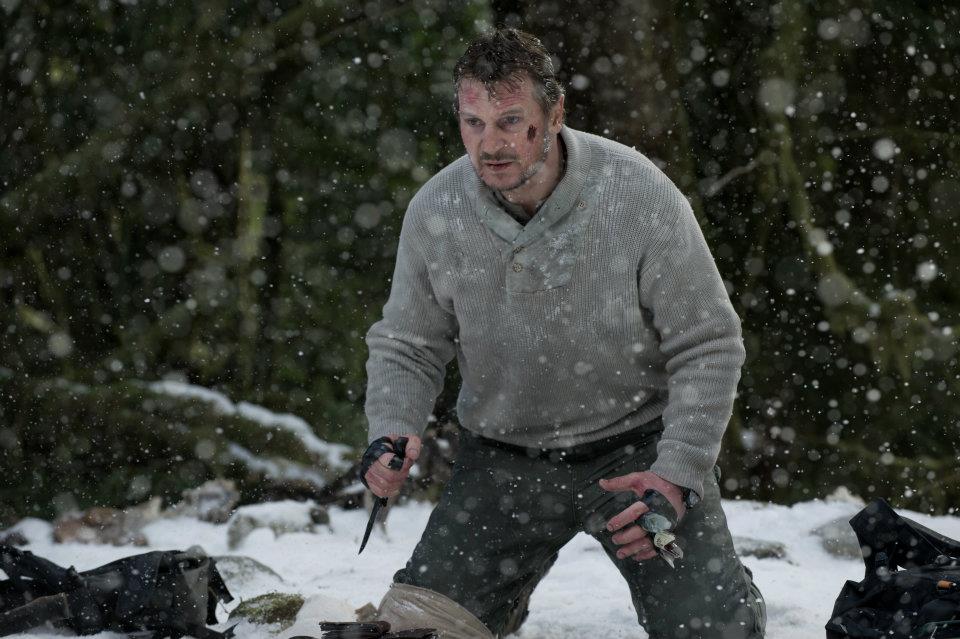
27) The Grey, dir Joe Carnahan, USA
One from way back at the start of the year, 'The Grey' sees Liam Neeson again in action hero mode, but this time he's battling the elements, a pack of ravenous wolves and himself (coming to terms with the loss of his wife and a new-found dislike of humanity). It's supremely effective and an interesting change of direction for the director after making that forgettable 'A-Team' movie a couple of years back.
26) Side by Side, dir Christopher Kenneally, USA
A timely film arriving at the end of the celluloid age, 'Side by Side' would be interesting enough if it were simply a dry look at the difference between the old technology and digital and the potential problems and advantages arising from the change. But it's much more fun than that, however, with Keanu Reeves interviewing a stellar line-up of filmmakers, actors, producers and technicians that includes Martin Scorsese, David Lynch and an especially enthusiastic Danny Boyle. The likes of David Fincher and Steven Soderbergh provide some extremely memorable and amusing quotes too, ensuring this is a must-watch movie for anyone with an interest in filmmaking - even if they aren't necessarily bothered about competing storage media. Though those who go in without an opinion are sure to leave 'Side by Side' feeling pretty strongly one way or the other.
25) The Hunger Games, dir Gary Ross, USA
With extremely low expectations I read The Hunger Games in the run-up to the summer movie and, to my surprise, really enjoyed it. Enough that I swiftly read the next two books and got pretty into that world. I'd be the first to admit that the books are flawed, but they are pretty good and the film lives up to the first one and - in a couple of ways - improves upon it. It made for an interesting film and one which leaves me excited enough to want to see the sequels.
24) Carnage, dir Roman Polanski, FRA/GER/SPA/POL
Great performances from the cast and a really smart script, this is a tight, little drama with a sharp wit. It's the best film Polanski's made in at least a decade. Not a lot more to say about it than that without going into specifics and reviewing it all over again... so there it is.
23) Chronicle, dir Josh Trank, USA
A slick mix of horror, "found footage" movie and super hero actioner, 'Chronicle' - written by Max Landis, son of John - is inventive, exciting and tense. The film even finds time to become a drama about growing up and to some extent an angsty teens new-found abilities form part of a commentary on high school shootings and the sorts of troubled kids who perpetrate them: the anti-social and violent side of the geek empowerment fantasy around which all super hero stories are built.
22) Brave, dir Mark Andrews & Brenda Chapman, USA
A huge improvement on the studio's last two films - both sequels - 'Brave' is only just short of being up there with 'Up' and 'Wall-E' in the Pixar canon. It succeeds mostly because it's not the film you think it's going to be based on the trailers. This isn't a trite story about a woman who doesn't want to be pretty but wants to be a warrior instead - the usual route of female empowerment being depicted as increased masculinity - but rather the tale of a stubborn teenager and her equally stubborn mother trying to improve their mutually antagonistic relationship during a tough transitional time in their lives. This is the story of a mother getting to grips with her daughter's increasing independence from her care, whilst that daughter has to juggle with discovering who she is and what she wants to do. The popular culture is full of stories about father-son bonding and that relationship in general, but this is the first mainstream children's movie I can recall that's all about the relationship between mother and daughter.
21) Argo, dir Ben Affleck, USA
Whilst not my favourite film of the year - in fact it's 20 spaces off the top spot - 'Argo' could easily be crowned Best Picture at next year's Oscars. Ben Affleck has established a good reputation behind the camera, with 'The Town' already seen as an unlucky loser last time around despite strong early buzz, whilst the Academy traditionally loves actors-turned-directors. It's also got a liberal political stance on the situation in modern Iran, laying the blame for the current regime at America's feet. Yet overall it isn't going to alienate more conservative voters, because it's a film in which the CIA are the good guys and "bringing our boys home" is the objective. It is - spoiler warning - an American success story in a part of the world where those are currently difficult to come by. And, finally, much of it takes place in Hollywood and lampoons that community - but in a gentle and affectionate way that can only be received warmly. Thought of that way it's a pretty safe movie, especially as - in terms of plot and the way it's shot - it recalls the sort of 1970s political thrillers they just don't make any more. It is, however, also very good - so I wouldn't begrudge it any of that success.
Labels:
Argo,
Brave,
Carnage,
Chronicle,
Magic Mike,
Polls,
Side by Side,
The Grey,
The Hunger Games,
The Muppets,
The Woman in Black
Sunday, 18 December 2011
My Top 30 Films of 2011: 10-1
This is the concluding part of my 2011 top 30 films list. You can read the previous entries here: 30-21 and 20-11.
10) Pina, dir Wim Wenders, GER
What I said: "[Wenders'] use of space, the way he stages the action, is just incredible and wholly new, whilst the cinematography and camerawork is beautiful to behold. 'Pina' is a technical masterpiece and a bold piece of work all ways around. Watching it I was struck by how conceivably any film characterised by incredible blocking and interesting use of space would not only work in [3D] but would in fact be enhanced by it... 'Pina' proves there is a place for 3D in the arthouse and in the hands of auteurs."

3D adds depth, obviously, but is that useful and if so how? Its advocates often compare stereoscopy to the additions of sound and colour, yet it seems clearer to us what those advancements have enabled filmmakers to convey from a dramatic or artistic standpoint. A Marx Brothers comedy would simply not work if we couldn't hear Groucho's rapid-fire one-liners, whilst 'The Wizard of Oz' would probably not dazzle us so much if it remained in black and white after Dorothy set foot in the fantasy realm of the title. But, by comparison, what does 3D offer and what do we stand to lose without it? How can the addition of depth be used beyond the initial spectacle, in order to assist a director in telling a particular type of story or giving a very specific experience?
This year 3D has been used by some heavyweight talents, whose movies are perhaps more familiar to arthouse patrons than mass audiences. Werner Herzog used the technique to give us a rare glimpse inside the Chauvet caves in 'Cave of Forgotten Dreams', whilst Martin Scorsese had a lot of fun with its possibilities making 'Hugo' (more on that below). But it's really Wim Wenders who has provided the most compelling evidence that 3D can undeniably add something to a cinema experience that you'd miss greatly if it were taken away. I'd watch most other 3D movies in 2D with minimal complaint, but to me it seems central to what made Wenders' 'Pina' work.
A quasi-documentary, the film is a tribute to the late experimental dance artist Pina Bausch, bringing together a series of dance sequences as performed by her troupe. These expressionistic pieces range from harrowing to comical to downright bizarre and are separated by passionate monologues delivered by those who knew her, talking about Bausch's character and attitude to art. The 3D allows us to appreciate the dances more fully than we might otherwise, giving a proper sense of how the performers negotiate space. Wenders shoots almost every scene from a slightly elevated angle that emphasises the depth of each frame and gives us the best possible view of Bausch's inimitable choreography.
9) The Skin I Live In, dir Pedro Almodóvar, SPA
What I said: "When reviewing so-called "World Cinema" you often encounter brilliant films that you know stand next to no chance of reaching a wide audience. For most 'Of Gods and Men' would be far too austere and ponderous, whilst even 'The Tree of Life' was far too esoteric for the crowds that flocked to see "that Brad Pitt movie". Yet 'The Skin I Live In' has such tremendous, heartening potential for cross-over appeal, thanks to its tight, well-paced and surprise-filled story. It's never less than engaging for a single frame and, with its ruminations on identity and moral complexity (to put it lightly), must also rank among the year's most intelligent and thought-provoking films."

It's a slightly tawdry premise in keeping with the bulk of director Pedro Almodóvar's filmography, handled with the same mix of black humour, cheerful amorality and brightly lit, intensely colourful cinematography. In 'The Skin I Live In' a mysterious prisoner (Elena Anaya) is kept locked up within the mansion of a mad scientist (Antonio Banderas). He's a world class plastic surgeon and it becomes clear that this beautiful woman has undergone extensive, experimental surgery transforming her unrecognisably from whoever she once was. But who is she?
Seldom does a plot twist have this much impact on me, but 'The Skin I Live In' kept me guessing all the way through and, when the big reveal is made, left me gasping. Almodóvar very cleverly misdirects the viewer, making them draw conclusions throughout which, with each passing scene, make events seem more outrageous and Banderas' character seem ever more psychotic. But beyond this guessing game the film is surprisingly profound as an exploration of identity. To what extent are we defined by what we look like and how people treat us? Are we much more than the skin we inhabit?
8) Rise of the Planet of the Apes, dir Rupert Wyatt, USA
What I said: "'Rise' is a dramatic story first and an action film second and this all comes courtesy of [Andy] Serkis and WETA. It is a combination of a skilled character actor and tremendous animators that creates such a compelling and credible character in Caesar. A chimp adopted by James Franco's scientist after his mother is killed in the lab, he is the focus of the entire film and we follow him from newborn to energetic teenager, before he is brutalised and locked away. Caesar then (perhaps reluctantly) takes up the mantle of revolutionary leader to free apes from their human oppressors, grappling with moral and existential concerns along the way. What nuance the film has is in this journey, as key moments include subtle looks in the ape's eyes as we see his worldview change wordlessly."

The human characters - who include James Franco and Freida Pinto - might be a little bland, but 'Rise of the Planet of the Apes' is all about the titular chimps as they get smart and begin a revolution which will (eventually) lead to the crazy, upside down world of the original 60s movie. As nominal head of the ape revolution, Caesar is the focus of the story - as played by Andy Serkis in a masterpiece of motion capture performance - and we see events through his eyes, coming to empathise with the apes rather than our own kind. But it's more than just an animal welfare story, with the apes' rise emblematic of how a mistreated underclass may act if pushed too far. That the press screening I attended coincided with the London riots was lost on no one.
I think a large part of my loving it also came from the film's use of the city of San Francisco, where I had been only weeks before the screening. Hitherto unknown director Rupert Wyatt shoots the city in a way which is entirely consistent with the real layout and - although the climactic (magnificently staged) battle takes place on the Golden Gate Bridge - he doesn't overdose on landmarks. I was also really amazed by how credible Wyatt's movie is able to make the entire 'Apes' premise. How is it possible for chimps to organise the overthrow of mankind, with all our guns and helicopters? This is how.
As the marvellously dystopian credits rolled, my cheering for the apes gave way to the realisation that it would soon be curtains for mankind. Proof if it were needed that we will basically root for anything if asked to by a filmmaker.
7) Hugo, dir Martin Scorsese, USA
What I said: "'Hugo' is not the most exciting, consistent or perfectly structured children's film you'll ever see. In fact it often seems like a slick piece of educational programming rather than a fun family movie - with the slapstick chases around the station the least effective sequences. It's almost as if Scorsese has engineered a self-indulgent piece of fan fiction as a clandestine way to educate children about the art form he loves and give some of his favourite film clips a fresh airing for a new audience. But as a fellow lover of cinema I find this entirely admirable. It's heartening to see such an unabashed celebration of art."

It's perhaps not an entirely successful family film, seeing as how every person I've spoken to saw it with only half a dozen middle aged men for company, but 'Hugo' made me smile with its brazen, unapologetic love for cinema. It's less a children's adventure story than an excuse for Martin Scorsese to show us all his favourite silent movie clips and even stage an overdue lifetime's achievement evening for cinema's first magician Georges Méliès. Though it hardly matters when the result is this joyful and affirmative about the importance of art - as well as the preservation, history and criticism of that art.
I worry that it's ended up only preaching to the converted, though I fancy a lot of kids would find themselves inspired by Martin Scorsese's beautiful cinema history lesson, even if just as many were bored to tears. And whilst not as experimental or accomplished as that in 'Pina', the use of 3D here is another powerful statement of intent from a respected pro. Scorsese may be approaching 70 but he's clearly still every bit as excited about the future and the possibilities of his medium as anyone.
6) Hanna, dir Joe Wright, GER/UK/USA
What I said: "The first time we hear anything of the intricate, energetic Chemical Brothers score is when Hanna makes a conscious decision to leave the safety of life with he father and accept her deadly mission. The music makes her anxiety and excitement palpable, and every time we hear it subsequently – such as when she is escaping from a military facility in a spectacularly choreographed light show – it forms part of a hyper-stylised representation of Hanna’s psyche. When soldiers surround her log cabin near the start of the film, the score stands for the nervous anticipation of first contact with people other than her father. In this way 'Hanna' is an example of proper cinema which, rather than being a slave to dialogue, tells its story through the harmonious marriage of sound and image – and with magnificent economy."

An exuberant, hi-octane modern fairytale, 'Hanna' is a coming of age story about one young woman whose years in near isolation are ended suddenly, opening up a new world of senses, sounds and experiences. The titular teen assassin (Saoirse Ronan) spans Europe, running for her life to a breathless Chemical Brothers score, chased by a wicked witch (Cate Blanchett's obsessive CIA operative) and her campy German goons (led by Tom Hollander). Director Joe Wright tells a very simple story with singular vision and confidence, with sound and image merging together in a way that makes the hairs on the back of my neck stand on end.
I liked it the first time I saw it, especially because of its immensely capable if socially challenged heroine, but only really started loving it on repeat viewing where it all started to make much more sense. It's the sort of film I find literally mesmerising, in that I'd be compelled to continue watching it if I saw a single scene.
5) Tinker Tailor Soldier Spy, dir Tomas Alfredson, UK/FRA
What I said: "This is not a glossy, establishment picture of Britain we're being sold. It's a world very alien from that James Bond inhabits, as our spies juggle with mundane concerns and petty office politics as well as the very real risk of death at the hands of enemy agents. It's a film where our heroes spend most of the movie secretly investigating their friends and, in effect, battling their own government whilst (ironically) trying to catch out one charged with doing the same. Seldom have the words "we're not so very different you and I" seemed less like hollow cliche as they do here, as [protagonist George] Smiley - not an idealist or ardent anti-communist by any standard - ponders on the moral equivalence of it all."

The source of more violent disagreements than any other on this year's entire top 30 list, Tomas Alfredson's follow-up to 'Let the Right One In' is not to everybody's taste. It's cold, slow, complicated and packs little action. There isn't much to be gained here by trying to guess who the Soviet spy is either, with little effort made to plant seeds, and I don't think that's the intention anyway: the reveal is supposed to be anti-climactic and disappointing (a fact which is clear in the novel). For a film which, on the face of it, promises to be a Cold War thriller, it isn't exactly thrilling. It's in many ways the anti-Bond, where spies live quiet, unfulfilled lives and never get the girl. Yet as a study of isolation and faded idealism it can't be beat.
I enjoyed Afredson's adaptation so much that I read John le Carré's original novel (which I also enjoyed greatly) straight afterwards and discovered, to my delight, that the film version still holds up incredibly well. The novel is, of course, much bigger: with more detail, more incident and a greater number of characters. But viewing the film subsequently I don't think there's anything important missing, as Peter Straughan's screenplay combines with Alfredson's eye for the smallest detail to ensure everything is there, even if it's only captured in a glance or a brief close-up. 'Tinker Tailor Soldier Spy' is a film that rewards those who watch films with both eyes open and their brain switched on. It desires to be read, studied and actively engaged with - not merely because of the labyrinthine plotting, but because Alfredson shows all and tells almost nothing.
It needn't be said that Gary Oldman gives a performance of understated brilliance as protagonist George Smiley (a man of more advanced years than his own), whilst everyone else, from Colin Firth to Mark Strong, is also terrifically cast and linger in the memory even with minimal screen time. Especially Tom Hardy as cocky maverick Ricki Tarr and Benedict Cumberbatch as Peter Guillam, here re-conceived as a closet homosexual.
4) Captain America: The First Avenger, dir Joe Johnston, USA
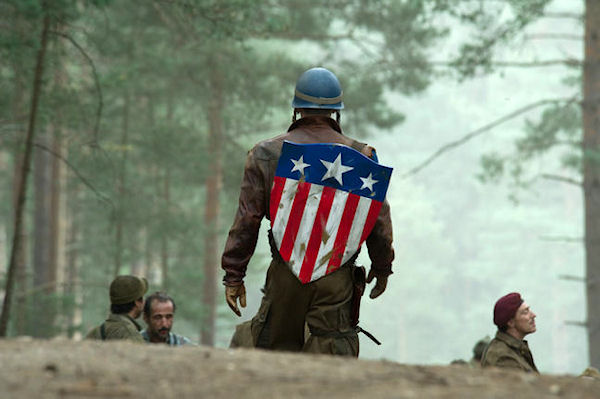
What I said: "The best thing about Johnston’s Captain America is that it’s completely earnest... Chris Evans’ Steve Rogers is played almost completely straight. Other characters make jokes about his shrimpy pre-experiment figure, but Steve himself is on the level. When asked why he wants to kill Nazis he delivers what is, for me, the film’s key line of dialogue: “I don’t want to kill anybody. I just don’t like bullies.” Laugh if you want but that’s a glorious sentiment at a time when cold-hearted revenge movies are at a premium. It also serves to ensure that Steve’s wish to go to the front isn’t because he is some kind of wide-eyed boy adventurer who never read any Wilfred Owen... He isn’t an alpha-male douchebag, he’s a little guy motivated by a desire to protect the weak from the strong. His motivations are pretty much that simple and it makes for a likable, surprisingly compelling character, with Evans a thoroughly engaging presence from beginning to end."

My most controversial choice here, by some distance, 'Captain America: The First Avenger' is not a film I suspect will register on the best film lists of even the most blockbuster-friendly critics. But it's no fluke that I've put it here. I've seen it four times since release at the time of writing, and I've enjoyed it just as much on each occasion. In fact the last time I saw it I was moved to tears (I honestly was) by its simple, honest charm and unimpeachable good nature.
You see, as someone who was bullied and carries a certain amount of insecurity and anxiety with him as a result, a hero like Steve Rogers (Chris Evans) means a great deal. He's a man defined by weakness of body and faltering health; a man whose every day has been lived as the butt of every punchline. Yet he's kind and compassionate to a fault in spite of it all. This is his greatest strength: he is basically a nice guy. Living in 40s New York, Steve believes in everything America represented and without question. He believes in the idea of America regardless of the reality and this is something Joe Johnston's comic book adaptation allows this unambiguous hero to do without sniggering and covering its ass with irony.
It's completely earnest and totally lacking in cynicism. Which is - beyond being admirable - disarmingly brave in an age where ironic distance is a knee-jerk response for so many. When Rogers is made a beefcake super soldier, and assumes the mantle of Captain America, we don't hate this newly muscle-bound Adonis because he remains at heart the same weedy kid with wide-eyes and good intentions, not intent on killing enemies but solely set on protecting the weak against the strong.
But beyond the fact it clearly touched me on a personal level, it also made me smile - almost more than anything else this year. Alan Silvestri's triumphant score accompanies daringly stylised visuals from Johnston, reminiscent of his 90s flop 'The Rocketeer' and with a definite Steven Spielberg's 'Amazing Stories' vibe. There is even a song, with lyrics by Disney veteran Alan Menkin, sung by chorus girls during a sparkly USO show (my favourite section of the film). In 2D the special effects look somehow much less impressive - and the ending is more about setting up next year's 'The Avengers' than closing Johnston's movie - but I could care less. I just plain love this movie.
3) Hara-Kiri: Death of a Samurai, dir Takashi Miike, JAP
What I said: "With '13 Assassins' Miike playfully mocked Japanese tradition and criticised the country's historic cultural values. He questioned why honour and death are so often linked and had his heroes kick dirt in their enemies faces - fighting for survival rather than as part of some slickly choreographed pageant. Here these criticisms are foregrounded. Social class, poverty and a culture of obligation are targets, as well as the wisdom of bushido. And just as the child-murdering, woman-deforming lord in '13 Assassins' represented all that's contradictory about a society which saw swordplay as equivalent to penmanship and poetry - outwardly representing all that was considered beautiful - in 'Hara-Kiri' such vanity is attacked again."

Takashi Miike is fast becoming one of my favourite active filmmakers, having produced two masterful samurai epics (probably the greatest of all genres) in as many years. I find it hard to choose between this and '13 Assassins' (high up on last year's list) but at the moment I'm leaning towards regarding 'Hara-Kiri: Death of a Samurai' as the superior film - even if it's far less exciting in terms of visceral bloody action.
What I really like about 'Hara-Kiri' is that it takes Miike's subversion of tradition and satire of violence to new levels as he abandons his usual fun, anarchic sensibility to make a heartfelt and passionate period melodrama. In this deeply humanist film, Miike contrasts real honour and courage with the pretence of honour, found in ritualised (dehumanising) behaviour. I don't want to repeat myself, so I'll just put a link to my review here - if you're interested in how he subverts feudal Japanese values and why I loved it so much.
The film is also notable in that it's the first straight drama I've seen designed for 3D (in fact it's the first 3D film in history to play in competition in Cannes) and it works very well. It seems entirely appropriate that a film involving the elaborate and precise staging of a ritual should wish to fully exploit depth and create a sense of space, though this also has a dramatic effect, distancing our hero from those who sit in judgement and occupy more lofty positions in society.
2) A Separation, dir Asghar Farhadi, IRN
What I said: "[A Separation] is a tightly made ensemble piece that is as enthralling as it is tear-inducing. It is quite simply the best film I have seen so far this year and the first film to really knock me for six at [this year's Berlin Film Festival]. A human story of great social relevance as well as unmatched depth of feeling. Sincere, passionate and intelligent."

I feel as though I've been going on about this one all year - since even before it had a localised English title and I was still calling it 'Nader and Simin: A Separation' - following its triumph in Berlin. It was, without doubt, the best film I saw at that festival, though that's taking nothing away from the competition because 'A Separation' is a film of singular greatness. It tells a morally complex story populated by well-rounded, fully-formed characters. It would be possible to pick any character and side with them fully in this feud between two families (divided by class and religion) who go to a "family court" in Tehran to solve a highly complex dispute.
Director Asghar Farhadi reserves judgement on proceedings almost entirely, allowing his camera to act as an impartial observer and in doing so gives us a very humane, apolitical account of life in his country. It isn't as stylishly shot as many of the other films on this list, though it's certainly handsomely made, but in this case the content more than justifies the form (making it pretty much the opposite of 'Drive').
1) Melancholia, dir Lars Von Trier, DEN
What I said: "Von Trier has long been able to dazzle critics with his technique and 'Melancholia' is an immensely beautiful film, comprised of haunting and truly spectacular images from start to finish. Taken at face value the impending apocalypse plot is also dramatic and terrifying. But more significantly, what we have here is his most candid and revealing film. It's thought-provoking, personal, earnest and far less oblique than some of his previous work."

A highly personal choice, as I hope you'll appreciate from my review (and my evangelical, hyper-passionate podcast on the subject), 'Melancholia' has divided critics this year but I was among those deeply moved and inspired by it. Having struggled with depression myself over the years I find Kirtsen Dunst's star turn here as deeply affecting as Von Trier's stunningly realised story, which works in its own right as intriguing doomsday sci-fi. Here the imminent destruction of the planet by another heavenly body is a potent metaphor for the suffocating, world-ending effects of the illness.
But forgetting my personal attachment to the themes, 'Melancholia' is also a beautiful experience full of droll satire and deftly-observed social observations. The art design and special effects are jaw-droppingly gorgeous, whilst there isn't a bad performance among the terrific cast. I can't think of a more perfect film this year. It beats out long-time frontrunner 'A Separation' by virtue of Von Trier's virtuosity and because of the deep, personal connection I feel to every minute I spent locked in this world.
'Melancholia', for me anyway, perfectly captures what it feels like to be depressed and, as a result, I can't imagine a film less depressing or more life-affirming. Often knowing that someone else is going through a similar thing can be helpful and there is no greater thrill than seeing my own scattered thoughts and feelings distilled in this way, far more competently conveyed than I could hope to do in words. He might have pissed a lot of people off with his daft comments at Cannes earlier this year, but Lars Von Trier has helped me a great deal and I will be forever thankful.
10) Pina, dir Wim Wenders, GER
What I said: "[Wenders'] use of space, the way he stages the action, is just incredible and wholly new, whilst the cinematography and camerawork is beautiful to behold. 'Pina' is a technical masterpiece and a bold piece of work all ways around. Watching it I was struck by how conceivably any film characterised by incredible blocking and interesting use of space would not only work in [3D] but would in fact be enhanced by it... 'Pina' proves there is a place for 3D in the arthouse and in the hands of auteurs."

3D adds depth, obviously, but is that useful and if so how? Its advocates often compare stereoscopy to the additions of sound and colour, yet it seems clearer to us what those advancements have enabled filmmakers to convey from a dramatic or artistic standpoint. A Marx Brothers comedy would simply not work if we couldn't hear Groucho's rapid-fire one-liners, whilst 'The Wizard of Oz' would probably not dazzle us so much if it remained in black and white after Dorothy set foot in the fantasy realm of the title. But, by comparison, what does 3D offer and what do we stand to lose without it? How can the addition of depth be used beyond the initial spectacle, in order to assist a director in telling a particular type of story or giving a very specific experience?
This year 3D has been used by some heavyweight talents, whose movies are perhaps more familiar to arthouse patrons than mass audiences. Werner Herzog used the technique to give us a rare glimpse inside the Chauvet caves in 'Cave of Forgotten Dreams', whilst Martin Scorsese had a lot of fun with its possibilities making 'Hugo' (more on that below). But it's really Wim Wenders who has provided the most compelling evidence that 3D can undeniably add something to a cinema experience that you'd miss greatly if it were taken away. I'd watch most other 3D movies in 2D with minimal complaint, but to me it seems central to what made Wenders' 'Pina' work.
A quasi-documentary, the film is a tribute to the late experimental dance artist Pina Bausch, bringing together a series of dance sequences as performed by her troupe. These expressionistic pieces range from harrowing to comical to downright bizarre and are separated by passionate monologues delivered by those who knew her, talking about Bausch's character and attitude to art. The 3D allows us to appreciate the dances more fully than we might otherwise, giving a proper sense of how the performers negotiate space. Wenders shoots almost every scene from a slightly elevated angle that emphasises the depth of each frame and gives us the best possible view of Bausch's inimitable choreography.
9) The Skin I Live In, dir Pedro Almodóvar, SPA
What I said: "When reviewing so-called "World Cinema" you often encounter brilliant films that you know stand next to no chance of reaching a wide audience. For most 'Of Gods and Men' would be far too austere and ponderous, whilst even 'The Tree of Life' was far too esoteric for the crowds that flocked to see "that Brad Pitt movie". Yet 'The Skin I Live In' has such tremendous, heartening potential for cross-over appeal, thanks to its tight, well-paced and surprise-filled story. It's never less than engaging for a single frame and, with its ruminations on identity and moral complexity (to put it lightly), must also rank among the year's most intelligent and thought-provoking films."

It's a slightly tawdry premise in keeping with the bulk of director Pedro Almodóvar's filmography, handled with the same mix of black humour, cheerful amorality and brightly lit, intensely colourful cinematography. In 'The Skin I Live In' a mysterious prisoner (Elena Anaya) is kept locked up within the mansion of a mad scientist (Antonio Banderas). He's a world class plastic surgeon and it becomes clear that this beautiful woman has undergone extensive, experimental surgery transforming her unrecognisably from whoever she once was. But who is she?
Seldom does a plot twist have this much impact on me, but 'The Skin I Live In' kept me guessing all the way through and, when the big reveal is made, left me gasping. Almodóvar very cleverly misdirects the viewer, making them draw conclusions throughout which, with each passing scene, make events seem more outrageous and Banderas' character seem ever more psychotic. But beyond this guessing game the film is surprisingly profound as an exploration of identity. To what extent are we defined by what we look like and how people treat us? Are we much more than the skin we inhabit?
8) Rise of the Planet of the Apes, dir Rupert Wyatt, USA
What I said: "'Rise' is a dramatic story first and an action film second and this all comes courtesy of [Andy] Serkis and WETA. It is a combination of a skilled character actor and tremendous animators that creates such a compelling and credible character in Caesar. A chimp adopted by James Franco's scientist after his mother is killed in the lab, he is the focus of the entire film and we follow him from newborn to energetic teenager, before he is brutalised and locked away. Caesar then (perhaps reluctantly) takes up the mantle of revolutionary leader to free apes from their human oppressors, grappling with moral and existential concerns along the way. What nuance the film has is in this journey, as key moments include subtle looks in the ape's eyes as we see his worldview change wordlessly."

The human characters - who include James Franco and Freida Pinto - might be a little bland, but 'Rise of the Planet of the Apes' is all about the titular chimps as they get smart and begin a revolution which will (eventually) lead to the crazy, upside down world of the original 60s movie. As nominal head of the ape revolution, Caesar is the focus of the story - as played by Andy Serkis in a masterpiece of motion capture performance - and we see events through his eyes, coming to empathise with the apes rather than our own kind. But it's more than just an animal welfare story, with the apes' rise emblematic of how a mistreated underclass may act if pushed too far. That the press screening I attended coincided with the London riots was lost on no one.
I think a large part of my loving it also came from the film's use of the city of San Francisco, where I had been only weeks before the screening. Hitherto unknown director Rupert Wyatt shoots the city in a way which is entirely consistent with the real layout and - although the climactic (magnificently staged) battle takes place on the Golden Gate Bridge - he doesn't overdose on landmarks. I was also really amazed by how credible Wyatt's movie is able to make the entire 'Apes' premise. How is it possible for chimps to organise the overthrow of mankind, with all our guns and helicopters? This is how.
As the marvellously dystopian credits rolled, my cheering for the apes gave way to the realisation that it would soon be curtains for mankind. Proof if it were needed that we will basically root for anything if asked to by a filmmaker.
7) Hugo, dir Martin Scorsese, USA
What I said: "'Hugo' is not the most exciting, consistent or perfectly structured children's film you'll ever see. In fact it often seems like a slick piece of educational programming rather than a fun family movie - with the slapstick chases around the station the least effective sequences. It's almost as if Scorsese has engineered a self-indulgent piece of fan fiction as a clandestine way to educate children about the art form he loves and give some of his favourite film clips a fresh airing for a new audience. But as a fellow lover of cinema I find this entirely admirable. It's heartening to see such an unabashed celebration of art."

It's perhaps not an entirely successful family film, seeing as how every person I've spoken to saw it with only half a dozen middle aged men for company, but 'Hugo' made me smile with its brazen, unapologetic love for cinema. It's less a children's adventure story than an excuse for Martin Scorsese to show us all his favourite silent movie clips and even stage an overdue lifetime's achievement evening for cinema's first magician Georges Méliès. Though it hardly matters when the result is this joyful and affirmative about the importance of art - as well as the preservation, history and criticism of that art.
I worry that it's ended up only preaching to the converted, though I fancy a lot of kids would find themselves inspired by Martin Scorsese's beautiful cinema history lesson, even if just as many were bored to tears. And whilst not as experimental or accomplished as that in 'Pina', the use of 3D here is another powerful statement of intent from a respected pro. Scorsese may be approaching 70 but he's clearly still every bit as excited about the future and the possibilities of his medium as anyone.
6) Hanna, dir Joe Wright, GER/UK/USA
What I said: "The first time we hear anything of the intricate, energetic Chemical Brothers score is when Hanna makes a conscious decision to leave the safety of life with he father and accept her deadly mission. The music makes her anxiety and excitement palpable, and every time we hear it subsequently – such as when she is escaping from a military facility in a spectacularly choreographed light show – it forms part of a hyper-stylised representation of Hanna’s psyche. When soldiers surround her log cabin near the start of the film, the score stands for the nervous anticipation of first contact with people other than her father. In this way 'Hanna' is an example of proper cinema which, rather than being a slave to dialogue, tells its story through the harmonious marriage of sound and image – and with magnificent economy."

An exuberant, hi-octane modern fairytale, 'Hanna' is a coming of age story about one young woman whose years in near isolation are ended suddenly, opening up a new world of senses, sounds and experiences. The titular teen assassin (Saoirse Ronan) spans Europe, running for her life to a breathless Chemical Brothers score, chased by a wicked witch (Cate Blanchett's obsessive CIA operative) and her campy German goons (led by Tom Hollander). Director Joe Wright tells a very simple story with singular vision and confidence, with sound and image merging together in a way that makes the hairs on the back of my neck stand on end.
I liked it the first time I saw it, especially because of its immensely capable if socially challenged heroine, but only really started loving it on repeat viewing where it all started to make much more sense. It's the sort of film I find literally mesmerising, in that I'd be compelled to continue watching it if I saw a single scene.
5) Tinker Tailor Soldier Spy, dir Tomas Alfredson, UK/FRA
What I said: "This is not a glossy, establishment picture of Britain we're being sold. It's a world very alien from that James Bond inhabits, as our spies juggle with mundane concerns and petty office politics as well as the very real risk of death at the hands of enemy agents. It's a film where our heroes spend most of the movie secretly investigating their friends and, in effect, battling their own government whilst (ironically) trying to catch out one charged with doing the same. Seldom have the words "we're not so very different you and I" seemed less like hollow cliche as they do here, as [protagonist George] Smiley - not an idealist or ardent anti-communist by any standard - ponders on the moral equivalence of it all."

The source of more violent disagreements than any other on this year's entire top 30 list, Tomas Alfredson's follow-up to 'Let the Right One In' is not to everybody's taste. It's cold, slow, complicated and packs little action. There isn't much to be gained here by trying to guess who the Soviet spy is either, with little effort made to plant seeds, and I don't think that's the intention anyway: the reveal is supposed to be anti-climactic and disappointing (a fact which is clear in the novel). For a film which, on the face of it, promises to be a Cold War thriller, it isn't exactly thrilling. It's in many ways the anti-Bond, where spies live quiet, unfulfilled lives and never get the girl. Yet as a study of isolation and faded idealism it can't be beat.
I enjoyed Afredson's adaptation so much that I read John le Carré's original novel (which I also enjoyed greatly) straight afterwards and discovered, to my delight, that the film version still holds up incredibly well. The novel is, of course, much bigger: with more detail, more incident and a greater number of characters. But viewing the film subsequently I don't think there's anything important missing, as Peter Straughan's screenplay combines with Alfredson's eye for the smallest detail to ensure everything is there, even if it's only captured in a glance or a brief close-up. 'Tinker Tailor Soldier Spy' is a film that rewards those who watch films with both eyes open and their brain switched on. It desires to be read, studied and actively engaged with - not merely because of the labyrinthine plotting, but because Alfredson shows all and tells almost nothing.
It needn't be said that Gary Oldman gives a performance of understated brilliance as protagonist George Smiley (a man of more advanced years than his own), whilst everyone else, from Colin Firth to Mark Strong, is also terrifically cast and linger in the memory even with minimal screen time. Especially Tom Hardy as cocky maverick Ricki Tarr and Benedict Cumberbatch as Peter Guillam, here re-conceived as a closet homosexual.
4) Captain America: The First Avenger, dir Joe Johnston, USA
What I said: "The best thing about Johnston’s Captain America is that it’s completely earnest... Chris Evans’ Steve Rogers is played almost completely straight. Other characters make jokes about his shrimpy pre-experiment figure, but Steve himself is on the level. When asked why he wants to kill Nazis he delivers what is, for me, the film’s key line of dialogue: “I don’t want to kill anybody. I just don’t like bullies.” Laugh if you want but that’s a glorious sentiment at a time when cold-hearted revenge movies are at a premium. It also serves to ensure that Steve’s wish to go to the front isn’t because he is some kind of wide-eyed boy adventurer who never read any Wilfred Owen... He isn’t an alpha-male douchebag, he’s a little guy motivated by a desire to protect the weak from the strong. His motivations are pretty much that simple and it makes for a likable, surprisingly compelling character, with Evans a thoroughly engaging presence from beginning to end."

My most controversial choice here, by some distance, 'Captain America: The First Avenger' is not a film I suspect will register on the best film lists of even the most blockbuster-friendly critics. But it's no fluke that I've put it here. I've seen it four times since release at the time of writing, and I've enjoyed it just as much on each occasion. In fact the last time I saw it I was moved to tears (I honestly was) by its simple, honest charm and unimpeachable good nature.
You see, as someone who was bullied and carries a certain amount of insecurity and anxiety with him as a result, a hero like Steve Rogers (Chris Evans) means a great deal. He's a man defined by weakness of body and faltering health; a man whose every day has been lived as the butt of every punchline. Yet he's kind and compassionate to a fault in spite of it all. This is his greatest strength: he is basically a nice guy. Living in 40s New York, Steve believes in everything America represented and without question. He believes in the idea of America regardless of the reality and this is something Joe Johnston's comic book adaptation allows this unambiguous hero to do without sniggering and covering its ass with irony.
It's completely earnest and totally lacking in cynicism. Which is - beyond being admirable - disarmingly brave in an age where ironic distance is a knee-jerk response for so many. When Rogers is made a beefcake super soldier, and assumes the mantle of Captain America, we don't hate this newly muscle-bound Adonis because he remains at heart the same weedy kid with wide-eyes and good intentions, not intent on killing enemies but solely set on protecting the weak against the strong.
But beyond the fact it clearly touched me on a personal level, it also made me smile - almost more than anything else this year. Alan Silvestri's triumphant score accompanies daringly stylised visuals from Johnston, reminiscent of his 90s flop 'The Rocketeer' and with a definite Steven Spielberg's 'Amazing Stories' vibe. There is even a song, with lyrics by Disney veteran Alan Menkin, sung by chorus girls during a sparkly USO show (my favourite section of the film). In 2D the special effects look somehow much less impressive - and the ending is more about setting up next year's 'The Avengers' than closing Johnston's movie - but I could care less. I just plain love this movie.
3) Hara-Kiri: Death of a Samurai, dir Takashi Miike, JAP
What I said: "With '13 Assassins' Miike playfully mocked Japanese tradition and criticised the country's historic cultural values. He questioned why honour and death are so often linked and had his heroes kick dirt in their enemies faces - fighting for survival rather than as part of some slickly choreographed pageant. Here these criticisms are foregrounded. Social class, poverty and a culture of obligation are targets, as well as the wisdom of bushido. And just as the child-murdering, woman-deforming lord in '13 Assassins' represented all that's contradictory about a society which saw swordplay as equivalent to penmanship and poetry - outwardly representing all that was considered beautiful - in 'Hara-Kiri' such vanity is attacked again."

Takashi Miike is fast becoming one of my favourite active filmmakers, having produced two masterful samurai epics (probably the greatest of all genres) in as many years. I find it hard to choose between this and '13 Assassins' (high up on last year's list) but at the moment I'm leaning towards regarding 'Hara-Kiri: Death of a Samurai' as the superior film - even if it's far less exciting in terms of visceral bloody action.
What I really like about 'Hara-Kiri' is that it takes Miike's subversion of tradition and satire of violence to new levels as he abandons his usual fun, anarchic sensibility to make a heartfelt and passionate period melodrama. In this deeply humanist film, Miike contrasts real honour and courage with the pretence of honour, found in ritualised (dehumanising) behaviour. I don't want to repeat myself, so I'll just put a link to my review here - if you're interested in how he subverts feudal Japanese values and why I loved it so much.
The film is also notable in that it's the first straight drama I've seen designed for 3D (in fact it's the first 3D film in history to play in competition in Cannes) and it works very well. It seems entirely appropriate that a film involving the elaborate and precise staging of a ritual should wish to fully exploit depth and create a sense of space, though this also has a dramatic effect, distancing our hero from those who sit in judgement and occupy more lofty positions in society.
2) A Separation, dir Asghar Farhadi, IRN
What I said: "[A Separation] is a tightly made ensemble piece that is as enthralling as it is tear-inducing. It is quite simply the best film I have seen so far this year and the first film to really knock me for six at [this year's Berlin Film Festival]. A human story of great social relevance as well as unmatched depth of feeling. Sincere, passionate and intelligent."

I feel as though I've been going on about this one all year - since even before it had a localised English title and I was still calling it 'Nader and Simin: A Separation' - following its triumph in Berlin. It was, without doubt, the best film I saw at that festival, though that's taking nothing away from the competition because 'A Separation' is a film of singular greatness. It tells a morally complex story populated by well-rounded, fully-formed characters. It would be possible to pick any character and side with them fully in this feud between two families (divided by class and religion) who go to a "family court" in Tehran to solve a highly complex dispute.
Director Asghar Farhadi reserves judgement on proceedings almost entirely, allowing his camera to act as an impartial observer and in doing so gives us a very humane, apolitical account of life in his country. It isn't as stylishly shot as many of the other films on this list, though it's certainly handsomely made, but in this case the content more than justifies the form (making it pretty much the opposite of 'Drive').
1) Melancholia, dir Lars Von Trier, DEN
What I said: "Von Trier has long been able to dazzle critics with his technique and 'Melancholia' is an immensely beautiful film, comprised of haunting and truly spectacular images from start to finish. Taken at face value the impending apocalypse plot is also dramatic and terrifying. But more significantly, what we have here is his most candid and revealing film. It's thought-provoking, personal, earnest and far less oblique than some of his previous work."

A highly personal choice, as I hope you'll appreciate from my review (and my evangelical, hyper-passionate podcast on the subject), 'Melancholia' has divided critics this year but I was among those deeply moved and inspired by it. Having struggled with depression myself over the years I find Kirtsen Dunst's star turn here as deeply affecting as Von Trier's stunningly realised story, which works in its own right as intriguing doomsday sci-fi. Here the imminent destruction of the planet by another heavenly body is a potent metaphor for the suffocating, world-ending effects of the illness.
But forgetting my personal attachment to the themes, 'Melancholia' is also a beautiful experience full of droll satire and deftly-observed social observations. The art design and special effects are jaw-droppingly gorgeous, whilst there isn't a bad performance among the terrific cast. I can't think of a more perfect film this year. It beats out long-time frontrunner 'A Separation' by virtue of Von Trier's virtuosity and because of the deep, personal connection I feel to every minute I spent locked in this world.
'Melancholia', for me anyway, perfectly captures what it feels like to be depressed and, as a result, I can't imagine a film less depressing or more life-affirming. Often knowing that someone else is going through a similar thing can be helpful and there is no greater thrill than seeing my own scattered thoughts and feelings distilled in this way, far more competently conveyed than I could hope to do in words. He might have pissed a lot of people off with his daft comments at Cannes earlier this year, but Lars Von Trier has helped me a great deal and I will be forever thankful.
Wednesday, 14 December 2011
My Top 30 Films of 2011: 20-11
This is the second part of my 2011 top 30 films list/shameless vanity exercise. If you haven't already read through entries 30-21, then do so here.
20) Midnight in Paris, dir Woody Allen, USA
What I said: "It is fair to say my expectations for 'Midnight in Paris' were set extremely low - especially given that Allen's last film ['You Will Meet a Tall Dark Stranger'] was utterly abysmal. But for the first time in what feels like a decade, I absolutely loved a new Woody Allen film, almost without qualification. For the first time since childhood I laughed at one of his movies: not knowing laughs of polite recognition, but hearty, belly laughs. For the first time in around a decade, here is a Woody Allen film with imagination."

"Return to form" is an overused phrase critics have trotted out to describe almost every Woody Allen film since the early 90s. His fall from talent has been exaggerated in part because, however enjoyable 'Whatever Works' might be, it's never going to measure up alongside the man's most iconic 70s masterpieces, 'Annie Hall' and 'Manhattan'. Allen has gone from being mentioned in the same company as Fellini and Bergman, to being merely considered occasionally brilliant. Had an unknown director given us 'Deconstructing Harry' or 'Sweet and Lowdown', perhaps critics (and audiences) would have been more enthusiastic.
In any case, this year's Woody Allen film, 'Midnight in Paris', not only warrants the phrase "return to form" but also, for the first time in a long time, lives up to its billing as a comedy. Unlike the banal dramas that have followed in the wake of the dreary 'Match Point', here is an Allen movie that has the sort of bizarre premise he used to be known for, with time travel central to the plot as Owen Wilson's Gil Pender travels between modern Paris and its boisterous 1920s past. Allen's shooting of the city itself could be dismissed as the dreaded "tourist's eye view", but he shoots Paris as romantically as he's ever shot his beloved New York. It exists here as Pender imagines it, without cynicism: as a place of unimpeachable beauty and radiant charm.
19) Caves of Forgotten Dreams, dir Werner Herzog, FRA/USA/GER
What I said: "It seems clear to me that the man who once pulled a steamboat over a mountain is again revelling in a self-imposed impossible challenge, perhaps as a reaction against the fact that he is forced to use amateur cameras for the expedition. It is entirely possible that [Herzog] only considered making the film [in 3D] due to the fact that it wouldn’t even have occurred to anyone else that it could be. “One small, inexpensive camera? I bet I can do a 3D film this way” I can imagine him saying to himself, as if for his own sense of pride and amusement. It’s bonkers and brilliant, especially when he attaches a small RC helicopter to his camera in order to pull off a series of sweeping 3D aerial shots of a ravine, all on a micro budget."

For me the release of a new Werner Herzog documentary is a keenly awaited cinematic event that never disappoints. He asks strange and profound questions that wouldn't occur to anybody else, seeking out odd, often dangerous, subject matter armed only with a grim Teutonic stare. Yet for all the bad impressions of his distinctive narration, Herzog manages to seem sincere and unpretentious even when he chooses to end a documentary on pre-historic cave paintings musing on the significance - and possible future proliferation - of "mutant albino crocodiles".
'Cave of Forgotten Dreams', filmed innovatively in lo-fi 3D, takes us into the Chauvet cave in southern France - thought to be home to the earliest examples of human art, hosting elaborate cave paintings over 30,000 years old. It's a revealing documentary which, like the best history, explores how similar our ancestors were to us as opposed to sensationally playing up superficial differences (what I like to call the "how did Henry VIII go to the toilet?" line of enquiry). Here Herzog suggests the paintings provide us a glimpse into the aspirations of the artists who painted them - showing us how they perceived the world around them: a Europe filled with bears, tigers and rhinos, yet familiar in surprising ways. At one point he describes the paintings as a kind of "proto-cinema", projecting dreams onto the walls of a darkened room. Whatever you make of that, it's difficult to watch this existential documentary in anything other than a state of awe.
18) The Tree of Life, dir Terrence Malick, USA
What I said: "'The Tree of Life' offers a simplistic and idealistic version of nature and of our place within it, where spirituality is unchallenged from its dominant Hollywood position where it stands for "depth" and "truth". In this way Malick has made a movie which supports the dominant ideology almost wholeheartedly, however ambitious it might be in scale. It's a seductive tapestry and, in a few instances, it is genuinely heartfelt, yet something is missing. The anti-war sentiment of 'The Thin Red Line' and its critique of capitalism ("the whole thing's about property") or the nihilistic, satirical edge of 'Badlands', seem like they come from a very distant place from 'The Tree of Life', which unambiguously advocates an intelligent design view of life on our planet. Religion has always formed a large part of the sub-text, and even the text, of Malick movies - but never to the same extent as this passionate hymn."

I'm deeply conflicted about where I stand on Terence Malick's 'The Tree of Life'. I don't share its creators reductive, idyllic view of nature - which reaches its nadir during one preposterous sequence in which carnivorousness dinosaur shows a wounded herbivore compassion. Nor do I particularly care about the questions he is asking in relation to the increasingly trite concept of "faith", let alone God and/or heaven (tweely presented as a beach where we can hang out with all our favourite people). It's a sappy, sun-soaked, slightly ponderous film, however technically accomplished, and its place at the apex of so many other "best of 2011" lists will likely always be a thing of mystery to me.
So why is it on my list? Why have I placed it higher up than, say, 'Midnight in Paris', which I adored? Simply because no other film has inspired as much debate this year and because few other films (and I mean in history) have been as ambitious. This is a movie which gives you the beginning of time, the end of time (by far the most impressive sequence emotionally and cinematically), Sean Penn living in the future, Brad Pitt living in the 1950s and CGI dinosaurs. It's a film that exists purely to ask big unanswerable questions like "why are we here?", "what is there next?", "do our finite (mortal) existences have meaning?" and, more to the point, trusts cinema at its most visual as a tool to explore them. I applaud the scope of 'The Tree of Life' and the boldness with which it was made. I like that you can spend hours discussing it when the vast majority of movies are forgotten days after leaving the cinema.
17) Attack the Block, dir Joe Cornish, UK
What I said: "Far from being the sustained, middle class wink that I'd feared, 'Attack the Block' is the smart, funny and slickly produced feature that I'd hoped for. As a first time director, Joe Cornish has displayed a level of assuredness that is encouraging and - if he can resist the inevitable overtures of Hollywood - his brand of eye-catching, socially conscious and unpretentious comedy could be a sizable boon for British cinema for years to come."

Thanks to people like Owen Jones - author of one of 2011's best-selling books: Chavs: The Demonization of the Working Class - use of the word "chav" is increasingly unfashionable. For the best part of a decade it has been the acceptable face of bigotry in the UK to make glib jokes at the expense of the urban poor, with the fashion, patois and even leisure choices of the country's most disenfranchised social group providing years of material for middle-class, millionaire comedians like Jimmy Carr.
With social class now returning to political discourse, Joe Cornish's 'Attack the Block' could have been ill-timed: the latest tired re-hash of a joke that peaked with Little Britain almost ten years ago (and even then wasn't very funny). A comedy-horror about an alien invasion of a council estate, I worried it might be little more than a series of jokes about people saying "innit blood". Instead it's one of the most timely and significant British films of the year, taking these urban boogie men (young, hoodie-wearing males) and humanising them without condescension.
In fact Cornish manages a very difficult balancing act which involves presenting the kids both as threatening examples of gang culture, not sanitising their manner or attitude to violence as they begin the film robbing a woman at knife-point, whilst also making us care for them and - hopefully - understand their concerns. It's a cultural minefield navigated with preternatural skill and no lack of cinematic flare. There are jokes about the culture, of course, but they are gentle and affectionate rather than just plain derogatory. For instance, one of the gang responds to the alien invasion by saying, without irony, "I wanna go home, lock my door and play FIFA." That's probably the single funniest line of 2011.
16) Thor, dir Kenneth Branagh, USA
What I said: "'Thor' is good value entertainment with its share of climactic fist-pumping moments. It's also not as shallow as you might expect, with pretty well-rounded characters and a sympathetic villain. Its director is best known for adapting Shakespeare for the screen and, had the Bard penned a treatment of the screenplay, it would be easy to imagine this story from the point of view of Loki (Tom Hiddleston) as a great tragedy."

For me the year's two biggest surprises have been Marvel comic adaptations, with the unsung and potentially ridiculous 'Captain America' and 'Thor' both far exceeding my meagre expectations. Both exist, primarily, to set up next year's 'The Avengers' superhero team-up movie and, as such, could have been little more than glossy, two hour long trailers (just like 'Iron Man 2'). But both were actually incredibly good blockbusters, far better than the average shlock served up to "the kids" and made with a genuine sense of style. Tightly paced, intelligently realised entertainment.
'Thor', directed by Kenneth Branagh, is made with a great deal of care, love and attention to detail, working from a smart script populated by interesting characters. The story arc of the titular god of thunder (Chris Hemsworth) must go on that familiar trajectory of growth and discovery, yet it doesn't feel contrived or hokey in the least. The performances (notably from Tom Hiddleston, Anthony Hopkins and Natalie Portman) are terrific, the action is exciting and Branagh even manages to suspend audience disbelief enough that we accept an alien world of Viking gods is connected to our own without sniggering. It's a colourful, fun superhero movie that proves you can stick closely to the source material without being either campy or knowing.
Making a big-budget movie version of 'Thor' was a risk on Marvel's part, with the blockbuster success of niche superhero franchises never a sure-fire thing. History is littered with the corpses of 'Daredevil', 'The Fantastic Four', 'The Punisher', 'Hulk', 'Ghost Rider' and, lest we forget, this year's universally panned 'The Green Lantern'. So to make a movie about an alien in a red cape, who comes riding on a rainbow from a world of Viking gods in order to "find himself" with a group of plucky tornado chasers in the New Mexico desert - and to play that concept almost totally straight - was a ballsy move. A move that could have even jeopardised other now co-dependant franchises, such as 'Iron Man'. To greenlight that movie and assign it to a director primarily famous for Shakespeare adaptations? Sometimes the studios get it right.
15) Blue Valentine, dir Derek Cianfrance, USA
What I said: "'Blue Valentine' isn't that sad little emo poem of a movie you might think it is from the poster. It's a riveting film that says as much about love and romantic relationships as any other film I've seen as it bravely and skilfully jumps between emotional extremes with great economy and even subtlety. If it doesn't resonate with you on some level then I can only surmise that you haven't ever left the house. It's one of those movies that makes two hours feel like twenty minutes and leaves you feeling satisfied by the art form you love so much, despite the fact it so often breaks your fragile little heart."

Kicking off "the year of the Gosling", which has since seen the internet meme/indie heartthrob star in 'Drive', 'The Ides of March' and 'Crazy, Stupid, Love', 'Blue Valentine' is the story of a tempestuous relationship between a blue-collar high school dropout (Gosling) and a troubled medical student (Michelle Williams). Williams - as the reining queen of American independent film - is Gosling's female equivalent and the duo brood, pout and sigh through their ups and downs, pausing only to look moodily handsome.
As I contemplated in my original review, 'Blue Valentine' is easy to poke fun at in these terms, especially if you haven't seen it. The thing is it transcends this stereotype and becomes something much more emotionally affecting and much less preening. It was hyped at the time of its American release for supposedly being sexually explicit, though what's striking about the film is actually the rawness of both actors emotional commitment to each new argument or moment of exquisite joy. Unlike the relationships depicted in a lot of lesser movies, the married couple here convince as best friends in the early stages, with genuine chemistry, and do just as good a job portraying the later bitterness as strangers sharing a bed, tied together by a sense of obligation.
14) The Forgiveness of Blood, dir Joshua Marston, USA/ALB
What I said: "It’s old testament justice in the age of Facebook, mobile phone videos and PlayStation games, and the film shows this problem of a country straddling two eras by highlighting the divide between young and old people. Mark [Refet Abazi] is an agricultural worker and yet his eldest son, Nik (Tristan Halilaj), dreams of opening an internet cafe. However, Nik’s dreams – along with those of his siblings – are put on hold after [Mark commits] murder, as custom dictates that they stay in their homes on the understanding that any male who leaves is open to a revenge attack. The children are therefore no longer allowed outside and can not attend school. And though women are generally considered immune from the threat of violence, Nik’s little sister Rudina (Sindi Lacej) is also forced to abandon her dream of going to college as she has to take on the workload of the imprisoned males, which forces her to grow up prematurely."

A difficult film to adequately describe, 'The Forgiveness of Blood' may be set in contemporary Europe but it's so culturally specific to its northern Albanian setting - dealing with barbaric medieval blood feuds that are a widespread occurrence in the region - that it might as well be set on the moon. Director Joshua Marston is an American, but an Albanian co-writer (Andamion Murataj) and a cast primarily made up of local non-actors give this bleak family drama an air of rare authenticity. It's with no small amount of indignation and disbelief that I watched the film, as I never thought a system of institutionalised revenge could exist in a country only a short ferry ride from Italy.
Rather than have me explain the practice in a drawn-out fashion here, I'd recommend you Google "Albanian blood feuds" and have a quick look for yourself. What I will say is that the sense of social isolation and frustration felt by the children in the film is palpable, whilst it's beautiful to look at as it takes you to a place few tourists venture and few movies are set. 'The Forgiveness of Blood' is certainly eye-opening, which would be enough in of itself, yet this is also a brilliantly made film by any standard - as you might expect from the man behind 'Maria Full of Grace'.
13) The Guard, dir John Michael McDonagh, IRE
What I said: "Like the characters of 'In Bruges', Boyle [Brendan Gleeson] has a subversive sense of humour, which rubs [Don] Cheadle’s more disciplined law man up the wrong way. “I thought only black boys were drug dealers” Boyle says incredulously – and it’s never clear whether he is knowingly confrontational or just ignorant. When [Cheadle] is offended by his racism Boyle replies, “I’m Irish. Racism is part of me culture.” To say The Guard is ‘black comedy’ is to put it lightly. In addition to being a heavy drinker, Boyle beds prostitutes and makes extra money from selling firearms to the IRA. The film opens on his observing a car crash only to walk over to the dead body of a teenage victim and frisk it for drugs, which he finds and then uses on the spot."

A terrifically funny film (in fact the highest ranking comedy on this year's list), 'The Guard' is - like Edgar Wright's 'Hot Fuzz' - a routed in the juxtaposition of Hollywood movie police archetypes with rural law enforcement across the pond, in this case the Irish Garda. Don Cheadle's FBI Agent is a dispassionate professional and a less dangerous character than Brendan Gleeson's hedonistic local Gerry Boyle, with whom he is paired in order to track down a group of homicidal drug dealers in the Irish countryside.
Almost every aspect of the film operates on some slightly bizarre comic plane, from the incongruous use of Latin American music in an overcast Northern European setting to Boyle's wholesale lack of anything resembling duty, respect or good taste (always an interesting combination for a hero). There's humour in incidental details too, such as the Daniel O'Donnell poster that hangs on the Irish policeman's bedroom wall. Directed by the brother of 'In Bruges' writer-director Martin McDonagh, 'The Guard' does compare to that film with its pitch black comedy and cleverly written characters, who in both instances have an unexpected innocence which prevents the film from being nasty.
12) We Need to Talk About Kevin, dir Lynne Ramsay, UK
What I said: "Ramsay tastefully avoids depicting the horrific event itself (or indeed many of the preceding horrific events), but even so she manages to make even the most banal instances (a drive through suburbia, a trip to the supermarket) intense and frightening throughout. This has a lot to do with punchy editing, jarring musical choices and a stand out performance from relative unknown [Ezra] Miller."

As with 'The Tree of Life', this is a film I have developed a complicated relationship with. Framed around the questions of nurture vs. nature, we contemplate the "evil" actions of the titular schoolboy (Ezra Miller) and ponder the culpability of his mother (Tilda Swinton). The problem for me is that I don't have any time for the suggestion that evil exists, let alone the idea that it could possibly be an innate property. Therefore one reading of the film leaves me totally unsatisfied, as we are shown a small toddler who seems to maliciously undermine his mother at every turn. The other idea, that the boy's upbringing/environment is to blame for his crimes, is equally lacking, with trite finger-pointing at "the media" and violent video games which fails to treat the issue with appropriate levels of engagement.
It works slightly better if you switch focus from vainly asking "why?" and look at it as a study of Swinton's despairing mother, living in the aftermath of her son's actions. We see her slapped, spat at, harassed at work and out at the supermarket. Her house and car are repeatedly vandalised and her family has been destroyed. What must it be like to live in the shadow of a relative who's committed a famous violent crime? That seems, to me, a more interesting and unorthodox question. And whilst the film doesn't delve too deeply into Kevin's psychology (however brilliantly he's played by Miller), Swinton's performance is full of nuance and depth.
But if the film doesn't totally work for me - at least on its own terms - then why is it so high up this list? The simple answer is because Lynne Ramsay has made one of the scariest, most uncomfortable, most tense films I have ever sat through in a cinema. The permanent sense of unease created by the film owes a lot to the editing, the claustrophobic shooting style and some inspired musical choices. Especially as the climactic acts of violence are never shown. As a sensory experience - and as an acting showcase for Tilda Swinton - 'We Need to Talk About Kevin' is almost unbeatable.
11) Weekend, dir Andrew Haigh, UK
What I said: "Director Andrew Haigh's naturalistic screenplay, along with the fine performances of both leads, brings to life a film of emotional substance and nuance, in which neither character is judged by the filmmaker even as they judge and contradict each other. Glen's cynical take on marriage, as a sort of fay middle class obligation, is every bit as persuasive as Russell's suggestion that the ritual represents a bold public declaration of love. In this way the lengthy, often drug-fuelled, exchanges between them - as they discuss art, sex and gay rights of passage - are always interesting, funny and heartfelt - never sentimental or contrived."

Films are very expensive to produce. That might seem obvious but it's worth pointing out here anyway. This, I would argue, is the reason we don't see many films about homosexuality at the multiplex. Producers will make anything (and I mean anything) as long as they think it stands a chance of making money, which is why we see so many obnoxious movies ostensibly aimed at young, white males. There is a reason 'Fast Five' has that "five" in the title: because films about muscle-bound douchebags blowing stuff up and driving really fast cars consistently reap commercial rewards.
At the risk of seeming naive, I think prejudice and bigotry are less the cause of this kind of thing than cold market forces. Simply put: prove that there's a huge audience for mature movies about homosexuality that aren't tacky or condescending and you might just see three more pop up in its place. 'Weekend' is that pioneering movie: a huge independent sleeper hit that forced cinema after cinema to take it on long after its release date due to fervent popular demand.
'Weekend' is on this list in part because it's a refreshingly frank and, as far as I can tell, honest depiction of a minority group that's under-represented in the mainstream media. It's so high on this list because it's a superbly made film by any standard: sweet, thoughtful and funny, with two terrific lead actors and an intelligent screenplay.
20) Midnight in Paris, dir Woody Allen, USA
What I said: "It is fair to say my expectations for 'Midnight in Paris' were set extremely low - especially given that Allen's last film ['You Will Meet a Tall Dark Stranger'] was utterly abysmal. But for the first time in what feels like a decade, I absolutely loved a new Woody Allen film, almost without qualification. For the first time since childhood I laughed at one of his movies: not knowing laughs of polite recognition, but hearty, belly laughs. For the first time in around a decade, here is a Woody Allen film with imagination."

"Return to form" is an overused phrase critics have trotted out to describe almost every Woody Allen film since the early 90s. His fall from talent has been exaggerated in part because, however enjoyable 'Whatever Works' might be, it's never going to measure up alongside the man's most iconic 70s masterpieces, 'Annie Hall' and 'Manhattan'. Allen has gone from being mentioned in the same company as Fellini and Bergman, to being merely considered occasionally brilliant. Had an unknown director given us 'Deconstructing Harry' or 'Sweet and Lowdown', perhaps critics (and audiences) would have been more enthusiastic.
In any case, this year's Woody Allen film, 'Midnight in Paris', not only warrants the phrase "return to form" but also, for the first time in a long time, lives up to its billing as a comedy. Unlike the banal dramas that have followed in the wake of the dreary 'Match Point', here is an Allen movie that has the sort of bizarre premise he used to be known for, with time travel central to the plot as Owen Wilson's Gil Pender travels between modern Paris and its boisterous 1920s past. Allen's shooting of the city itself could be dismissed as the dreaded "tourist's eye view", but he shoots Paris as romantically as he's ever shot his beloved New York. It exists here as Pender imagines it, without cynicism: as a place of unimpeachable beauty and radiant charm.
19) Caves of Forgotten Dreams, dir Werner Herzog, FRA/USA/GER
What I said: "It seems clear to me that the man who once pulled a steamboat over a mountain is again revelling in a self-imposed impossible challenge, perhaps as a reaction against the fact that he is forced to use amateur cameras for the expedition. It is entirely possible that [Herzog] only considered making the film [in 3D] due to the fact that it wouldn’t even have occurred to anyone else that it could be. “One small, inexpensive camera? I bet I can do a 3D film this way” I can imagine him saying to himself, as if for his own sense of pride and amusement. It’s bonkers and brilliant, especially when he attaches a small RC helicopter to his camera in order to pull off a series of sweeping 3D aerial shots of a ravine, all on a micro budget."

For me the release of a new Werner Herzog documentary is a keenly awaited cinematic event that never disappoints. He asks strange and profound questions that wouldn't occur to anybody else, seeking out odd, often dangerous, subject matter armed only with a grim Teutonic stare. Yet for all the bad impressions of his distinctive narration, Herzog manages to seem sincere and unpretentious even when he chooses to end a documentary on pre-historic cave paintings musing on the significance - and possible future proliferation - of "mutant albino crocodiles".
'Cave of Forgotten Dreams', filmed innovatively in lo-fi 3D, takes us into the Chauvet cave in southern France - thought to be home to the earliest examples of human art, hosting elaborate cave paintings over 30,000 years old. It's a revealing documentary which, like the best history, explores how similar our ancestors were to us as opposed to sensationally playing up superficial differences (what I like to call the "how did Henry VIII go to the toilet?" line of enquiry). Here Herzog suggests the paintings provide us a glimpse into the aspirations of the artists who painted them - showing us how they perceived the world around them: a Europe filled with bears, tigers and rhinos, yet familiar in surprising ways. At one point he describes the paintings as a kind of "proto-cinema", projecting dreams onto the walls of a darkened room. Whatever you make of that, it's difficult to watch this existential documentary in anything other than a state of awe.
18) The Tree of Life, dir Terrence Malick, USA
What I said: "'The Tree of Life' offers a simplistic and idealistic version of nature and of our place within it, where spirituality is unchallenged from its dominant Hollywood position where it stands for "depth" and "truth". In this way Malick has made a movie which supports the dominant ideology almost wholeheartedly, however ambitious it might be in scale. It's a seductive tapestry and, in a few instances, it is genuinely heartfelt, yet something is missing. The anti-war sentiment of 'The Thin Red Line' and its critique of capitalism ("the whole thing's about property") or the nihilistic, satirical edge of 'Badlands', seem like they come from a very distant place from 'The Tree of Life', which unambiguously advocates an intelligent design view of life on our planet. Religion has always formed a large part of the sub-text, and even the text, of Malick movies - but never to the same extent as this passionate hymn."

I'm deeply conflicted about where I stand on Terence Malick's 'The Tree of Life'. I don't share its creators reductive, idyllic view of nature - which reaches its nadir during one preposterous sequence in which carnivorousness dinosaur shows a wounded herbivore compassion. Nor do I particularly care about the questions he is asking in relation to the increasingly trite concept of "faith", let alone God and/or heaven (tweely presented as a beach where we can hang out with all our favourite people). It's a sappy, sun-soaked, slightly ponderous film, however technically accomplished, and its place at the apex of so many other "best of 2011" lists will likely always be a thing of mystery to me.
So why is it on my list? Why have I placed it higher up than, say, 'Midnight in Paris', which I adored? Simply because no other film has inspired as much debate this year and because few other films (and I mean in history) have been as ambitious. This is a movie which gives you the beginning of time, the end of time (by far the most impressive sequence emotionally and cinematically), Sean Penn living in the future, Brad Pitt living in the 1950s and CGI dinosaurs. It's a film that exists purely to ask big unanswerable questions like "why are we here?", "what is there next?", "do our finite (mortal) existences have meaning?" and, more to the point, trusts cinema at its most visual as a tool to explore them. I applaud the scope of 'The Tree of Life' and the boldness with which it was made. I like that you can spend hours discussing it when the vast majority of movies are forgotten days after leaving the cinema.
17) Attack the Block, dir Joe Cornish, UK
What I said: "Far from being the sustained, middle class wink that I'd feared, 'Attack the Block' is the smart, funny and slickly produced feature that I'd hoped for. As a first time director, Joe Cornish has displayed a level of assuredness that is encouraging and - if he can resist the inevitable overtures of Hollywood - his brand of eye-catching, socially conscious and unpretentious comedy could be a sizable boon for British cinema for years to come."

Thanks to people like Owen Jones - author of one of 2011's best-selling books: Chavs: The Demonization of the Working Class - use of the word "chav" is increasingly unfashionable. For the best part of a decade it has been the acceptable face of bigotry in the UK to make glib jokes at the expense of the urban poor, with the fashion, patois and even leisure choices of the country's most disenfranchised social group providing years of material for middle-class, millionaire comedians like Jimmy Carr.
With social class now returning to political discourse, Joe Cornish's 'Attack the Block' could have been ill-timed: the latest tired re-hash of a joke that peaked with Little Britain almost ten years ago (and even then wasn't very funny). A comedy-horror about an alien invasion of a council estate, I worried it might be little more than a series of jokes about people saying "innit blood". Instead it's one of the most timely and significant British films of the year, taking these urban boogie men (young, hoodie-wearing males) and humanising them without condescension.
In fact Cornish manages a very difficult balancing act which involves presenting the kids both as threatening examples of gang culture, not sanitising their manner or attitude to violence as they begin the film robbing a woman at knife-point, whilst also making us care for them and - hopefully - understand their concerns. It's a cultural minefield navigated with preternatural skill and no lack of cinematic flare. There are jokes about the culture, of course, but they are gentle and affectionate rather than just plain derogatory. For instance, one of the gang responds to the alien invasion by saying, without irony, "I wanna go home, lock my door and play FIFA." That's probably the single funniest line of 2011.
16) Thor, dir Kenneth Branagh, USA
What I said: "'Thor' is good value entertainment with its share of climactic fist-pumping moments. It's also not as shallow as you might expect, with pretty well-rounded characters and a sympathetic villain. Its director is best known for adapting Shakespeare for the screen and, had the Bard penned a treatment of the screenplay, it would be easy to imagine this story from the point of view of Loki (Tom Hiddleston) as a great tragedy."

For me the year's two biggest surprises have been Marvel comic adaptations, with the unsung and potentially ridiculous 'Captain America' and 'Thor' both far exceeding my meagre expectations. Both exist, primarily, to set up next year's 'The Avengers' superhero team-up movie and, as such, could have been little more than glossy, two hour long trailers (just like 'Iron Man 2'). But both were actually incredibly good blockbusters, far better than the average shlock served up to "the kids" and made with a genuine sense of style. Tightly paced, intelligently realised entertainment.
'Thor', directed by Kenneth Branagh, is made with a great deal of care, love and attention to detail, working from a smart script populated by interesting characters. The story arc of the titular god of thunder (Chris Hemsworth) must go on that familiar trajectory of growth and discovery, yet it doesn't feel contrived or hokey in the least. The performances (notably from Tom Hiddleston, Anthony Hopkins and Natalie Portman) are terrific, the action is exciting and Branagh even manages to suspend audience disbelief enough that we accept an alien world of Viking gods is connected to our own without sniggering. It's a colourful, fun superhero movie that proves you can stick closely to the source material without being either campy or knowing.
Making a big-budget movie version of 'Thor' was a risk on Marvel's part, with the blockbuster success of niche superhero franchises never a sure-fire thing. History is littered with the corpses of 'Daredevil', 'The Fantastic Four', 'The Punisher', 'Hulk', 'Ghost Rider' and, lest we forget, this year's universally panned 'The Green Lantern'. So to make a movie about an alien in a red cape, who comes riding on a rainbow from a world of Viking gods in order to "find himself" with a group of plucky tornado chasers in the New Mexico desert - and to play that concept almost totally straight - was a ballsy move. A move that could have even jeopardised other now co-dependant franchises, such as 'Iron Man'. To greenlight that movie and assign it to a director primarily famous for Shakespeare adaptations? Sometimes the studios get it right.
15) Blue Valentine, dir Derek Cianfrance, USA
What I said: "'Blue Valentine' isn't that sad little emo poem of a movie you might think it is from the poster. It's a riveting film that says as much about love and romantic relationships as any other film I've seen as it bravely and skilfully jumps between emotional extremes with great economy and even subtlety. If it doesn't resonate with you on some level then I can only surmise that you haven't ever left the house. It's one of those movies that makes two hours feel like twenty minutes and leaves you feeling satisfied by the art form you love so much, despite the fact it so often breaks your fragile little heart."

Kicking off "the year of the Gosling", which has since seen the internet meme/indie heartthrob star in 'Drive', 'The Ides of March' and 'Crazy, Stupid, Love', 'Blue Valentine' is the story of a tempestuous relationship between a blue-collar high school dropout (Gosling) and a troubled medical student (Michelle Williams). Williams - as the reining queen of American independent film - is Gosling's female equivalent and the duo brood, pout and sigh through their ups and downs, pausing only to look moodily handsome.
As I contemplated in my original review, 'Blue Valentine' is easy to poke fun at in these terms, especially if you haven't seen it. The thing is it transcends this stereotype and becomes something much more emotionally affecting and much less preening. It was hyped at the time of its American release for supposedly being sexually explicit, though what's striking about the film is actually the rawness of both actors emotional commitment to each new argument or moment of exquisite joy. Unlike the relationships depicted in a lot of lesser movies, the married couple here convince as best friends in the early stages, with genuine chemistry, and do just as good a job portraying the later bitterness as strangers sharing a bed, tied together by a sense of obligation.
14) The Forgiveness of Blood, dir Joshua Marston, USA/ALB
What I said: "It’s old testament justice in the age of Facebook, mobile phone videos and PlayStation games, and the film shows this problem of a country straddling two eras by highlighting the divide between young and old people. Mark [Refet Abazi] is an agricultural worker and yet his eldest son, Nik (Tristan Halilaj), dreams of opening an internet cafe. However, Nik’s dreams – along with those of his siblings – are put on hold after [Mark commits] murder, as custom dictates that they stay in their homes on the understanding that any male who leaves is open to a revenge attack. The children are therefore no longer allowed outside and can not attend school. And though women are generally considered immune from the threat of violence, Nik’s little sister Rudina (Sindi Lacej) is also forced to abandon her dream of going to college as she has to take on the workload of the imprisoned males, which forces her to grow up prematurely."

A difficult film to adequately describe, 'The Forgiveness of Blood' may be set in contemporary Europe but it's so culturally specific to its northern Albanian setting - dealing with barbaric medieval blood feuds that are a widespread occurrence in the region - that it might as well be set on the moon. Director Joshua Marston is an American, but an Albanian co-writer (Andamion Murataj) and a cast primarily made up of local non-actors give this bleak family drama an air of rare authenticity. It's with no small amount of indignation and disbelief that I watched the film, as I never thought a system of institutionalised revenge could exist in a country only a short ferry ride from Italy.
Rather than have me explain the practice in a drawn-out fashion here, I'd recommend you Google "Albanian blood feuds" and have a quick look for yourself. What I will say is that the sense of social isolation and frustration felt by the children in the film is palpable, whilst it's beautiful to look at as it takes you to a place few tourists venture and few movies are set. 'The Forgiveness of Blood' is certainly eye-opening, which would be enough in of itself, yet this is also a brilliantly made film by any standard - as you might expect from the man behind 'Maria Full of Grace'.
13) The Guard, dir John Michael McDonagh, IRE
What I said: "Like the characters of 'In Bruges', Boyle [Brendan Gleeson] has a subversive sense of humour, which rubs [Don] Cheadle’s more disciplined law man up the wrong way. “I thought only black boys were drug dealers” Boyle says incredulously – and it’s never clear whether he is knowingly confrontational or just ignorant. When [Cheadle] is offended by his racism Boyle replies, “I’m Irish. Racism is part of me culture.” To say The Guard is ‘black comedy’ is to put it lightly. In addition to being a heavy drinker, Boyle beds prostitutes and makes extra money from selling firearms to the IRA. The film opens on his observing a car crash only to walk over to the dead body of a teenage victim and frisk it for drugs, which he finds and then uses on the spot."

A terrifically funny film (in fact the highest ranking comedy on this year's list), 'The Guard' is - like Edgar Wright's 'Hot Fuzz' - a routed in the juxtaposition of Hollywood movie police archetypes with rural law enforcement across the pond, in this case the Irish Garda. Don Cheadle's FBI Agent is a dispassionate professional and a less dangerous character than Brendan Gleeson's hedonistic local Gerry Boyle, with whom he is paired in order to track down a group of homicidal drug dealers in the Irish countryside.
Almost every aspect of the film operates on some slightly bizarre comic plane, from the incongruous use of Latin American music in an overcast Northern European setting to Boyle's wholesale lack of anything resembling duty, respect or good taste (always an interesting combination for a hero). There's humour in incidental details too, such as the Daniel O'Donnell poster that hangs on the Irish policeman's bedroom wall. Directed by the brother of 'In Bruges' writer-director Martin McDonagh, 'The Guard' does compare to that film with its pitch black comedy and cleverly written characters, who in both instances have an unexpected innocence which prevents the film from being nasty.
12) We Need to Talk About Kevin, dir Lynne Ramsay, UK
What I said: "Ramsay tastefully avoids depicting the horrific event itself (or indeed many of the preceding horrific events), but even so she manages to make even the most banal instances (a drive through suburbia, a trip to the supermarket) intense and frightening throughout. This has a lot to do with punchy editing, jarring musical choices and a stand out performance from relative unknown [Ezra] Miller."

As with 'The Tree of Life', this is a film I have developed a complicated relationship with. Framed around the questions of nurture vs. nature, we contemplate the "evil" actions of the titular schoolboy (Ezra Miller) and ponder the culpability of his mother (Tilda Swinton). The problem for me is that I don't have any time for the suggestion that evil exists, let alone the idea that it could possibly be an innate property. Therefore one reading of the film leaves me totally unsatisfied, as we are shown a small toddler who seems to maliciously undermine his mother at every turn. The other idea, that the boy's upbringing/environment is to blame for his crimes, is equally lacking, with trite finger-pointing at "the media" and violent video games which fails to treat the issue with appropriate levels of engagement.
It works slightly better if you switch focus from vainly asking "why?" and look at it as a study of Swinton's despairing mother, living in the aftermath of her son's actions. We see her slapped, spat at, harassed at work and out at the supermarket. Her house and car are repeatedly vandalised and her family has been destroyed. What must it be like to live in the shadow of a relative who's committed a famous violent crime? That seems, to me, a more interesting and unorthodox question. And whilst the film doesn't delve too deeply into Kevin's psychology (however brilliantly he's played by Miller), Swinton's performance is full of nuance and depth.
But if the film doesn't totally work for me - at least on its own terms - then why is it so high up this list? The simple answer is because Lynne Ramsay has made one of the scariest, most uncomfortable, most tense films I have ever sat through in a cinema. The permanent sense of unease created by the film owes a lot to the editing, the claustrophobic shooting style and some inspired musical choices. Especially as the climactic acts of violence are never shown. As a sensory experience - and as an acting showcase for Tilda Swinton - 'We Need to Talk About Kevin' is almost unbeatable.
11) Weekend, dir Andrew Haigh, UK
What I said: "Director Andrew Haigh's naturalistic screenplay, along with the fine performances of both leads, brings to life a film of emotional substance and nuance, in which neither character is judged by the filmmaker even as they judge and contradict each other. Glen's cynical take on marriage, as a sort of fay middle class obligation, is every bit as persuasive as Russell's suggestion that the ritual represents a bold public declaration of love. In this way the lengthy, often drug-fuelled, exchanges between them - as they discuss art, sex and gay rights of passage - are always interesting, funny and heartfelt - never sentimental or contrived."

Films are very expensive to produce. That might seem obvious but it's worth pointing out here anyway. This, I would argue, is the reason we don't see many films about homosexuality at the multiplex. Producers will make anything (and I mean anything) as long as they think it stands a chance of making money, which is why we see so many obnoxious movies ostensibly aimed at young, white males. There is a reason 'Fast Five' has that "five" in the title: because films about muscle-bound douchebags blowing stuff up and driving really fast cars consistently reap commercial rewards.
At the risk of seeming naive, I think prejudice and bigotry are less the cause of this kind of thing than cold market forces. Simply put: prove that there's a huge audience for mature movies about homosexuality that aren't tacky or condescending and you might just see three more pop up in its place. 'Weekend' is that pioneering movie: a huge independent sleeper hit that forced cinema after cinema to take it on long after its release date due to fervent popular demand.
'Weekend' is on this list in part because it's a refreshingly frank and, as far as I can tell, honest depiction of a minority group that's under-represented in the mainstream media. It's so high on this list because it's a superbly made film by any standard: sweet, thoughtful and funny, with two terrific lead actors and an intelligent screenplay.
Subscribe to:
Posts (Atom)


.jpg)