Showing posts with label Ryan Gosling. Show all posts
Monday, 12 August 2013
'From Up On Poppy Hill', 'Only God Forgives' and 'Blackfish': review round-up
Not seen a lot of movies of late, but here's a round-up of some recent cinema trips. I won't review 'Red 2' (above) - because I only saw the first half - but thought I'd mention the fact that it was (from what I saw) so empty, lifeless and insipid that it was the catalyst for my second ever walk-out. Everyone, most especially Bruce Willis, was just going through the motions. Mary Louise Parker was watchable enough, but the constant misogynistic comments about her from Willis ("you don't give the girl a gun!" and "you don't bring the girl along on a mission!"), whose character talks about her to others constantly whilst she's standing right there, were grating to say the least. I'm sure Willis' character learns some valuable lesson about trust and/or sharing by the film's end, but I couldn't face another 45 minutes waiting for a grown-up to learn that women are people too. Anyway, it just wasn't funny, it was really slow, the action was deathly boring and at one point there was a lingering close-up of a tube of Pringles. There are obviously worse films, but very few are this lacklustre.
The first film I ever walked out of? Since you asked, I couldn't stomach Richard Curtis' interminable 'The Boat That Rocked' - even though I had been allowed to watch it whilst on the clock at a cinema. I was having such a bad time with that one that I left to go and Brasso some door handles instead. One major reason for this was that I'd just encountered a comic scene in which a man committed statutory rape - sneaking into bed with a woman in the dark, pretending to be her partner (which I felt was less "cheeky" than it was "creepy" and "sexual assaulty"). But the main reason was that I checked my watch, expecting to be halfway through this 135 minute epic, to find I'd been sat there for only half an hour. Just over an hour and a half left to go! No thanks, Curtis. No thanks.
'From Up On Poppy Hill' - Dir. Goro Miyazaki (U)
A colleague of mine aptly described this one as "minor Ghibli", and it certainly is one of the less significant entries in the Japanese animation house's filmography, but that's not to say it isn't entirely pleasant from start to finish. It's gentle, charming and life-affirming without being overly cheesy. It's also a damn sight better than director Goro Miyazaki's (son of Hayao) first attempt following his move from landscaping to filmmaking: the uncharacteristically dull and unpolished 'Tales From Earthsea' - sections of which felt like limited TV animation and a far cry from the finesse of 'Spirited Away' or 'My Neighbour Totoro'. The animation here is much better, though still not up there with the work Miyazaki senior or Isao Takahata, Ghibli's other master - responsible for the studio's most mature (less magical) works 'Only Yesterday' and 'Grave of the Fireflies'.
'Poppy Hill' - adapted from a 1980 manga by Tetsurō Sayama and Chizuru Takahashi - is a wistful and nostalgic 60s-set story about two school kids who fall in love only to find that they are likely brother and sister: both having the same sea-faring father, who perished during the Korean War. This small-scale character-driven plot runs against the backdrop of more typically active movie fare, as the kids try to organise the student body to persuade the authorities not to demolish the old clubhouse and replace it with a newer building, in a rapidly developing Japan looking to eradicate reminders of its recent history. The clubhouse - home to a myriad of wacky extra-curricular activities, all taken extremely seriously by the student body - is reminiscent of something out of Wes Anderson's 'Rushmore' and is as fun a place to be as that suggests.
Perhaps the story reaches an all-to-sudden and convenient conclusion in the last few minutes, but it's genuine and heartfelt and difficult to be too cynical about. Filler until the next big Miyazaki masterpiece, maybe, but there are less winsome ways to spend an hour and a half.
'Only God Forgives' - Dir. Nicolas Winding Refn (18)
Hmmmmmmmm. And there I was thinking the last collaboration between Danish director Nicolas Winding Refn and star Ryan Gosling was all style and no substance. Well, say what you will about the hipster-baiting self-styled "instant cult classic" 'Drive', but compared to 'Only God Forgives' it's a nuanced character study and a hi-octane crime thriller of the highest order. This one sees Gosling play an American living in Bangkok, who runs a boxing club and whose nose is put very slightly out of joint when a cop allows a victim's father to kill his murderous rapist brother. The main thing you need to know about this character is that he looks pretty good in a suit - choosing to fight whilst dressed like a particularly trendy barista.
At my weary, bored-to-tears best estimate, around 80% of 'Only God Forgives' consists of Gosling sitting in the semi-darkness, staring into the middle distance, somewhere off camera (a friend suggested somebody on-set was waving something colourful) emoting nothing at all. Ignoring the bit where he shouts at a prostitute in a slightly weedly and accidentally comic way, his acting range in this film goes between expressions of acute indifference all the way up to moderate contemplation. There's a method writers employ to assess whether their characters are fully formed which requires them to be able to describe any given character without mentioning the way they dress or what they do for a living. Try doing that here, with any of the characters, and get back to me if you manage it. And "has penis-envy of his brother and wants to fuck his mum" doesn't count, because the film just outright, explicitly tells us that (several times) via Kristen Scott-Thomas in her ground-breaking against-type role as middle-aged-women-who-says-cunt.
Vithaya Pansringarm plays a brutal cop that many are calling the highlight of the movie, but this is another non-character. Or at least it's a movie stock character: a walking cliché - the violent killer with a code, whose capacity for ultra-violence sits in contrast to a peculiar affectation and/or hobby (in this instance karaoke). This character has been in every Quentin Tarantino film ever made, for instance. Where the film appears to think it has something to say is in relation to the Oedipus complex: it's all tracking shots down red hallways, Gosling's disgustingly literal urge to return to the womb, his apparent lust for his mother and the detail that he apparently murdered his father. But what the film is saying about all this is beyond me. In 'The Man Who Wasn't There' ace lawyer Freddy Riedenschneider tries to bamboozle a jury by claiming they should not look at the facts but the meaning behind the facts, and that the facts have no meaning. He might as well have been reviewing 'Only God Forgives'.
As a visual/sensory exercise though, it's obviously a piece of world-class work - the stuff of a real virtuoso. As with 'Drive' and 'Bronson' (the one Refn film I uncomplicatedly like) before it, 'Only God Forgives' shows Refn as a supremely visual storyteller and a real stylist. I eagerly await the next time these qualities once again combine with the urge to tell an actual story of some substance.
'Blackfish' - Dir. Gabriela Cowperthwaite (15)
I write this every time I review a documentary, but it's difficult to separate what you think of the film's point of view from the quality of the film itself. Especially when said film is such a polemic, highlighting facts and cherry-picking interview subjects to arrive at a previously determined conclusion (however valid said conclusion might be). In this case, I overwhelmingly agree with the basic premise of and majority of the arguments in 'Blackfish': for what it's worth, I think the process of gathering cetaceans for commercial use is cruel and the evidence seems to suggest that life in captivity is detrimental to the animals' well-being.
That said, I don't think 'Blackfish' says anything that 2009's 'The Cove' didn't say far better and in a more slick and cinematic way that better delivers that point to an audience. 'The Cove' also looks at the subject in a much broader way - considering international whaling lobbyists, the anti-whaling movement and other things - whereas 'Blackfish' looks at SeaWorld very specifically. Aside from specific accounts of incidents at SeaWorld parks, involving the injury and death of employees working with orcas, I didn't find it particularly illuminating. It also takes a lot of things for granted and doesn't hold its subjects, mostly former SeaWorld employees, up to any amount of scrutiny. For instance, non-scientists make statements such as "scientists are reluctant to say whales have language but it's clear they have language" which go wholly unsubstantiated in the film and, at one point, one of the most vocal collaborators confesses "I know nothing about whales".
For those in the dark about the issues raised here, it may be a far better and more effective piece of filmmaking than I found it to be. It's a laudable and worthy film, for sure - and I hope a lot of people see it, as it could do some tangible good in the world (apparently it's already caused Pixar to re-write the end of their 'Finding Nemo' sequel) - it doesn't tell you anything you couldn't glean from skim-reading a couple of Wikipedia articles. However, it should perhaps be required viewing for those thinking of visiting a SeaWorld water park.
Monday, 15 April 2013
'In the House', 'The Place Beyond the Pines' and 'Finding Nemo 3D': review round-up and more Joe Blann quiz art
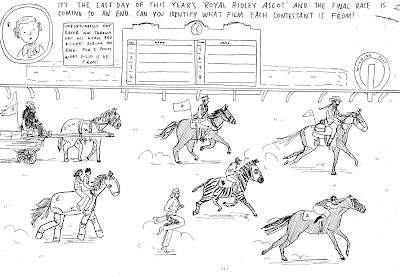
Finally getting around to some more reviews. My January resolution of 10 posts a month has failed spectacularly! Anyway, above is the latest Joe Blann picture round masterpiece from the Duke's at Komedia film quiz - Hold Onto Your Butts (first Thursday of every month). Below are some reviews.
'In the House' - Dir. Francois Ozon (15)
Prior to this one, my only exposure to the work of French filmmaker Francois Ozon was the kitsch and campy 'Potiche' - a multi-coloured 70s-set comedy about sexual politics that really grated on me in Venice, way back in 2010. It's possible that my intense dislike of that film has grown out of proportion since being bored by it at that festival, perhaps as much as a result of its bizarre appropriation by Odeon Orange Wednesday ads as by exaggerated memories of the film itself. In any case, my disdain for his last work almost prevented me from seeing Ozon's 'In the House' which, it turns out, would have been scandalous. It's one of the best films of the year: smart, funny, gripping, with a sly wit - excellently performed and with lots to say about storytelling, writing, voyeurism and more. It's truly excellent.
It stars the affable Fabrice Luchini, who seems to specialize in playing oblivious middle-class intellectuals, as a French literature teacher and failed author who is intrigued to find one piece of homework not written by a vacuous moron and becomes obsessed with the student responsible (Claude, Ernst Umhauer). Convinced that Claude has raw talent in need of guidance, Luchini takes him under his wing, giving him extra hours outside of school. However beneath this inspirational 'Dead Poets Society' style love of education and artistry there is also a slightly grubby aspect to proceedings: Claude's writings to Luchini take the form of an ongoing serial based on the student's real life obsession with and manipulation of the family of one of his classmates. So, in aiding Claude, Luchini is actively encouraging this increasingly destructive venture into another's family home and doing so partly to satisfy his own voyeuristic interest in the soap opera of their lives. A saga upon which he and his art gallery manager wife (Kristin Scott Thomas) are hopelessly hooked - filling the void left by their joyless, sexless marriage.
In telling this story Ozon's film is always fresh and imaginative. For instance, we occasionally witness the same events told by Claude in different ways, responding to the directions of his tutor. His style of storytelling and preoccupations also change in reaction to Luchini's advice. We see Luchini pop-up and offer critique to his student, even as events in the titular house unfold, in a device that feels like something out of the best Woody Allen comedy. There's obviously something about storytelling as voyeurism going on here throughout - and also the way the same events can be warped and manipulated when described to an audience, but what I found especially intriguing is the way Ozon's screenplay - based on a Spanish stageplay by Juan Mayorga - eventually finds a way to come full circle and investigate the homes of the protagonists: their growing obsession with this one, pretty ordinary family, ultimately saying more about their own unhappy lives. Literature as theraputic release or as harmful self-delusion? The ending left me uncertain.
'The Place Beyond the Pines' - Dir. Derek Cianfrance (15)
High expectations for Derek Cianfrance's epic follow-up to 'Blue Valentine' were undermined by my increasingly aggressive indifference to the growing hipster cult of Ryan Gosling. But, for reasons that become clear about a third of a way in, 'The Place Beyond the Pines' isn't really the spiritual successor to 'Drive' it's been marketed as in some places, on account of "the Gos" playing an ace motorcyclist-turned-criminal. It's much better than that: a cross-generational tale of fathers and sons - of consequences and regrets. Ambitious, sprawling and never less than compelling. It's the tale of one ostensibly bad man who will do anything for his son, even if it means breaking the law. And one clean-cut good-guy who will do his utmost to defend the law even if it means neglecting his son. There's more to it than that, especially in the third act, but it's an interesting central dichotomy.
Visually it's stunning, as shot by Steve McQueen's regular DP Sean Bobbitt, and somehow structurally tight in a way that belies its long running time. Factor in the fact that both Gosling and the recently Oscar-nominated Bradley Cooper are on top, career-defining form and it's potentially a modern American indie classic. It's not the crime thriller a lot of people will be expecting (it's really a fairly patient and introspective drama), yet 'Pines' isn't for want of horribly tense moments or spectacular sequences - notably a one-take car chase shot from the perspective of police cars in pursuit of Gosling's motorcycle. To say much more about it at this point would be to risk spoiling it, so I'll just leave it there for now.
'Finding Nemo (3D)' - Dir. Andrew Stanton (U)
It's not really a new release as far as I'm, concerned, so I'll keep it extremely brief. Andrew Stanton's classic - one of the vintage Pixar films - returns to cinemas, and I was delighted to find it was as funny and charming as the first time around. The gags come thick and fast, and range from the knock-about and silly, to the existential and witty, and more often than not they work. The animation and attention to detail - particularly the work the animators have done acting the various characters facially (no small ask considering all the characters are still recognisably fish) - is terrific and still holds up very well, even given Pixar's constant boundary pushing in the decade(!) since the film's original release. The 3D isn't really noticeable in all honesty so, given the damage the process seems to do to the vividness of the colours, I'd have rather seen it re-released in 2D. But don't let that put you off: like I say, It's barely noticeable - though that does call into question being asked to pay extra for the privilege...
Also, on a related note, the new 'Toy Story' short that precedes the film is really, really funny. Probably the best one yet - and a perfect antidote to 'Spring Breakers' (you'll know what I mean if you've seen it).
Wednesday, 26 October 2011
'The Ides of March' review:
The story of a wide-eyed idealist's transformation into a dead-eyed cynic, 'The Ides of March' is George Clooney's fourth film behind the camera and, based on the play Farragut North, marks a return to the type of earnest liberal outrage that marked his one unequivocal success to date as a director: 'Good Night, and Good Luck'. It's also the first major movie tangibly stained with the disappointment that has followed the euphoria of Barack Obama's 2008 election victory, with Clooney casting himself as a presidential candidate who similarly promises much but - even during the nomination process - is forced to concede many of his closely held ideals in order to become president.
With its focus on the American electoral process - with terms like "delegates" and "primaries" bandied about - Aaron Sorkin's seminal TV series 'The West Wing' is an obvious point of reference and indeed that show's legacy is felt here in some of the fast-paced banter between the candidate and his staffers, as well as in the breathless walk and talks that see strategy mapped out in corridors. But whereas Sorkin depicted political aides who fought passionately for their ideals in spite of a flawed system, here the fall of Ryan Gosling's campaign strategist paints a more pessimistic picture of American political life, with the relatively young and (we're told) brilliant campaigner coming to disregard his principles through a combination of ambition and betrayal. And whilst 'The West Wing' is, at its core, about a group of highly intelligent and well-meaning Democrats who always have each other's backs, 'The Ides of March' follows a group of highly intelligent and well-meaning Democrats who will sell out the few friends they have the moment their political careers are jeopardised.

The resolute heartlessness of Clooney's film will come as a surprise to many, with an overwhelming mood of hopelessness surrounding the fate of his characters and the suggestion that genuine friendship is impossible in high-end politics. Almost no one appears to have been satisfied ultimately, not Philip Seymour Hoffman's highly strung campaign manager, his underhanded political rival played by Paul Giamatti or Evan Rachel Wood's tragic and sexy young intern. In this world those with the least scruples are those who seem to get ahead - with Marisa Tomei's investigative journalist (portrayed as little more than a gossip merchant) and Jeffery Wright's ambitious, mercenary senator emerging from the thriller's twists and turns unscathed. That all the double-crossing schemers depicted are supporters of the same political party only heightens the sense of despair.
It's not as accomplished as 'Good Night, and Good Luck' or as inventive as 'Confessions of a Dangerous Mind', but with snappy, quotable dialogue ("you can start a war, you can bankrupt a country, but you can't fuck the interns! They get you for that!"), good performances from the uniformly excellent cast and Clooney's assured, unfussy handling of the material, 'The Ides of March' is an entirely decent political thriller. Be warned though, it's not exactly a "feel-good" movie. After all, when one of Hollywood's most outspoken liberals loses all faith in politics, what hope is there for the rest of us?!
'The Ides of March' opens on Friday (28th October) in the UK and is rated '15' by the BBFC.
Labels:
George Clooney,
Politics,
Review,
Ryan Gosling,
The Ides of March,
The West Wing,
Trailers
Thursday, 29 September 2011
'Drive' review:
It's been called an arthouse version of 'The Transporter', though Nicolas Winding Refn's thriller 'Drive' has much more in common with the cool Californian car chases of 'Bullitt' and the professional criminal tropes of Michael Mann (in particular 'Thief'). Despite a seemingly contemporary setting, the car stereo music, the shocking pink opening titles and star Ryan Gosling's racing jacket all give it a very strong 80s vibe. Though despite all this loving homage, it's very much a film from the Danish director of 'Bronson' and 'Valhalla Rising', with Refn favouring long takes, limited dialogue and short bursts of intense violence centred around one enigmatic male lead.
'Drive' is the story of Gosling's LA stuntman and part-time mechanic known in the script as Driver. Driver is a man of few words (Gosling's dialogue through the entire film wouldn't comfortably fill half a page), never racing to fill silences or even answer direct questions as he chews on a toothpick. His motivations aren't altogether clear, beyond wanting to protect/possess his attractive neighbour (Carey Mulligan) and her young son as they come under threat from a criminal gang, and neither are his origins. By the end of the film you may even wonder whether he is a person at all as opposed to some mythical force of nature. Whatever he is, he isn't a conventional good guy.

Even if you look past the fact he moonlights as a getaway driver for criminals, a day job that gets him into a whole lot of trouble with Ron Perlman's petulant Mafia boss, this is a guy who thinks nothing of threatening a woman with violence when his back is against the wall. And his shy, quiet demeanour is undeniably disturbing given his capacity for sudden ultra violence, with the character seeming more than a little unhinged - particularly as he caves a man's skull in with his boots whilst a horrified Mulligan looks on. Perhaps the character has been looking for a fight all along as he usually has a hammer handy and - under Refn's unflinching gaze - you never have any doubt that we will see him use it.
Ultimately though 'Drive' for all its charms feels like a triumph of style over substance. Gosling's blank slate protagonist offers nothing emotionally and equally thinly drawn supporting characters are archetypes elevated only by the calibre of actor asked to portray them: Albert Brooks, Christina Hendricks and Bryan Cranston are all excellent but have little to do, whilst Mulligan is just a bit wet throughout. However, there is no denying everything looks great, especially during the thrillingly choreographed car chase sequences, and the retro feel combined with the synthesizer heavy soundtrack is compelling. It isn't difficult to see why Refn won the best director prize at this year's Cannes Film Festival, as some of the individual shot choices are truly inspired, whilst his direction somehow manages to seem both nimble and meticulously composed.
'Drive' is rated '18' by the BBFC and is out now across the UK.
Labels:
Drive,
Nicolas Winding Refn,
Review,
Ryan Gosling,
Trailers
Subscribe to:
Posts (Atom)